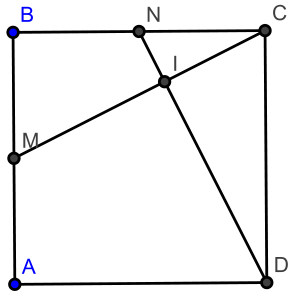
(i) ABCD is a square with side 1. M is the midpoint of AB, and N is the midpoint of BC. The lines CM and DN meet at I. Find the area of the triangle CIN.
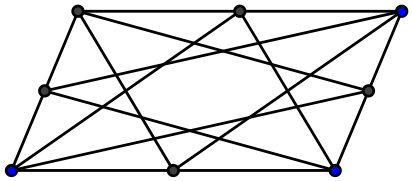
(ii) The midpoints of the sides AB, BC, CD, DA of the parallelogram ABCD are M, N, P, Q respectively. Each midpoint is joined to the two vertices not on its side. Show that the area outside the resulting 8-pointed star is 2/5 the area of the parallelogram.
(iii) ABC is a triangle with CA=CB and centroid G. Show that the area of AGB is 1/3 of the area of ABC.
(iv) Is (ii) true for all convex quadrilaterals ABCD?
Solution
(i) CIN is similar to DCN, so area CIN=(DNCN)2 area DCN=(5/221)2⋅41=
201
(ii) If we stretch the plane parallel to one of sides of the square then all areas are increased by the same factor and hence the ratio area ABCDarea CIN is unchanged. If we now shear parallel to one of the sides, areas are unchanged, so the ratio area ABCDarea CIN remains 201. Thus the result holds for parallelograms. The area outside the star is made up of 8 small triangles, each area 201, so it is 52.
(iii) Let the median be AM. Then AGB and ABC have the same base AB, so area ABCarea AGB=AMGM=31. This is trivial, but this is a hint for part (iv).
(iv) If we take A and B close together, then we get the same figure as in (iii) and so the ratio tends to 31. Hence the 52 result is not true for all convex quadrilaterals.
Want a route through all this instead of an archive? The track
puts 2,604 problems in a working order, from Junior Challenge level to the IMO shortlist.
Source: MathNet,
licensed CC-BY-4.0.
Statement reproduced verbatim; metadata (topic, difficulty) added by this project.