Let be an equilateral triangle with sides of length . The point on the ray and the point on the ray are chosen, so that and are positive integers.
Can the radius of the circumcircle of the triangle be ?
Croatian Mathematical Competitions
Solution
Let us assume that the radius of the circumcircle of the triangle is equal to .
In the triangle the angle opposite to the side is because the triangle is equilateral.
If is the radius of the circumcircle of the triangle , then
Let , , where and are positive integers.
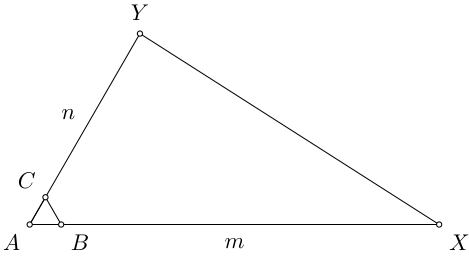
Applying the cosine rule to the triangle we get , which leads to
Let us first notice that the right-hand side of the equation is even. If and are of different parity or if they are both odd, then the left-hand side is odd, which is impossible.
The only remaining case is when and are both even. Then is divisible by , but is not, so we get another impossible case.
Therefore, the initial assumption is wrong, which means that can not be equal to .
Want a route through all this instead of an archive? The track
puts 2,604 problems in a working order, from Junior Challenge level to the IMO shortlist.