Let be a fixed segment in the plane, and let be a variable point in the plane not on the line . Distinct points and are chosen on the rays and , respectively, such that . Assume that the tangents to the circumcircle of at and meet line at and , respectively, such that the points , and are pairwise distinct and lie on the same side of . Let be the circle through and centred on . Similarly, let be the circle through and centred on . Prove that and intersect at two fixed points as varies.
Denmark, Daniel Pham Nguyen
Romanian Master of Mathematics
Solution
Let , and be the reflections across of , and , respectively. Then and are just the circles and , respectively.
Denote . Let cross at ; the case may be treated as a limit case. The symmetry yields that also lies on the line . The same symmetry, along with tangency of and to the circle , yields
This yields that each of the triples , , , and is collinear, and, moreover, that and . It follows now that quadrilaterals and are homothetic at . Therefore, so are and .
Let now and cross at and . Let and meet again at and . Since and , the point lies on the polar of with respect to . In other words, and are inverse with respect to that circle. This yields that the lines and also cross at .
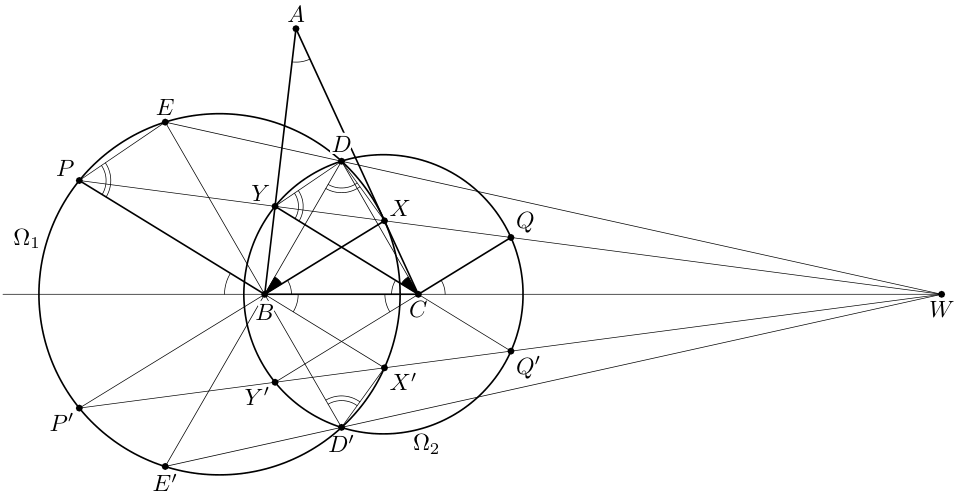
Now, we have (the last equality holds by means of homothety). Similarly, we have . Therefore, the triangles and are similar. Firstly, this yields that , whence . Secondly, this also implies that , or . But the triangles and are also similar (as both are similar to ), so , or . Thus, , and the triangle is equilateral. This finishes the solution.
Solution 2:
All angles in the solution are directed. All segment lengths on lines and (and parallel to them) are also oriented; we assume that the directions and are positive. As in the solution above, we prove that .
Assume that is oriented anti-clockwise. Let and be the points such that the triangles and are equilateral, and oriented anti-clockwise. We will show that and lie on the circle ; similarly, they lie on .
Notice that ; moreover, each of the triangles and is similar to and oriented differently than ; hence those two triangles are equi-oriented. Let denote the circle ; clearly, its centre lies on the perpendicular bisector of , i.e., on . We aim to prove that passes through ; that will yield that , which establishes what we are aimed to prove.
Denote . Since , we have , and hence lies on the perpendicular bisector of . By similarity, we get , or . Since , the triangles and are similar, so .
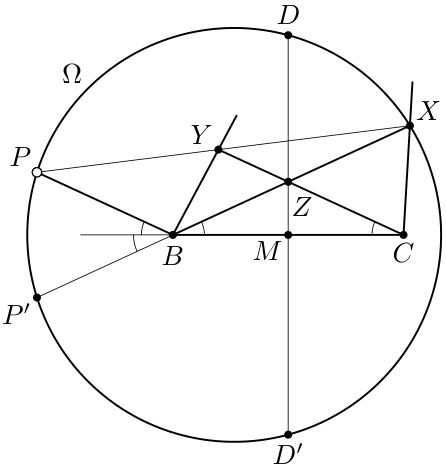
Therefore, .
On the other hand, let be the midpoint of , and let cross again at . Write the power of point with respect to as .
The two obtained relations yield
so , and so and are reflections of one another in the line . Thus, lies on , as desired.
Remarks.
(1) It is also possible to solve the problem via the moving points method. Introduce the points and as in Solution 2, and introduce the reflections , , , and of , , , and in the line , respectively, as in Solution 1, to read and as the circles and , respectively.
We need to show that lies on (the other incidences are similar). To this end, it suffices to check that .
Fix , , and the circle . As varies on that circle, the lines , , , and remain constant, and and depend projectively on . Choosing on such that , we need to show that , or that , , and are collinear. The point also depends projectively on , so it suffices to check that the points , , and are collinear for four specific positions of .
(2) Although inversion, homothety, and the moving point method are essentially the same thing, i.e., a Möbius transformation, we briefly sketch yet another approach below:
Let , , and . Let and be distinct points such that triangles and are equilateral. We first note that and , so the triangles and are homothetic from . Hence, , so lies on the radical axis of and . Since their centres both lie on , their radical axis is the perpendicular from to , i.e. the perpendicular bisector of . As and , it follows that and . As triangles and are similar, this means that .
Perform an inversion about , the circle of radius centred at . Let , , and denote the images of , and . As , we get and . Since lines , and , are symmetric about , it follows that , and , are symmetric about . Thus, and are reflections about . Since and all lie on , it follows that , , , all meet on . This implies that and both pass through and , the two required fixed points.
Want a route through all this instead of an archive? The track
puts 2,604 problems in a working order, from Junior Challenge level to the IMO shortlist.