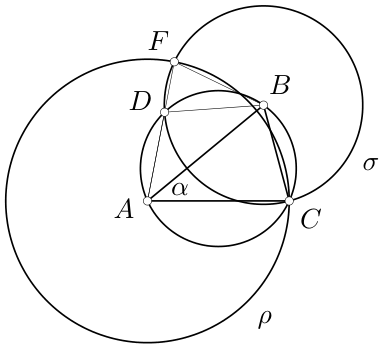
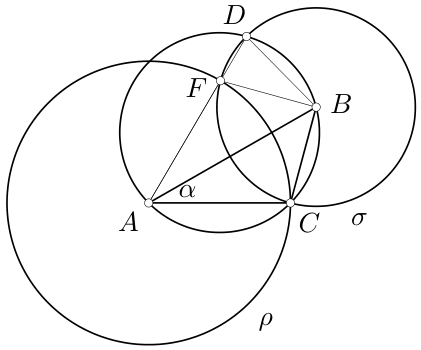
The largest angle of triangle is located at its vertex . Let be the circle with centre and radius , and let be the circle with centre and radius . The circle intersects the circumcircle of the triangle and the circle at points and , respectively (, ). Prove that , and are collinear.
Estonian Math Competitions
Solutions — 2
Solution 1
Denote (Figures 7 and 8 present two possible cases). Note that and as they are radii of circles and , respectively. Thus the triangles and are equal by three equal sides. Hence . From equal radii of , we also obtain . Now by inscribed angles subtending equal chords of the circumcircle of the triangle , we get . Consequently, points , and lie on one line.
Solution 2
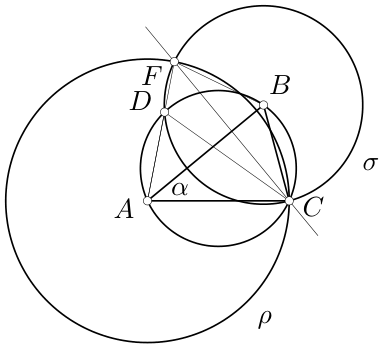
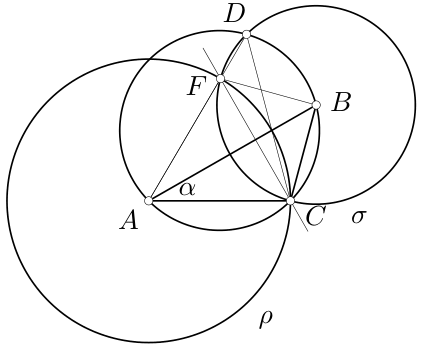
From the inscribed angles of the circumcircle of the triangle , we get . As in Solution 1, we can show that the triangles and are equal; thus . If and lie on the same side of the line (Fig. 9) then by the inscribed angle theorem. If and lie on different sides of the line (Fig. 10) then, analogously, . Altogether, we have either while and being on different sides of or while and being on different sides of . In both cases, the obtained equality implies that , and lie on the same line.
Want a route through all this instead of an archive? The track
puts 2,604 problems in a working order, from Junior Challenge level to the IMO shortlist.