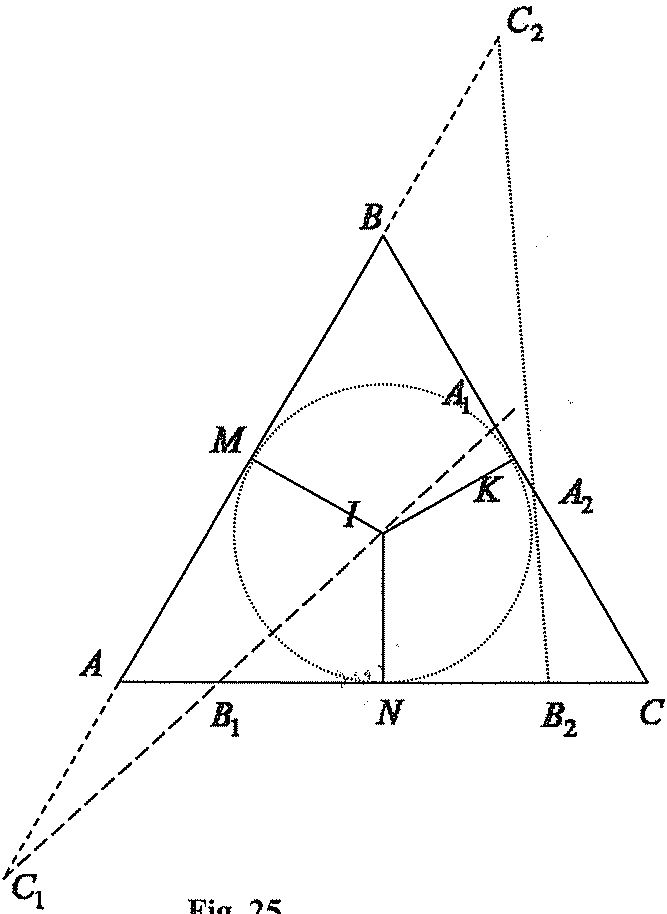
Let points B1 and C1 be on the sides, and A1 is on the extension of the side BC in direction of point B. By the Menelaus' theorem
B2A C2B A2CCB2 AC2 BA2=B1C C1A A1BAB1 BC1 CA1=1,
so points A2, B2 and C2 are collinear (fig. 25).
Let M be the middle of AB, N be the middle of AC, K be the base of the perpendicular dropped from a point I, the center of the inscribed circle, to a straight line B2C2. Triangles C2IM and C1IM are equal, so C2I=IC1, ∠C2IC1=180∘−2∠B1C1A. Similarly, B2I=B1I and ∠B2IB1=180∘−2∠C1B1A. Then,
∠B2IC2=2∠B1C1A+2∠C1B1A−180∘=2(180∘−∠A)−180∘=60∘.
Since ∠B2IC2=∠B1AC1 and C2IB2I=C1IB1I=C1AB1A (I is a base of the bisectrix AI of the triangle B1AC1), triangles B2IC2 and B1AC1 are homothetic, hence ∠C2B2I=∠AB1C1 and ∠B2C2I=∠AC1B1. The segment IB2 is common for the right-angled triangles B2MI and B2KI, and also ∠NB2I=∠NB1I=∠KB2I, so NB2=KB2. In the same way, KC2=C2M. Since
B2C+C2B=B2N+NC+BM+MC2=B2K+KC2+BC=B2C2+BC,
the quadrangle CB2C2B is circumscribed, therefore the straight line B2C2 touches the inscribed circle of the triangle ABC.