Suppose and are positive integers such that . Julian has a large pile of rectangular -tiles. Merlijn picks a positive integer , and receives from Julian tiles to place on an -board. On each tile, Julian writes whether this tile should be placed horizontally or vertically. Tiles may not overlap on the board, and they must fit entirely inside the board. What is the largest number that Merlijn can pick while still guaranteeing he can put all tiles on the board according to Julian's instructions?
IMO Team Selection Test 3, June, 2020
Solution
We show that the largest Merlijn can pick is . First we show that . If Merlijn asks for tiles, Julian can instruct Merlijn to place them all horizontally. As , it is impossible to place more than one tile horizontally on a single row, so Merlijn would need at least rows, this is a contradiction. Therefore .
Now suppose that Merlijn asks for tiles. Julian can now instruct Merlijn to place tiles vertically and tiles horizontally.
Note that vertical tiles always cover the rows in the middle of the board. Therefore the vertical tiles together cover at least squares in each of these rows in the middle of the board, leaving at most squares for the horizontal tiles. Therefore no horizontal tiles fit in these middle rows, and the horizontal tiles need to fit in the remaining rows. This is a contradiction. Therefore we must have . It follows that .
Now we show that it is always possible to place a pile of tiles on the board. We first consider two special configurations. Put horizontal tiles into a -rectangle at the bottom left. To the right of that, we can fit more vertical tiles into a -rectangle in the bottom right. Above that rectangle, we can fit more horizontal tiles into a -rectangle in the top right. Finally, to the left of that, we can fit more vertical tiles into a -rectangle in the top left. In this way, we can fit horizontal and vertical tiles on the board.
One other way to cover the board is as follows. Place vertical tiles in the top left, covering a -rectangle. Below that there is room for horizontal tiles to fit in an -rectangle. In this way, we can fit vertical and horizontal tiles on the board.
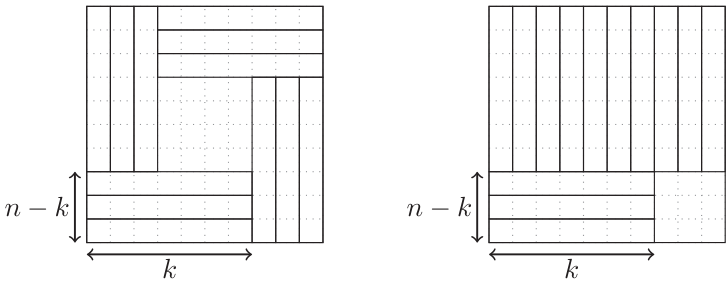
Suppose that Merlijn receives horizontal tiles and vertical tiles from Julian. Then we have and . Without loss of generality we assume that . If , then Merlijn uses the second special configuration, omitting tiles he doesn't have. As , this works. Else, , so . As , we also have , and Merlijn can use the first configuration, omitting tiles he doesn't have. Therefore it is always possible for Merlijn to place tiles on the board.
Want a route through all this instead of an archive? The track
puts 2,604 problems in a working order, from Junior Challenge level to the IMO shortlist.