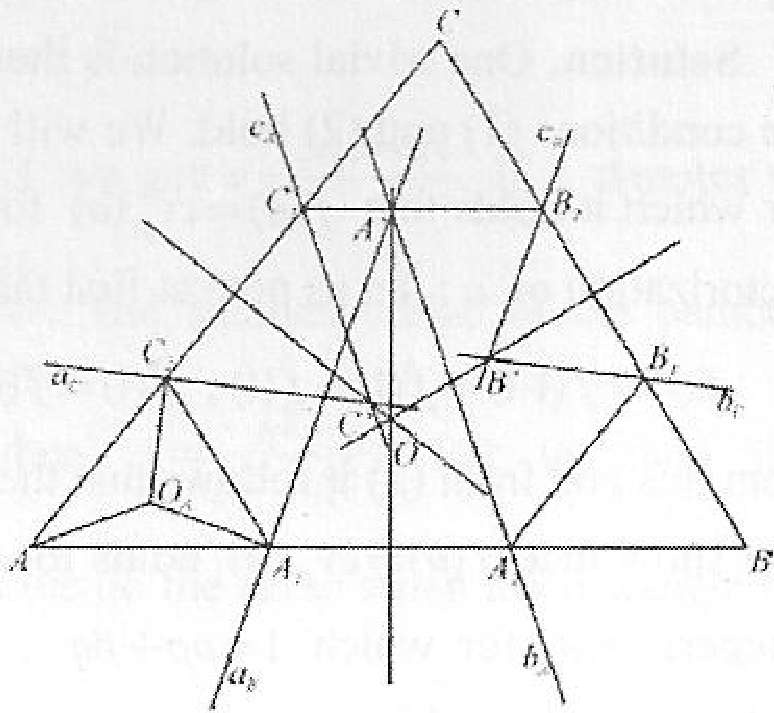
An acute-angled triangle ABC is given. The points A1, A2, B1, B2, C1 and C2 lie on its sides in such a way that AA1=A1A2=A2B=31AB, BB1=B1B2=B2C=31BC and CC1=C1C2=C2A=31CA. Let kA, kB and kC be the circumscribed circles of the triangles AA1C2, BB1A2 and CC1B2 respectively, aB and aC be the tangents of kA in A1 and C2, bC and bA be the tangents of kB in B1 and A2 and cA and cB be the tangents of kC in C1 and B2. Prove that the perpendiculars drawn from the intersection of aB and bA to AB, the intersection of bC and cB to BC and the intersection of cA and aC to CA intersect in one point.
Solution
Let us denote the intersections of aB, bC and cA with bA, cB and aC respectively by A′, B′ and C′. The triangle AA1C2 is similar to ABC, since they have a common angle and their sides are at a ratio 1:3. Let OA be the center of the circumscribed circle around the triangle AA1C2. Then: ∠OAA1A=21(180∘−∠AOAA1)=90∘−∠AC2A1=90∘−γ Since aB is perpendicular to OAA1 it follows that the angle between aB and AB equals 180∘−90∘−(90∘−γ)=γ Analogously, the angle between bA and AB equals γ, so that the triangle A1A2A′ is isosceles with base A1A2, that is, the perpendicular to AB through C′ passes through the midpoint of A1A2, which is also the midpoint of AB. Thus, the perpendicular passes through the center of the circumscribed circle around the triangle ABC. From symmetry reasons, all the three perpendiculars pass through the center of the circumscribed circle, that is, they pass through a common point.
Want a route through all this instead of an archive? The track
puts 2,604 problems in a working order, from Junior Challenge level to the IMO shortlist.
Source: MathNet,
licensed CC-BY-4.0.
Statement reproduced verbatim; metadata (topic, difficulty) added by this project.