The bisector of the angle of triangle intersects the side at . The point is the foot of the perpendicular from to and the point is the foot of the perpendicular from to . The lines and meet at .
Prove that is an altitude of the triangle .
Belarusian Mathematical Olympiad
Solutions — 2
Solution 1
Let be the foot of an altitude from in the triangle .
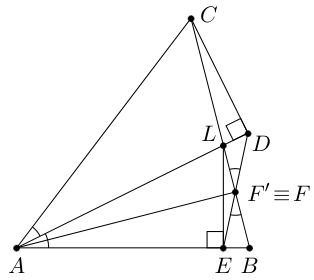
It is enough to prove that the points , and are colinear, since it will lead to which means that is an altitude of the triangle . Since , the quadrilateral is cyclic and therefore . Since , the quadrilateral is cyclic and hence . Since , then which means that , and are colinear.
Solution 2
Let the lines and meet at . Since the angles and are right, the points , , and lie on the circle with diameter . Hence . Since is the bisector, , whence . The latter is equivalent to , whence , , and lie on a circle.
Consider the Simson line of and the triangle . The foot of the perpendicular from to is , and to is , therefore this line is . Since meet at , is the foot of the perpendicular from to .
Want a route through all this instead of an archive? The track
puts 2,604 problems in a working order, from Junior Challenge level to the IMO shortlist.