△ABC is a triangle, M the midpoint of BC, D the projection of M on AC and E the midpoint of MD. Prove that the lines AE, BD are orthogonal if and only if AB=AC.
Solution
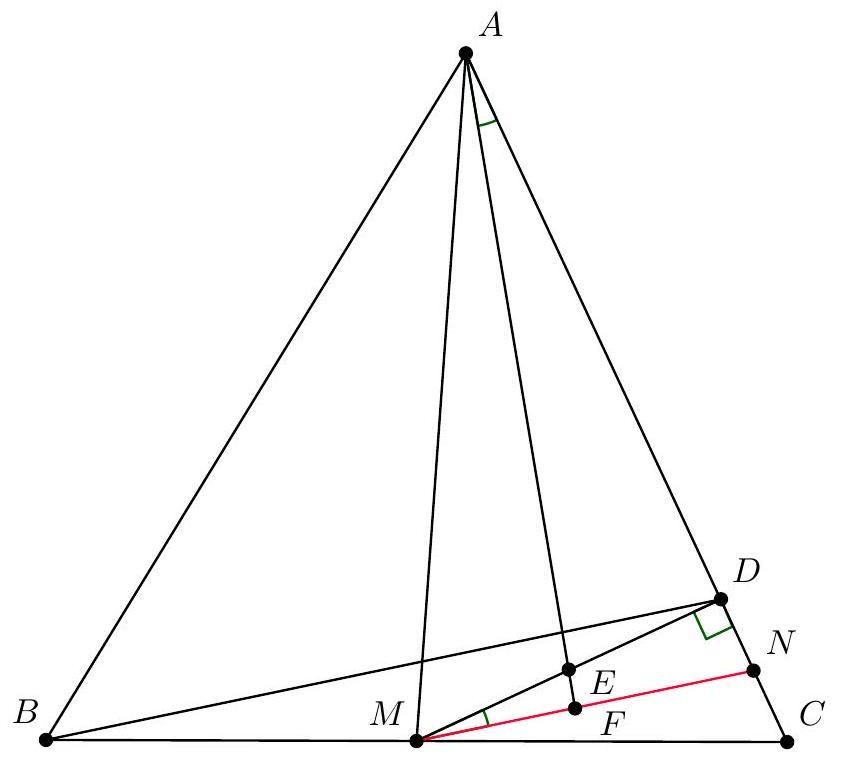
First solution. Let N be the midpoint of CD and F the intersection point of lines AE and MN. Since M is the midpoint of BC, the segment MN is parallel to BD.
Therefore, AE, BD are perpendicular if and only if AF, MN are perpendicular. Equivalently, triangles AFN and MDN are similar since they already share the same angle at N. Since AFN and ADE are similar, then triangles ADE and MDN are similar, which is equivalent to the fact that triangles ADM and MDC are similar since E is the midpoint of DM and N is the midpoint of DC. In conclusion, AE and BD are perpendicular if and only if the median AM of triangle ABC is also an altitude. That is AB=AC.
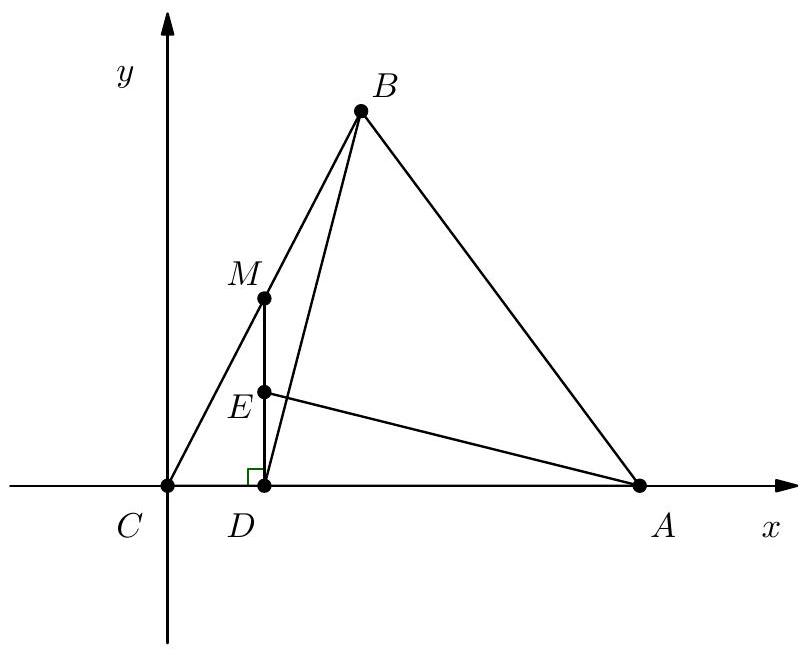
Second solution. By coordinates or equivalently by complex numbers. Fix the origin at C, and the x-axis to be CA. The affixes of the points are C(0),A(a) and B(b+ic), where a,b,c are positive real numbers. Hence, the affixes of the other points are M(2b+i2c),D(2b) and E(2b+i4c)
Therefore, the affixes of the vectors are DB(2b+ic) and EA(a−2b−i4c). On the other hand, the lengths of the sides are equal to AB=(a−b)2+c2 and AC=a The segments AE, BD are perpendicular if and only if Re((2b+ic)(a−2b+i4c))=0 which is equivalent to 2ab−b2−c2=0, or, after a straight computation, to AB=AC.
Third solution. By using scalar products of vectors. Because M is the midpoint of BC and E the midpoint of MD, we have DM=21(DB+DC), or, equivalently BD=2MD+DC and AE=AM+ME=21(AM+AD). Because MD and AC are perpendicular, we have AD⋅MD=ME⋅DC=0. Therefore AE⋅BD=2AE⋅MD+AE⋅DC=(AM+AD)⋅MD+(AM+ME)⋅DC=AM⋅MD+AM⋅DC=AM⋅MC=21AM⋅BC Hence, AE and BD are perpendicular if and only if the median AM of the triangle ABC is an altitude. This is equivalent to AB=AC.
Want a route through all this instead of an archive? The track
puts 2,604 problems in a working order, from Junior Challenge level to the IMO shortlist.
Source: MathNet,
licensed CC-BY-4.0.
Statement reproduced verbatim; metadata (topic, difficulty) added by this project.