Let be a triangle inscribed in a circle with center . Let be the incenter of and the contact points of the incircle of with , respectively. If is the foot of the perpendicular from to the line , prove that the line passes through the antipodal of with respect to .
Greece — Selection Examination
Solution
Let be the second intersection point of with , where is the antipodal of with respect to . We will prove that the points are collinear.
We have , so belongs to the circle of diameter . The same holds for the points and , thus is on the circumcircle of . Therefore . However, , and as a result the triangles are similar. It follows that,
Since the intersection of with is the isogonal conjugate of , and , we get that is the bisector of , thus
Finally, since , and , the triangles are similar, so
From (1), (2), (3) we get , which gives us that is the bisector of . Since is the midpoint of the arc at (), we have that is the bisector of , so are collinear
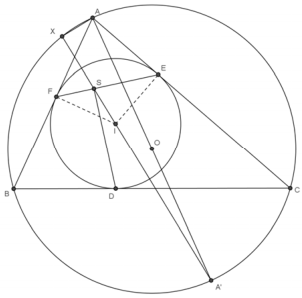
fig. 5
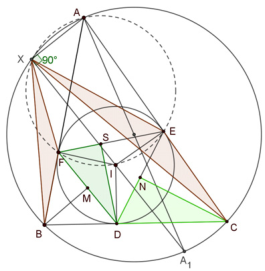
fig. 6
Let the midpoints of , then , and the right-angled triangles DFS, DCN are similar, so:
Similarly, from the similar triangles DES, BDM we get:
The relations (4) and (5) give
The last one with the help of (1) gives that XS is the bisector of . Since I is the midpoint of the arc EF at (AEIF), we have that XI is the bisector of , so X, S, I are collinear.
Want a route through all this instead of an archive? The track
puts 2,604 problems in a working order, from Junior Challenge level to the IMO shortlist.