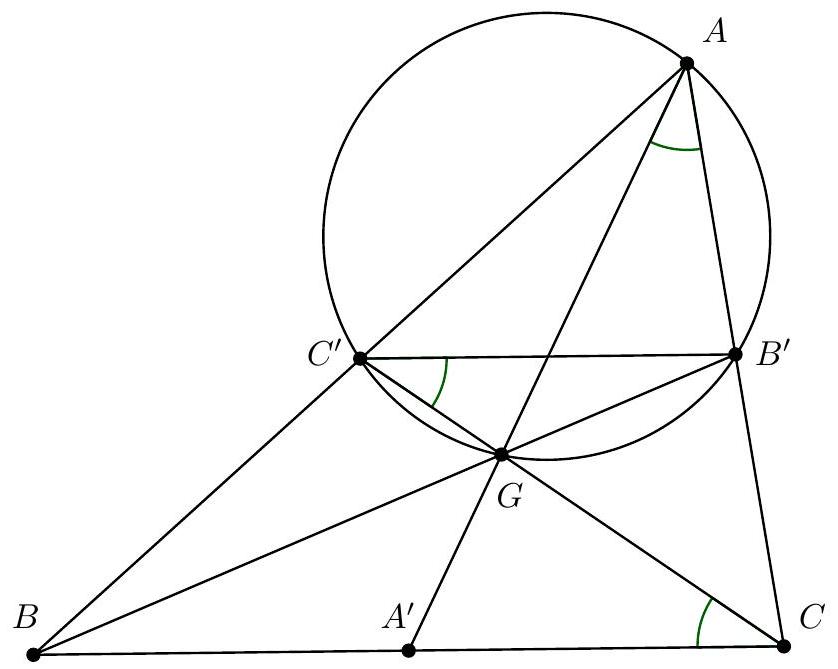
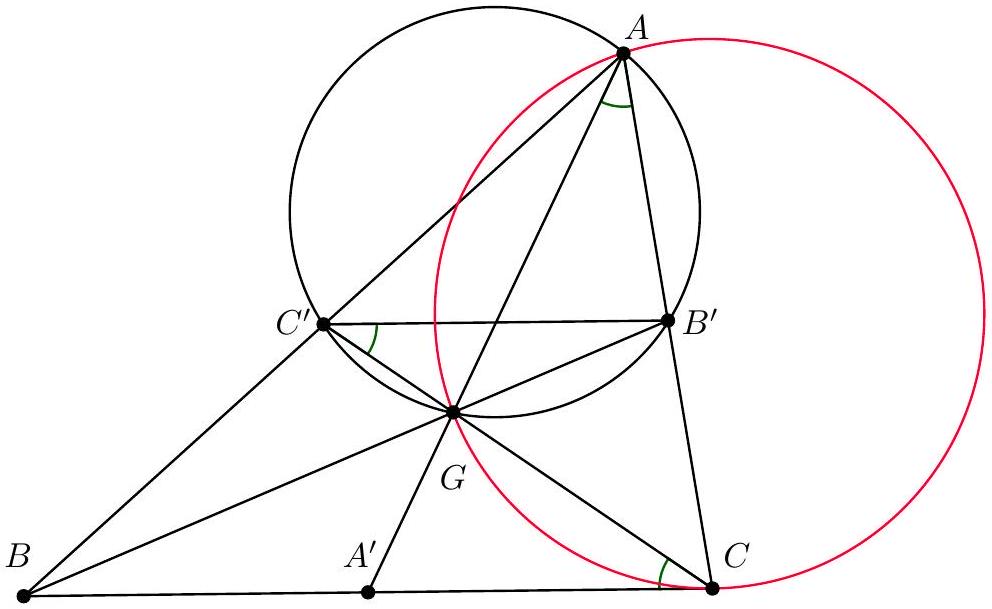
ABC is a triangle, G its centroid and A′, B′, C′ the midpoints of its sides BC, CA, AB, respectively. Prove that if the quadrilateral AC′GB′ is cyclic then AB⋅CC′=AC⋅BB′.
Solution
First solution. Because AC′GB′ is cyclic, we have ∡GAB′=∡GC′B′. Because B′C′ is parallel to BC, we have ∡CC′B′=∡C′CB. We deduce that sin∡A′AC=sin∡C′CB. But triangles AA′C, BCC′ have the same area which is half of the area of triangle ABC. We deduce that 21AA′⋅ACsin∡A′AC=21CC′⋅BCsin∡C′CB and therefore CC′AC=AA′BC. We proceed in a similar way, by considering triangles ABA′ and BCB′, obtaining BB′AB=AA′BC, and deduce the relation AB⋅CC′=AC⋅BB′.
Second solution. Lets us consider the power of the point B with respect to the circumcircle of the cyclic quadrilateral AC′GB′. We have P(B)=BC′⋅BA=BG⋅BB′. But BC′=21BA and BG=32BB′. We deduce that BB′=23AB. Similarly, by considering the power of the point C with respect to the circumcircle of the cyclic quadrilateral AC′GB′, we obtain CC′=23AC From these two relations we deduce easily that AB⋅CC′=AC⋅BB′.
Third solution (Contains also a proof for the converse). We can see from the first solution that the quadrilateral AC′GB′ is cyclic if and only if ∡GAC=∡GCB. This is equivalent to saying that the line BC is tangent to the circumcircle of triangle AGC. This property is equivalent to saying that A′C2=A′G⋅A′A by using the power of the point A′ with respect to this circumcircle. But A′C=21BC,A′G=31A′AandAA′=42AB2+2AC2−BC2. We deduce that AC′GB′ is cyclic if and only if 2BC2=AB2+AC2 Now, using the formulas for the medians BB′=42BC2+2AB2−CA2andCC′=42CA2+2BC2−AB2, we deduce that the relation AB⋅CC′=AC⋅BB′ is equivalent to AB2⋅(2CA2+2BC2−AB2)=AC2⋅(2BC2+2AB2−CA2), which is equivalent to (AB2−AC2)⋅(2BC2−AB2−AC2)=0 which is equivalent to either AB=AC or AC′GB′ is cyclic.
Want a route through all this instead of an archive? The track
puts 2,604 problems in a working order, from Junior Challenge level to the IMO shortlist.
Source: MathNet,
licensed CC-BY-4.0.
Statement reproduced verbatim; metadata (topic, difficulty) added by this project.