Let be the incenter of a triangle . The circle passing through the vertex and touches the line at intersects the sides and at points and , respectively. Let be the intersection point of the line and the side . Prove that
Czech and Slovak Mathematical Olympiad
Solution
Let denote the measures of the interior angles at the vertices , respectively, of the triangle , and let be the intersection point of the line and the side . (Fig. 2). The inscribed angle corresponds to the chord , while the inscribed angle corresponds to the chord , and since the measure of both of these angles is , the chords and share the same length as well.
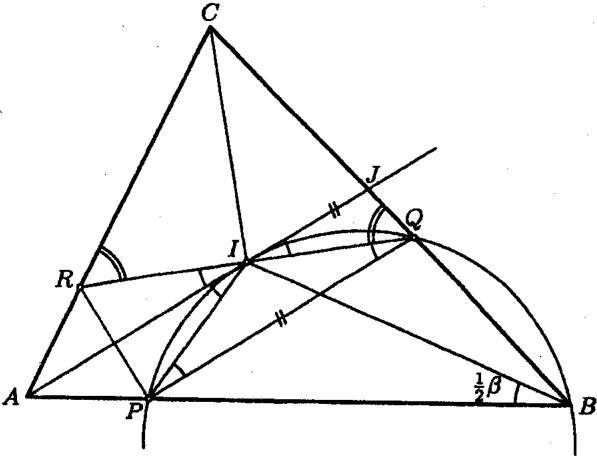
Fig. 2
Since the inscribed angle also corresponds to the chord , its measure is also . It follows from the congruence of vertical angles that . This measure is also shared by the inscribed angle as it corresponds to the chord of equal length as . Further, . The triangles and are thus congruent by ASA, hence .
Therefore, the measure of the angle is
The measure of the angle could also be determined as follows: Since the inscribed angles and correspond to chords of equal length, we have . The congruence of alternate angles implies that . Hence , and so as well since they are both inscribed angles corresponding to the chord .
Since and , it follows that . Therefore, , so
Want a route through all this instead of an archive? The track
puts 2,604 problems in a working order, from Junior Challenge level to the IMO shortlist.