Maths Olympiad Prep

Library / /17 of 34

Geometry Difficulty 5.6 AIME, harder Prove it Romania

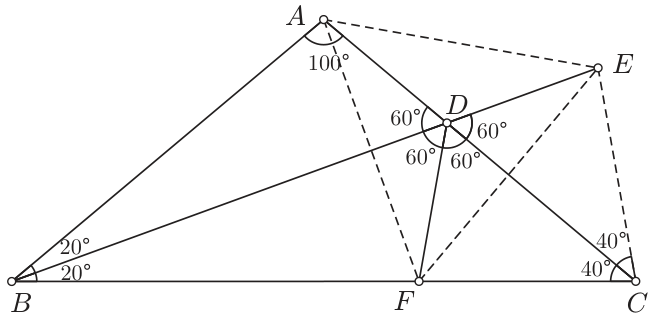
Consider the isosceles triangle ABCABC, with m(BAC)=100m(\angle BAC) = 100^\circ. Let BDBD be the angle bisector of the angle ABC^\widehat{ABC}, with D(AC)D \in (AC), the point EBDE \in BD such that D(BE)D \in (BE) and BE=BCBE = BC, and the point F(BC)F \in (BC) such that AB=BFAB = BF. Prove that the lines ACAC and EFEF are orthogonal.

Figure 1

Solution

Triangles ABDABD and FBDFBD are congruent (S.A.S.), so that m(FDB)=m(ADB)=60m(\angle FDB) = m(\angle ADB) = 60^\circ, and m(FDC)=60m(\angle FDC) = 60^\circ.

Triangle EBCEBC is isosceles (BE=BCBE = BC), with m(EBC)=20m(\angle EBC) = 20^\circ, hence m(BCE)=80m(\angle BCE) = 80^\circ, and from the hypothesis we have m(ACB)=40m(\angle ACB) = 40^\circ, so FCD=DCE\angle FCD = \angle DCE.

Thus, triangles FCDFCD and ECDECD are congruent (A.S.A.), hence triangle FCEFCE is isosceles. CDCD is an internal angle bisector, hence also a height. We conclude that ACFEAC \perp FE.

Want a route through all this instead of an archive? The track puts 2,000 problems in a working order, from AMC 10 level to the IMO shortlist.

Source: MathNet, licensed CC-BY-4.0. Statement and solution reproduced as published; topic and difficulty added by this site.