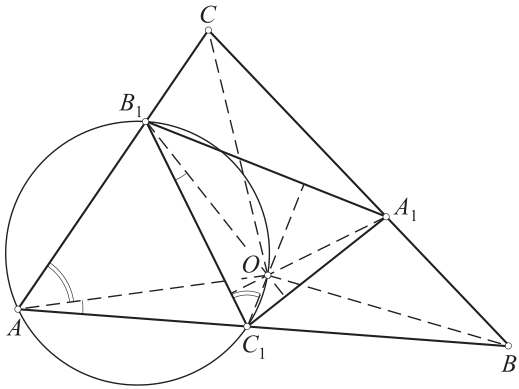
Let the triangle A1B1C1 be similar to the triangle ABC (∠A=∠A1=α, ∠B=∠B1=β, ∠C=∠C1=γ), and let the point O be the orthocentre of the triangle A1B1C1. Then ∠OB1C1=90∘−γ, ∠OC1B1=90∘−β, so ∠B1OC1=180∘−(90∘−γ)−(90∘−β)=β+γ. Since ∠B1AC1+∠B1OC1=α+β+γ=180∘, the quadrilateral AC1OB1 is cyclic. Hence ∠OAB1=OC1B1=90∘−β and ∠OAC1=∠OB1C1=90∘−γ.
Analogously, because quadrilaterals BA1OC1 and CB1OA1 are cyclic, we get ∠OBC1=90∘−γ, ∠OBA1=90∘−α and ∠OCA1=90∘−α, ∠OCB1=90∘−β, so O is the circumcentre of the triangle ABC.
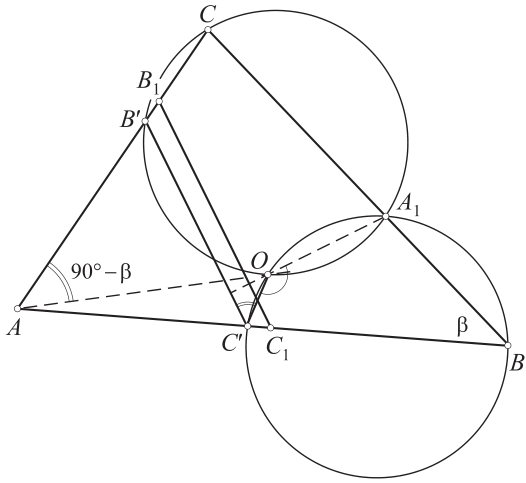
Now assume that the point O is the orthocentre of the triangle A1B1C1 and the circumcentre of the triangle ABC. Let ∠A=α, ∠B=β, ∠C=γ and ∠A1=α1, ∠B1=β1, ∠C1=γ1. Let the points B′ on CA and C′ on AB be such that the quadrilaterals CB′OA1 and BA1OC′ are cyclic. Then the quadrilateral AC′OB′ is also cyclic. Hence ∠OC′B′=∠OAB′=∠OAC=90∘−β. Since the supplementary angle of the angle ∠A1OC′ is β, the line A1O is perpendicular to B′C′. This implies B′C′∥B1C1.
Since O is the orthocentre of the triangle A1B1C1, the line B1C1 is between A and O, and ∠B1OC1=180∘−α1.
Since A1OB′C is cyclic, ∠A1OB′=180∘−γ, and similarly ∠A1OC′=180∘−β. The sum of these two angles is 180∘+α and therefore the line B′C′ lies between A and O.
We may assume that the line B′C′ is closer to the point A than the line B1C1 (the other case is similar). That implies ∠B′OC′≤B1OC1 and ∠B′A1C′≤B1A1C1. Adding these two inequalities gives
∠B′OC′+∠B′A1C′≤∠B1OC1+∠B1A1C1.(‡)
Since ∠B′A1C′=∠B′A1O+∠OA1C′=∠B′CO+∠OBC′=∠ACO+∠OBA=90∘−β+90∘−γ=α, we have ∠B′OC′+∠B′A1C′=180∘−α+α=180∘.
Also, ∠B1OC1+∠B1A1C1=180∘−α1+α1=180∘.
Therefore in (‡) we actually have equality, which can be attained only if ∠B′OC′=∠B1OC1 and ∠B′A1C′=∠B1A1C1, i.e. if α1=α and the lines B′C′ and B1C1 coincide. Then also β1=β and γ1=γ, so the triangles A1B1C1 and ABC are similar.