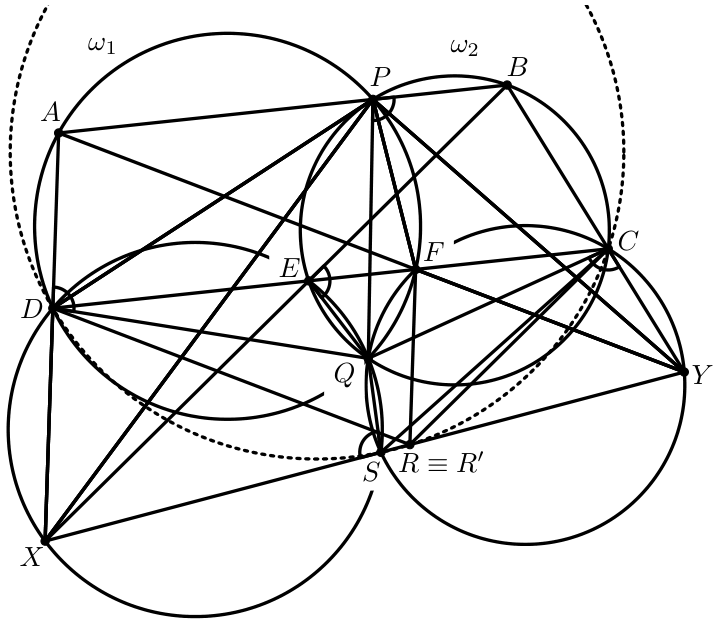
Two circle ω1 and ω2 intersect each other at points P and Q. An arbitrary line passes from P and intersects ω1 and ω2 respectively at points A and B. A line parallel to AB cuts ω1 at D and F, and cuts ω2 at C and E in a way that E and F lie between C and D. Let X be the intersection point of BE and AD, Y be the intersection of AF and BC, and R be the reflection of point P over CD.
i) Prove that R lies on XY.
ii) Prove that PR is the angle bisector of ∠XPY.
Solution
i) Notice that ∠QEB=∠QPB=∠QDA⟹∠QEX=∠QDX So quadrilateral XDEQ is cyclic and similarly quadrilateral YCFQ is cyclic. Let S be the second intersection point of these two circles. It's clear that ∠QSX=∠QEB=∠QCY so X,S,Y are collinear. Let R′ be the second intersection point of the circumcircle of triangle DSC with line XY. We have ∠R′DC=∠R′SC=∠YSC=∠YFC=∠FAP=∠FDP=∠CDP Similarly it's obtained that ∠R′CD=∠DCP. So R′ is the reflection of P onto CD, and so R≡R′. □
ii) It's easy to see that FR=FP=AD and RD=PD=AF. Thus AFRD is a parallelogram and therefore RD∥AF and RF∥AD. Hence, RXRY=DXAD=DXPF So the problem becomes equivalent to showing that RXRY=PXPY. Thus it suffices to show that PXPY=DXPF. Note that ∠ADP=∠AFP, so ∠PDX=∠PFY is enough to show that DXPD=FPFY⟺FYAF=ADDX From RD∥AF and RF∥AD both sides of the last equation are found to be equal to RYRX and hence the claim. □
Want a route through all this instead of an archive? The track
puts 2,604 problems in a working order, from Junior Challenge level to the IMO shortlist.
Source: MathNet,
licensed CC-BY-4.0.
Statement reproduced verbatim; metadata (topic, difficulty) added by this project.