GeometryDifficulty 5.1AIME, harderProve itSouth Africa
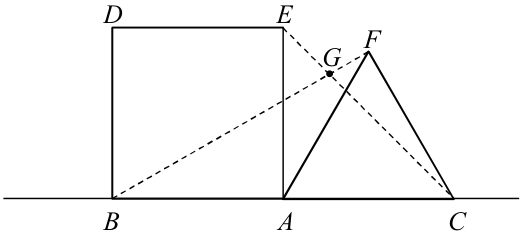
Let A, B, and C be distinct points on a straight line with AB=AC=1. Square ABDE and equilateral triangle ACF are drawn on the same side of line BC. Lines EC and BF cut in G. What is the size of ∠EGB?
Solution
We will compute the angle sizes of quadrilateral DEGB and use the fact that the sum of the interior angles of a quadrilateral is equal to 360∘.
Since AFC is an equilateral triangle, ∠FAC=60∘ and so ∠EAF=90∘−60∘=30∘, which yields ∠BAE=90∘+30∘=120∘. Since AB=AC=AF, triangle BAF is isosceles, and so ∠GBC=∠FBA=21(180∘−∠BAF)=21(180∘−120∘)=30∘. Next, AE=AB=AC, and so triangle EAC is a right-angled isosceles triangle, which means that ∠BCG=∠ACE=45∘. Hence, ∠ BGE = ∠ GBC + ∠ GCB = 30∘+45∘=75∘.
Want a route through all this instead of an archive? The track
puts 2,604 problems in a working order, from Junior Challenge level to the IMO shortlist.
Source: MathNet,
licensed CC-BY-4.0.
Statement reproduced verbatim; metadata (topic, difficulty) added by this project.