Maths Olympiad Prep

Library / /49 of 86

Geometry Difficulty 6.1 National olympiad Prove it Estonia

A point MM is chosen on the side ACAC of a triangle ABCABC and a point KK is chosen on the line segment BMBM so that AM=13ACAM = \frac{1}{3}AC and BK=14BMBK = \frac{1}{4}BM. Let NN be the intersection of the line AKAK and the side BCBC. What percentage of the area of the triangle ABCABC is the area of the quadrilateral MKNCMKNC?

Solutions — 2

Solution 1

*Answer:* 65%.

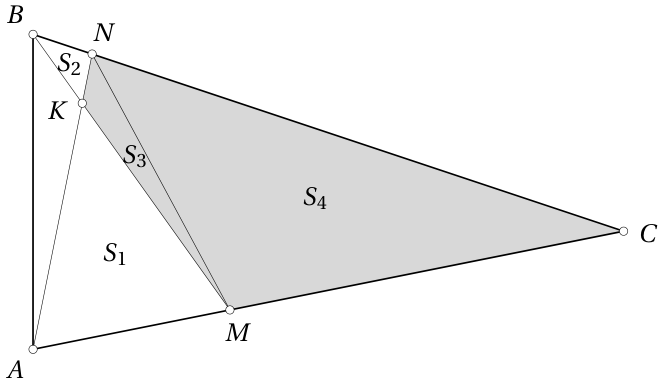
Let the area of the triangle ABCABC be SS and the areas of triangles AKMAKM, BKNBKN, MKNMKN and CMNCMN be S1S_1, S2S_2, S3S_3 and S4S_4, respectively (Fig. 30). Then:

* S2+S3+S4=23SS_2 + S_3 + S_4 = \frac{2}{3}S since the l.h.s. is the area of the triangle MBCMBC while triangles MBCMBC and ABCABC have equal altitudes and the ratio of the lengths of the corresponding bases is 23\frac{2}{3};
* S1+S3+S4=32S4S_1 + S_3 + S_4 = \frac{3}{2}S_4 since the l.h.s. is the area of the triangle ANCANC while triangles ANCANC and MNCMNC have equal altitudes and the ratio of the lengths of the corresponding bases is 32\frac{3}{2};
* S2=13S3S_2 = \frac{1}{3}S_3 because triangles BNKBNK and MNKMNK have equal altitudes and the ratio of the lengths of the corresponding bases is 13\frac{1}{3};
* S1=14SS_1 = \frac{1}{4}S because the ratio of altitudes of the triangles AKMAKM and ABCABC is 34\frac{3}{4} while the ratio of the lengths of the corresponding bases is 13\frac{1}{3}.

Figure 1

Substituting S1S_1 and S2S_2 from the latter two equations to the former two equations, we obtain the system of equations
{13S3+S3+S4=23S,14S+S3+S4=32S4. \begin{cases} \frac{1}{3}S_3 + S_3 + S_4 = \frac{2}{3}S, \\ \frac{1}{4}S + S_3 + S_4 = \frac{3}{2}S_4. \end{cases}
After adding 13S4\frac{1}{3}S_4 to both sides of the first equation and bringing the term with SS to the l.h.s., we obtain the equivalent system
{43(S3+S4)23S=13S4,(S3+S4)+14S=32S4. \begin{cases} \frac{4}{3}(S_3 + S_4) - \frac{2}{3}S = \frac{1}{3}S_4, \\ (S_3 + S_4) + \frac{1}{4}S = \frac{3}{2}S_4. \end{cases}
Solving with respect to S3+S4S_3 + S_4 and S4S_4 yields S3+S4=0.65SS_3 + S_4 = 0.65S. Hence the area of the quadrilateral MKNCMKNC equals 65% of the area of the triangle ABCABC.

Figure 1

Solution 2

Denote the area of a figure Π\Pi by SΠS_{\Pi}. From the conditions of the problem, we obtain the following:

* SABMSABC=AMAC=13\frac{S_{ABM}}{S_{ABC}} = \frac{|AM|}{|AC|} = \frac{1}{3}, whence SABM=13SABCS_{ABM} = \frac{1}{3}S_{ABC} and SCBM=23SABCS_{CBM} = \frac{2}{3}S_{ABC};
* SABKSABM=BKBM=14\frac{S_{ABK}}{S_{ABM}} = \frac{|BK|}{|BM|} = \frac{1}{4}, whence SABK=1413SABC=112SABCS_{ABK} = \frac{1}{4} \cdot \frac{1}{3}S_{ABC} = \frac{1}{12}S_{ABC} and, consequently, SAMK=(13112)SABC=14SABCS_{AMK} = (\frac{1}{3} - \frac{1}{12})S_{ABC} = \frac{1}{4}S_{ABC};
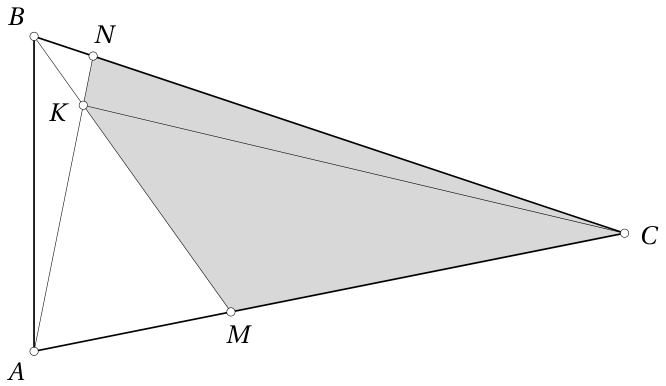
* SBCKSBCM=BKBM=14\frac{S_{BCK}}{S_{BCM}} = \frac{|BK|}{|BM|} = \frac{1}{4} (Fig. 31), whence SBCK=1423SABC=16SABCS_{BCK} = \frac{1}{4} \cdot \frac{2}{3}S_{ABC} = \frac{1}{6}S_{ABC} and SMCK=(2316)SABC=12SABCS_{MCK} = (\frac{2}{3} - \frac{1}{6})S_{ABC} = \frac{1}{2}S_{ABC}.

Since SABNSACN=BNCN=SKBNSKCN\frac{S_{ABN}}{S_{ACN}} = \frac{|BN|}{|CN|} = \frac{S_{KBN}}{S_{KCN}}, we obtain
SABNSACN=SABNSKBNSACNSKCN=SABKSAMK+SMCK=11214+12=11234=19. \frac{S_{ABN}}{S_{ACN}} = \frac{S_{ABN} - S_{KBN}}{S_{ACN} - S_{KCN}} = \frac{S_{ABK}}{S_{AMK} + S_{MCK}} = \frac{\frac{1}{12}}{\frac{1}{4} + \frac{1}{2}} = \frac{\frac{1}{12}}{\frac{3}{4}} = \frac{1}{9}.
Figure 2

Hence SABNSABC=SABNSABN+SACN=SABNSABN+9SABN=110\frac{S_{ABN}}{S_{ABC}} = \frac{S_{ABN}}{S_{ABN}+S_{ACN}} = \frac{S_{ABN}}{S_{ABN}+9S_{ABN}} = \frac{1}{10}, implying SABN=110SABCS_{ABN} = \frac{1}{10}S_{ABC}.

Altogether, we obtain
SMKNCSABC=SABCSABNSAMKSABC=111014=0.65, \frac{S_{MKNC}}{S_{ABC}} = \frac{S_{ABC} - S_{ABN} - S_{AMK}}{S_{ABC}} = 1 - \frac{1}{10} - \frac{1}{4} = 0.65,
meaning that the area of the quadrilateral MKNCMKNC equals 65% of the area of the triangle ABCABC.

Figure 2

Want a route through all this instead of an archive? The track puts 2,000 problems in a working order, from AMC 10 level to the IMO shortlist.

Source: MathNet, licensed CC-BY-4.0. Statement and solution reproduced as published; topic and difficulty added by this site.