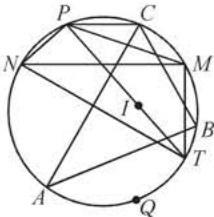
(1) As shown in Fig. 2, join NI, MI. Since PC∥MN and P,C,M,N are concyclic, PCMN is an isosceles trapezoid. Therefore, NP=MC, PM=NC.
Join AM, CI. Then AM intercepts CI at I. We have
∠MIC=∠MAC+∠ACI=∠MCB+∠BCI=∠MCI.
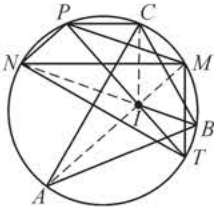
Fig. 2
Therefore, MC=MI. In the same way, NC=NI. Then NP=MI, PM=NI.
This means that MPNI is a parallelogram. Therefore, S△PMT=S△PNT, for the two triangles having the same base and height.
On the other hand, ∠TNP+∠PMT=180∘, as P,N,T,M are concyclic. Then we have
S△PMT=21PM×MTsin∠PMT=S△PNT=21PN×NTsin∠PNT=21PN×NTsin∠PMT.
Therefore, MP×MT=NP×NT.
(2) As shown in Fig. 3, we have
∠NCI1=∠NCA+∠ACI1=∠NQC+∠QCI1=∠CI1N.
Therefore, NC=NI1. In the same way, MC=MI2.
From MP×MT=NP×NT we get
MPNT=NPMT.
From (1) we know that MP=NC, NP=MC. Then
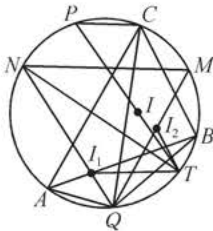
Fig. 3
NI1NT=MI2MT.
Furthermore,
∠I1NT=∠QNT=∠QMT=∠I2MT.
Therefore, △I1NT∼△I2MT. Consequently, ∠NTI1=∠MTI2. Then we have
∠I1QI2=∠NQM=∠NTM=∠I1TI2.
This means that Q,I1,I2,T are concyclic.