Let be a circular labelling of six distinct points on a circle centred at the point , and let be the midpoint of the segment , (indices are reduced modulo ). Assume that no opposite sides of the hexagon are parallel. A line through the point meets again the circle at the point , . Let be the tangent to the circle at the point , . The lines and meet to produce the point , where . Show that the three circles and the circle share a point in the plane.
ShortlistBMO, 2011
Solution
Let be the circle through the , centred at , and let tangents to at and meet at . Notice that the line is the image of the circle under the inversion of pole and power , where is the radius of . By Brianchon's theorem, the three lines are concurrent at a point . Notice further that is different from , for no opposite sides of the hexagon are parallel. Consequently, the three circles share a second point , different from : the image of the point under the inversion.
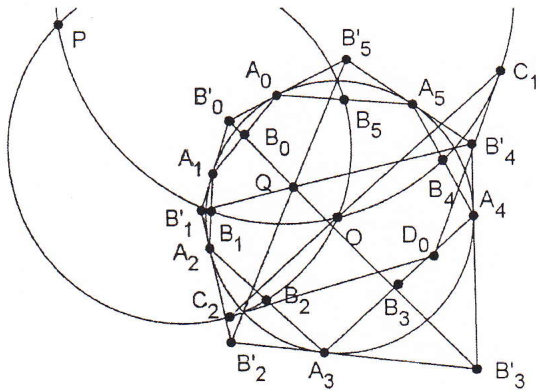
The lemma below shows that the points and are concyclic (not necessarily in this order), and the lines and are isogonal with respect to the lines and , where . Finally, a standard angle-chase argument shows that and the three points are concyclic: with reference to the figure below, write successively
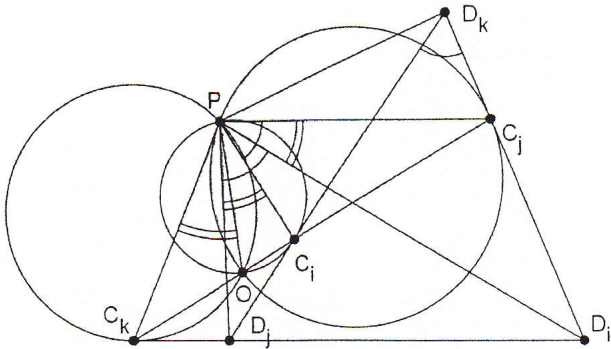
to conclude that the points and are indeed concyclic.
Lemma. Two circles, and , meet at the points and . A line through meets again at the point , and at the point . The tangent to at meets the tangent to at at the point . Then the points and are concyclic, and the lines and are isogonal with respect to the lines and .
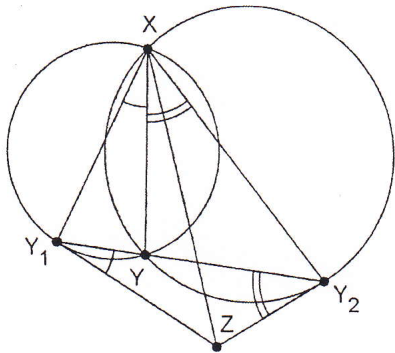
Proof. If and lie on opposite sides of the line through , then the angle is the sum of the angles and which are respectively equal to the angles and , whose sum is supplementary to the angle . Consequently, the quadrangle is cyclic. It then follows that the angles and are equal, and since the latter is equal to the angle , we conclude that the lines and are indeed isogonal with respect to the lines and .
If and lie on the same side of the line through , then the angle is the difference of the angles and in some order, depending on which side of the line the line is situated. The later angles are respectively supplementary to the angles and whose difference in the corresponding order is equal to the angle . Consequently, the quadrangle or is cyclic. Isogonality is proved by adapting the argument in the former case.
Want a route through all this instead of an archive? The track
puts 2,604 problems in a working order, from Junior Challenge level to the IMO shortlist.