Some of students in a class are friends. Any students in this class can form a circle so that any two students next to each other on the circle are friends, but all students cannot form a similar circle. Find the smallest possible value of .
Team Selection Test for IMO, 2009
Solution
We want to show that if has a Hamiltonian cycle for each vertex in a graph , but does not have a Hamiltonian cycle, then , and produce such a graph with .
Since cannot be adjacent with two consecutive vertices in a Hamiltonian cycle in , we have . On the other hand, if for some vertex , then there is no Hamiltonian cycle in where is vertex adjacent with . Therefore . In particular, .
Next observe that if is a Hamiltonian cycle in , and if is adjacent with and , , then and can not be adjacent with each other, as that would give a Hamiltonian cycle in .
From these observations it follows that and are impossible. If , then each vertex has degree 3 or 4, and they cannot all have degree 3 by the degree sum formula. Hence assume that and there is a vertex with .
Then must contain the graph on the left below.
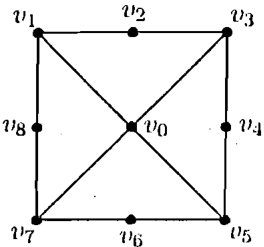
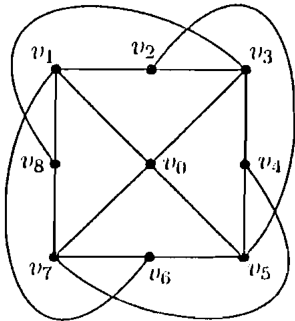
But then, again from the observations above, it follows that each must be adjacent with at least -and therefore exactly- one of and (indices considered mod 8), and there are no other edges. Since there are edges only between vertices of different parity in the resulting graph; if we remove an odd indexed vertex, the remaining graph cannot have a Hamiltonian cycle as it has unequal number of odd and even indexed vertices.
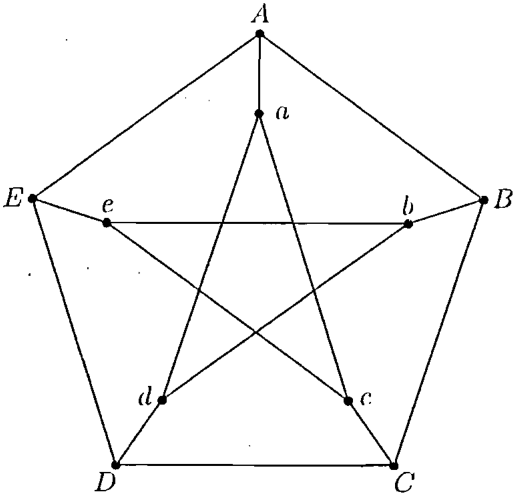
In this graph, and are Hamiltonian cycles for and , respectively.
itself does not have a Hamiltonian cycle. A Hamiltonian cycle cannot contain exactly two of the edges , , , , , as there are no adjacent pairs of vertices on the outer and the inner cycles. So it must contain exactly four of them; say, , , , . Then the cycle contains a path through , , , , , and a path through , , , , ; and these two paths cannot be completed to a Hamiltonian cycle.
Want a route through all this instead of an archive? The track
puts 2,604 problems in a working order, from Junior Challenge level to the IMO shortlist.