Let be a scalene triangle with circumcircle . Let be the midpoint of . A variable point is selected in the line segment . The circumcircles of triangles and intersect again at points and , respectively. The lines and intersect (a second time) the circumcircles to triangles and at and , respectively. Prove that as varies, the circumcircle of passes through a fixed point distinct from .
Asian Pacific Mathematics Olympiad
Solutions — 2
Solution 1
Let be the radical center of the circumcircles of triangles , and . The pairwise radical axes of these circles are , and , and hence they concur at . Now, note that in directed angles:
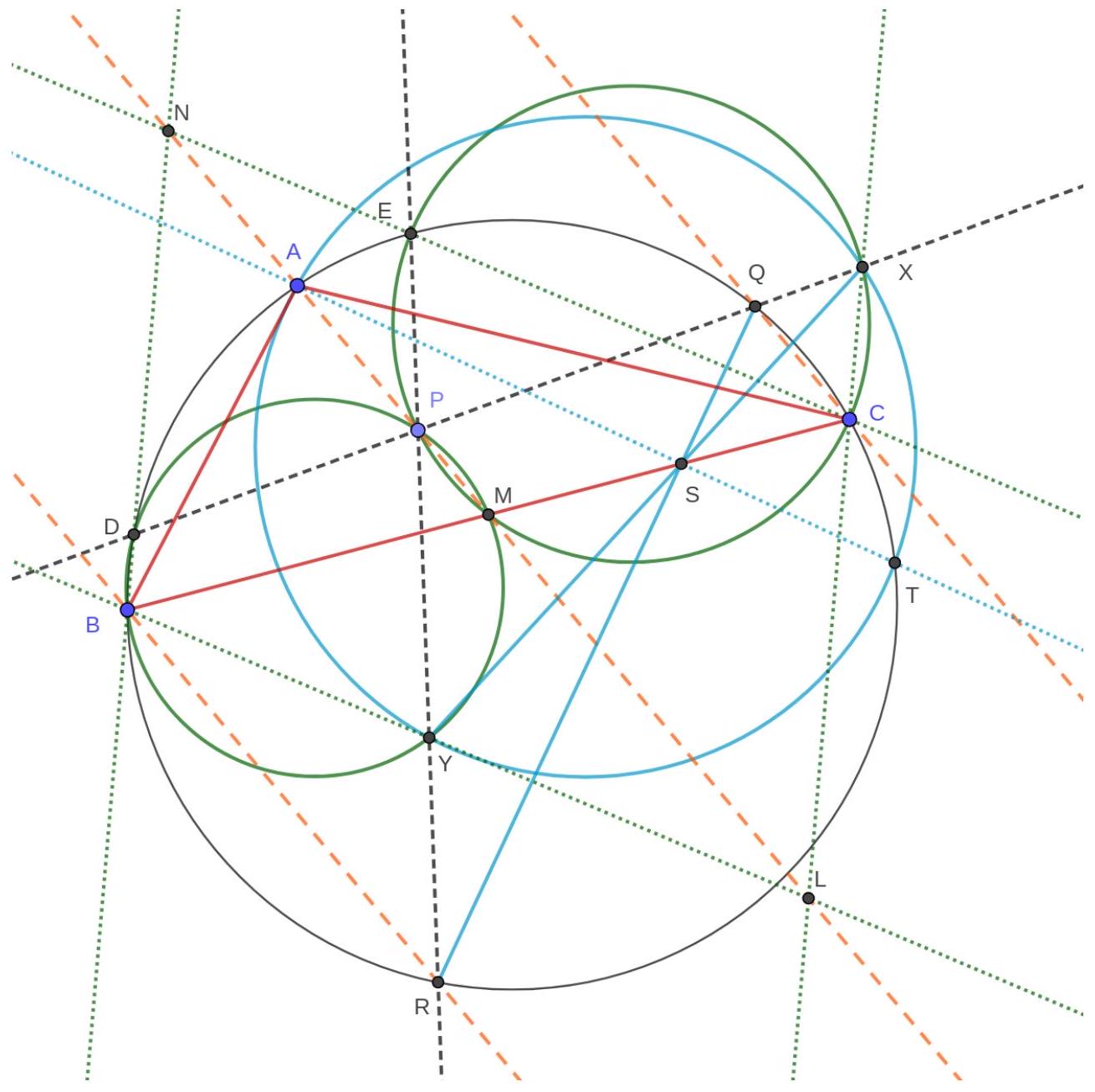
It follows that is parallel to , and analogously that is parallel to . Then, if is the intersection of and , it follows that is a parallelogram. Since we deduce that is the reflection of with respect to , and therefore . Using power of a point from to the circumcircles of triangles and , we have
Hence, is cyclic. Using the cyclic quadrilateral we find in directed angles:
Since , it follows that .
Let and be two points in such that , , and are all parallel. Then in directed angles:
Then , , are collinear. Analogously , , are collinear. From here we get , since and are parallel. Therefore is cyclic. Let be the radical center of the circumcircle of triangle and the circles and . This point lies in the lines , and because these are the radical axes of the circles. Let be the second intersection of with . By power of a point from to the circumcircle of and the circle we have
Therefore is in the circumcircle of triangle . Since and are fixed regardless of the choice of , then is also fixed, since it is the intersection of and . This implies is also fixed, and therefore, the circumcircle of triangle goes through for any choice of .
Solution 2
Let the lines and meet the circumcircle of again at and , respectively. Then , so . Similarly, .
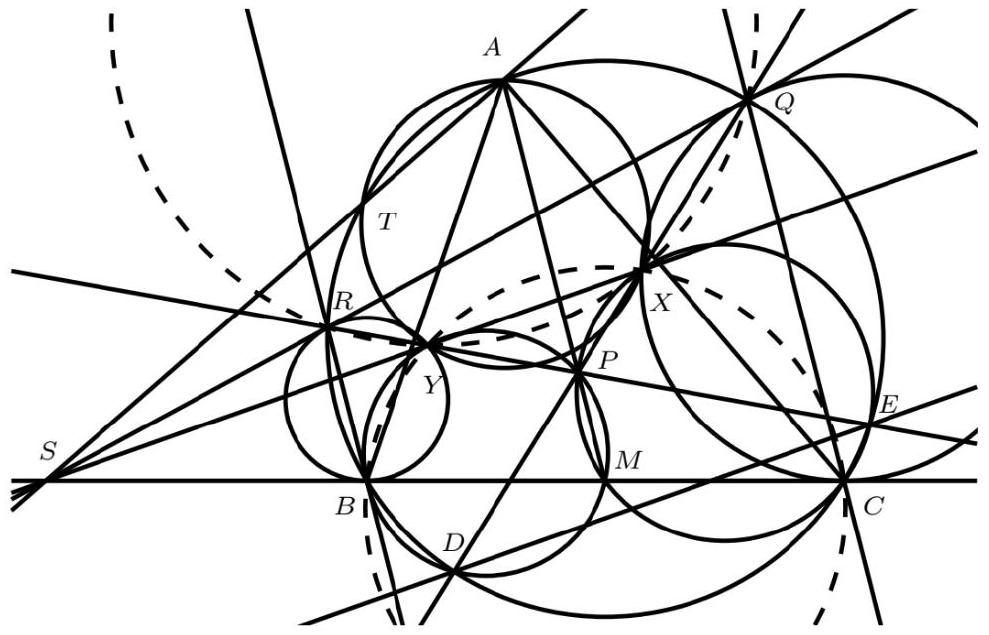
Now, , which is half of the arc in the circumcircle of . So is tangent to ; analogously, , the circumcircle of , is also tangent to . Since , the inscribed trapezoid is isosceles, and by symmetry is also tangent to both circles, and the common perpendicular bisector of and passes through the centers of and . Since and , the line is the radical axis of and .
However, is also the radical axis of the circumcircles of and of . Let and meet at . Let denote the power of a point with respect to a circumference . We have
Point is thus the radical center of , , , . Thus, the radical axes , , meet at . From here,
We may now finish as in Solution 1.
Want a route through all this instead of an archive? The track
puts 2,604 problems in a working order, from Junior Challenge level to the IMO shortlist.