Let be a triangle, and let be a point on the extension of beyond , and a point on the extension of beyond , such that . Moreover, let and be points on the extensions of and beyond such that and . Prove that lie on a circle whose centre lies on the circumcircle of .
South African Mathematical Olympiad Third Round
Solutions — 2
Solution 1
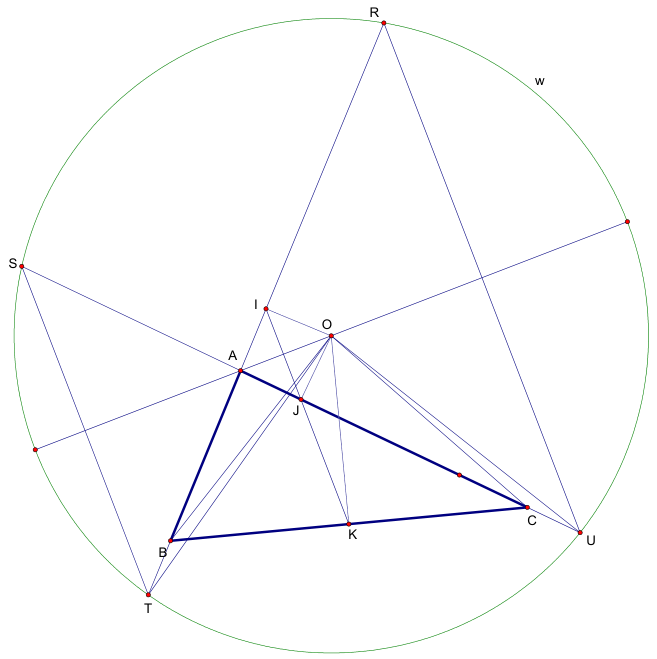
Figure 2
Since , we have . Similarly, , so that . This implies that and are concylic.
We now show that the centre of the circle through and , lies on the circumcircle of . We know that lies on the perpendicular bisector of (which is also the perpendicular bisector of , since ). This perpendicular bisector forms a diameter of , and contains .
If , then we are finished, since is certainly on the circumcircle of . So suppose that the points and are different, as shown in Figure 2. Drop perpendiculars from to (which is extended), to , and to . Let the feet of these perpendiculars be and , respectively. It is known that is on the circumcircle of if and only if the points and are collinear. (In case this happens, the line through is called the Simson line of determined by .)
In order to show that are collinear, it is sufficient to show that . Since , is a cyclic quadrilateral, so that . Our next observation is that . This follows from the fact that (from symmetry – recall that triangle is isosceles, and is on the perpendicular bisector of ), and , giving . Hence, , from which we get that triangles and are congruent. We therefore have . Finally, since is a cyclic quadrilateral (), we also have .
Putting everything together, we conclude that , and we are done.
Solution 2
The same strategy as in Solution 1 shows that is cyclic.
The centre must lie on the four perpendicular bisectors of and . But since triangles and are isosceles, the perpendicular bisectors of and pass through and bisect the angle .
Now , since is the centre of circle , which equals , since , which in turn equals , the exterior angle in triangle . This proves that is cyclic and hence .
Along with (radii) and the given , we conclude that triangles and are congruent, so . Finally and thus is cyclic.
(The problem could also be finished by noting that lies on the perpendicular bisector of and the exterior angle bisector of and thus lies on the circumcircle, but this assumes some extra knowledge that the above presentation doesn't.)
Want a route through all this instead of an archive? The track
puts 2,604 problems in a working order, from Junior Challenge level to the IMO shortlist.