The convex polygon is given. There is a square , that contains inside and has the minimum possible area. Is it obligatory for at least one of the sides of a square to contain one of the sides of the polygon ?
(Bogdan Rublyov)
Ukrainian Mathematical Competitions
Solution
Let's consider the smallest tangential square, that is circumscribed around the equilateral triangle (Fig. 46). And the side of the square contains the side of the triangle . It's clear, that it will be a square and the edge is located inside the square. Then let's make a small turn of the square around the edge . Let it be the square . So, the edge will be inside the new square. It's clear from the Fig. 46, if to continue the line till the intersection with at some point , then at is a hypotenuse, so, . That's why we can make a small compression of the (homothety with the center at the point and coefficient , but close enough to ), after which the area of the square will become smaller, but it will still cover the triangle .
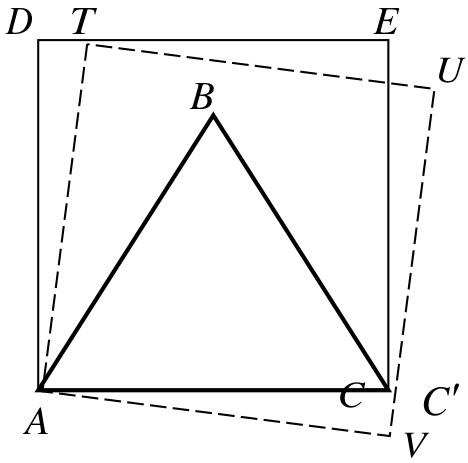
Fig. 46
Want a route through all this instead of an archive? The track
puts 2,604 problems in a working order, from Junior Challenge level to the IMO shortlist.