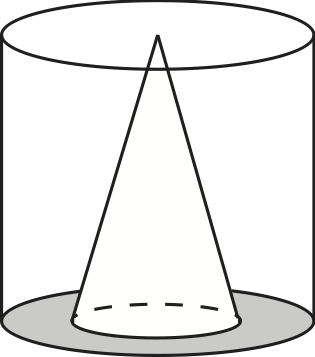
Suppose that the radius of the cylinder is r and the height of the cylinder is h.
This means that the volume of the cylinder is πr2h; the volume of half of the
cylinder is 21πr2h.
Also, the radius of the cone is 21r and the height of the cone
is h.
This means that the volume of the cone is 31π(21r)2h or 121πr2h.
When the cone is divided into two pieces by a horizontal plane at half
of its height, the top portion of the cone is a cone with the same
proportions, but with dimensions 21 of those of the larger
cone.
This means that the volume of the top portion is (21)3=81
of that of the cone, which equals 81⋅121πr2h
or 961πr2h.
To see this in another way, we note that this top portion of the cone
has height 21h and should
have radius 21⋅21r (because the radius decreases proportionally to
the height). This means that the volume of this portion is 31π(41r)2⋅21h which is again 961πr2h.
Using this information, the bottom portion of the cone has volume 87⋅121πr2h=967πr2h.
Now, when the cone is in the cylinder and the cylinder is filled with
water to half of its height, the volume of the bottom half of the
cylinder is filled with the bottom portion of the cone and with the
water.
Therefore, the volume of water is the difference between half of the
volume of the cylinder and the volume of the bottom portion of the cone,
or 21πr2h−967πr2h=9648πr2h−967πr2h=9641πr2h.
When the cone is removed, the water then occupies a cylinder with radius
r and volume 9641πr2h.
If the depth of the water in this configuration is d, then πr2d=9641πr2h and so d=9641h, which means that the
depth of the water is 9641
of the height of the cylinder.