In the diagram, is a square and is the midpoint of .
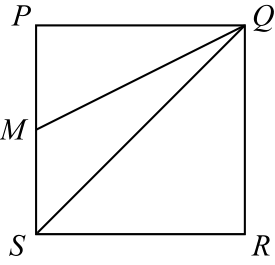
The ratio of the area of to the area of square is
Problem 534
Pick one
Official solution
Solution 1
Since is a square, then its diagonal cuts it into two equal areas.
Therefore, the ratio of the area of to the area of square is .
can be viewed as having base and height .
can be viewed as having base and height . (This is because is perpendicular to the line containing .)
Since , then the area of is one-half of the area of .
Since the ratio of the area of to the area of square is , then the ratio of the area of to the area of square is .
Solution 2
Suppose that the side length of square is .
Then the area of square is .
Since is the midpoint of side , then .
Then can be seen as having base and height . (This is because is perpendicular to the line containing .)
Since and , then the area of is .
Therefore, the ratio of the area of to the area of square is which equals .