Seven identical rectangles are used to create two larger
rectangles, as shown in Figure A and Figure B.
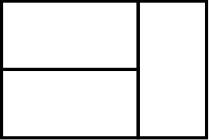
Figure A
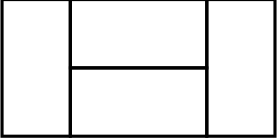
Figure B
The ratio of the perimeter of Figure A to the perimeter of Figure B
is
Seven identical rectangles are used to create two larger
rectangles, as shown in Figure A and Figure B.
Figure A
Figure B
The ratio of the perimeter of Figure A to the perimeter of Figure B
is
Pick one
Suppose that each of the small rectangles has shorter sides of
length .
Then the height of the rectangle in Figure A is , which means that the longer side of
each small rectangle has length .
Therefore, the rectangle in Figure A has height and width , which means that its
perimeter is . Also,
the rectangle in Figure B has height and width , so its perimeter is
.
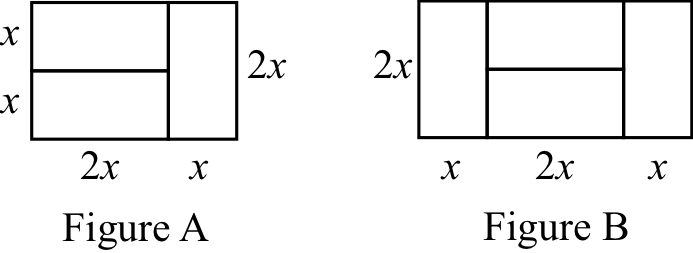
Therefore, the ratio of the perimeter of Figure A to the perimeter of
Figure B is which is
equal to , since .