There are several groups of six integers whose product is 1. Which of the following cannot be the sum of such a group of six integers?
Problem 540
Pick one
Official solutions — 2
Solution 1
For the product of two integers to equal 1, the two integers must both equal 1 or must both equal .
Similarly, if the product of six integers is equal to 1, then each of the six integers must equal 1 or .
For the product of six integers, each of which is equal to 1 or , to equal 1, the number of s must be even, because an odd number of s would give a product that is negative.
That is, there must be zero, two, four or six s among the six integers.
We summarize these four possibilities in the table below.
| Number of s | Product of the six integers | Sum of the six integers |
|---|---|---|
| 0 | ||
| 2 | ||
| 4 | ||
| 6 |
Of the answers given, the sum of such a group of six integers cannot equal 0.
Solution 2
Solution 1
The integers 1 to 32 are spaced evenly and in order around the outside of a circle.
Consider drawing a first straight line that passes through the centre of the circle and joins any one pair of these 32 numbers.
This leaves numbers still to be paired.
Since this first line passes through the centre of the circle, it divides the circle in half.
In terms of the remaining 30 unpaired numbers, this means that 15 of these numbers lie on each side of the line drawn between the first pair.
Let the number that is paired with 12 be .
If we draw the line through the centre joining 12 and , then there are 15 numbers that lie between 12 and (moving in either direction, clockwise or counter-clockwise).
Beginning at 12 and moving in the direction of the 13, the 15 numbers that lie between 12 and are the numbers .
Therefore, the next number after 27 is the number that is paired with 12.
The number paired with 12 is 28.
Solution 2
We begin by placing the integers 1 to 32, spaced evenly and in order, clockwise around the outside of a circle.
As in Solution 1, we recognize that there are 15 numbers on each side of the line which joins 1 with its partner.
Moving in a clockwise direction from 1, these 15 numbers are , and so 1 is paired with 17, as shown.
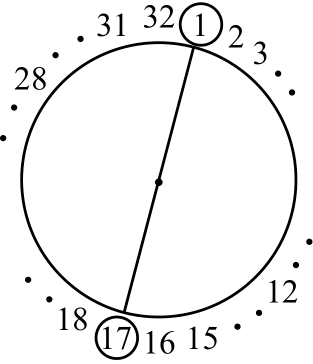
Since 2 is one number clockwise from 1, then the partner for 2 must be one number clockwise from 17, which is 18.
Similarly, 12 is 11 numbers clockwise from 1, so the partner for 12 must be 11 numbers clockwise from 17.
Therefore, the number paired with 12 is .