Three real numbers , , are chosen randomly, and independently of each other, between 0 and 1, inclusive. What is the probability that each of and is greater than and less than ?
Problem 848
Official solution
Consider a cube.
We associate a triple of real numbers with and and with a point inside this cube by letting be the perpendicular distance of a point from the left face, the perpendicular distance of a point from the front face, and the perpendicular distance from the bottom face.
We call this point . Choosing , and randomly and independently between 0 and 1 is equivalent to randomly and uniformly choosing a point on or inside the cube.
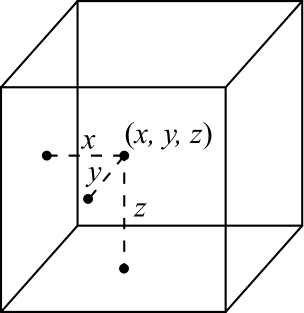
The conditions that and restrict the values of , and that can be chosen, which translates into restricting the points inside the cube that satisfy these conditions. Hence, these restrictions determine a region inside this cube.
The probability that a point randomly chosen inside this cube satisfies the given conditions will be equal to the volume of the region defined by the conditions divided by the volume of the entire cube.
Since the volume of the cube is 1, then the probability will equal the volume of the region defined by those conditions.
Consider now the region in the -plane defined by .
Re-arranging these inequalities, we obtain , which means that a point that satisfies these conditions lies above the line with equation and below the line with equation .
Restricting to and , we obtain the region shown:
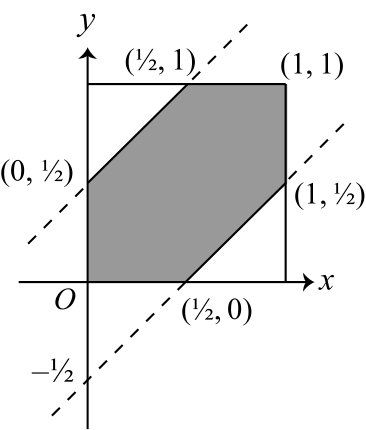
Since a point in the region satisifes , these conditions allow us to “slice” the cube from above keeping the portion that looks like the region above. The points that remain are exactly those that satisfy this condition.
Similarly, the conditions give , which has the same shape in the -plane.
Therefore, we can slice the cube from front to back to look like this shape. Now, we need to determine the volume of the remaining region.
To determine the volume of the region, we split the cube into eight cubes each measuring .
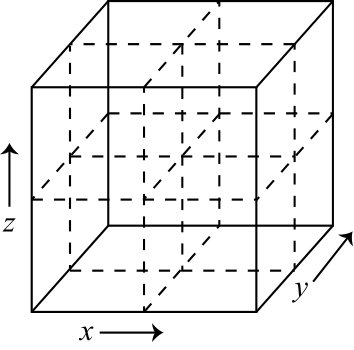
When this cube is sliced by the restrictions corresponding to , the back left and front right cubes on the top and bottom layers are sliced in half.
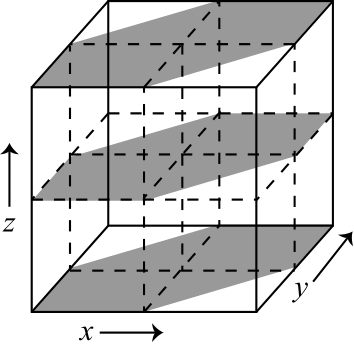
When this cube is sliced by the restrictions corresponding to , the top left and bottom right cubes in the front and back are sliced in half.
The eight little cubes are sliced as follows:
| Little cube | Sliced by | Sliced by |
|---|---|---|
| Bottom front left | No | No |
| Bottom front right | Yes | Yes |
| Bottom back left | Yes | No |
| Bottom back right | No | Yes |
| Top front left | No | Yes |
| Top front right | Yes | No |
| Top back left | Yes | Yes |
| Top back right | No | No |
This means that we can consider the little cubes as follows:
Bottom front left and top back right: these cubes are not sliced in either direction and so contribute to the volume of the solid.
Bottom back left, bottom back right, top front left, top front right: these cubes are sliced in half in one direction and are not sliced in the other direction, and so contribute of their volume (or each) to the solid.

Top back left and bottom front right: Each of these cubes is sliced in half in two directions. The first slice cuts the cube into a triangular prism, whose volume is half of the volume of the little cube, or . The second slice creates a square-based pyramid out of this prism. The pyramid has base with edge length and height , and so has volume .
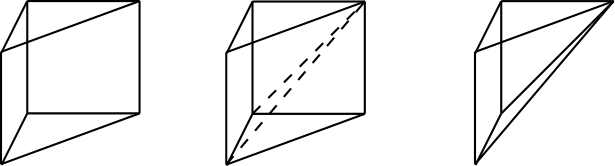
Therefore, the volume of the solid is .
Finally, this means that the required probability is .