Olympiad Maths Prep

Track / Stage 10 / 28 of 40 #1988 of 2000

Problem 1988

Hardest shortlist tier
Combinatorics Difficulty 9.3 Prove it SELECTION TESTS OF THE BELARUSIAN TEAM TO THE IMO · Belarus

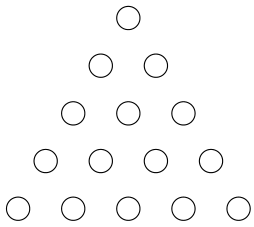
Given positive integers nn and knk \le n. Consider an equilateral triangular board with side nn, which consists of circles: in the first (top) row there is one circle, in the second row there are two circles, ..., in the bottom row there are nn circles (see the figure below). Let us place checkers on this board so that any line parallel to a side of the triangle (there are 3n3n such lines) contains no more than kk checkers. Denote by T(k,n)T(k, n) the largest possible number of checkers in such a placement.

Figure 1

a) Prove that the following upper bound is true:
T(k,n)k(2n+1)3. T(k, n) \le \left\lfloor \frac{k(2n + 1)}{3} \right\rfloor .

b) Find T(1,n)T(1, n) and T(2,n)T(2, n).

This one wants a proof. Work it on paper, read the official solution, then mark yourself honestly — the ladder only means something if the record is true.

Official solution

a. Let us prove that in any such placement of checkers on a triangular board with side nn, the number of checkers qq satisfies the inequality
q2n+13k. q \le \frac{2n + 1}{3} \cdot k.
The main idea of the proof is double counting. Note that wherever a checker stands, if you count all the cells of the three lines in which it stands, and take into account the cell on which it stands three times, you get 2n+12n + 1. Let us denote by SS this number summed over all checkers. We have
S=(2n+1)q. S = (2n + 1)q.

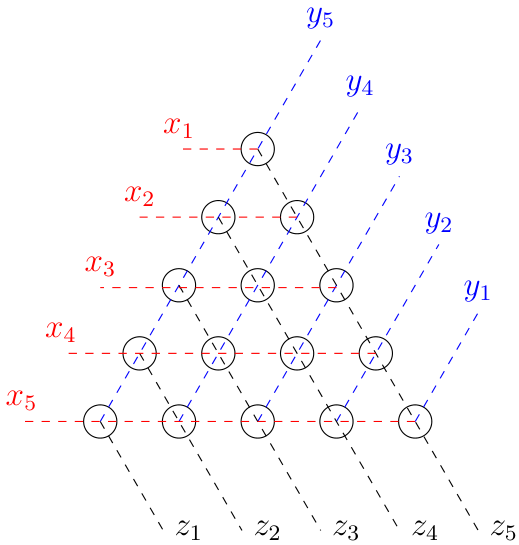
Now let's find this amount based on the location of the checkers along the lines. Let there be x1,,xnx_1, \dots, x_n checkers in the nn horizontal lines, y1,,yny_1, \dots, y_n checkers in the nn lines with angle 6060^\circ, and in the nn lines with angle 120120^\circ there are z1,,znz_1, \dots, z_n checkers, as shown in Figure 1.

Figure 2

The ii-th line has exactly ii cells, and each of them is in the same line with xi,yix_i, y_i or ziz_i checkers from that line depending on the angle. Therefore,
(3)S=1(x1+y1+z1)+2(x2+y2+z2)++n(xn+yn+zn). (3) \qquad S = 1 \cdot (x_1 + y_1 + z_1) + 2 \cdot (x_2 + y_2 + z_2) + \dots + n \cdot (x_n + y_n + z_n).
Since there are qq checkers in total, but there are no more than kk checkers in any row, we have the following conditions:
x1++xn=y1++yn=z1++zn=q,0xi,yi,zimin(i,k)for any 1in. x_1 + \dots + x_n = y_1 + \dots + y_n = z_1 + \dots + z_n = q, \\ 0 \le x_i, y_i, z_i \le \min(i, k) \quad \text{for any } 1 \le i \le n.
Let q=mk+rq = mk + r, where 0r<k0 \le r < k is the remainder when divided by kk. It is clear that the expression (3) is maximized when the sums xi+yi+zix_i + y_i + z_i with higher coefficients are the maximum possible (that is, equal to 3k3k). Hence, under these conditions we get
(2n+1)q=(x1+y1+z1)+2(x2+y2+z2)++n(xn+yn+zn)n3k+(n1)3k++(nm+1)3k+(nm)3r2nm+12m3k+(nm)3r6nmk3m2k+3mk2+3nr3mr6n(mk+r)3m2k+3(mk+r)3r6mr2(6n+3)q3m2k3r6mr2. \begin{aligned} (2n + 1)q &= (x_1 + y_1 + z_1) + 2(x_2 + y_2 + z_2) + \dots + n(x_n + y_n + z_n) \\ &\le n \cdot 3k + (n - 1) \cdot 3k + \dots + (n - m + 1) \cdot 3k + (n - m) \cdot 3r \\ &\le \frac{2n - m + 1}{2} m \cdot 3k + (n - m) \cdot 3r \\ &\le \frac{6nmk - 3m^2k + 3mk}{2} + 3nr - 3mr \\ &\le \frac{6n(mk + r) - 3m^2k + 3(mk + r) - 3r - 6mr}{2} \\ &\le \frac{(6n + 3)q - 3m^2k - 3r - 6mr}{2}. \end{aligned}
Moving (2n+1)q(2n + 1)q to the right side, multiplying the inequality by 2k2k and substituting mk=qrmk = q - r, we arrive at a quadratic inequality for qq:
0(6n+34n2)kq3(mk)23rk6mkr=(2n+1)kq3(qr)26(qr)r3rk=(2n+1)kq3q2+6qr3r26qr+6r23rk=3q2+(2n+1)kq+3r(rk), \begin{aligned} 0 &\le (6n + 3 - 4n - 2)kq - 3(mk)^2 - 3rk - 6mkr \\ &= (2n + 1)kq - 3(q - r)^2 - 6(q - r)r - 3rk \\ &= (2n + 1)kq - 3q^2 + 6qr - 3r^2 - 6qr + 6r^2 - 3rk \\ &= -3q^2 + (2n + 1)kq + 3r(r - k), \end{aligned}
from which we obtain
3q2(2n+1)kq+3r(rk)(2n+1)kq,that isq2n+13k, 3q^2 \le (2n + 1)kq + 3r(r - k) \le (2n + 1)kq, \quad \text{that is} \quad q \le \frac{2n + 1}{3}k,
because rk<0r - k < 0. Since qq is an integer, we get q2n+13kq \le \left\lfloor \frac{2n+1}{3}k \right\rfloor, as required.

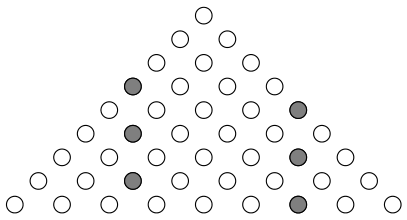
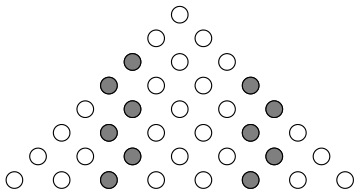
b. We have T(1,n)=2n+13T(1, n) = \left\lfloor \frac{2n+1}{3} \right\rfloor and T(2,n)=4n+23T(2, n) = \left\lfloor \frac{4n+2}{3} \right\rfloor. Placements of checkers, when equality is achieved in the last inequality, for k=1k=1 and k=2k=2, are shown in figures 2, 3 and 4.
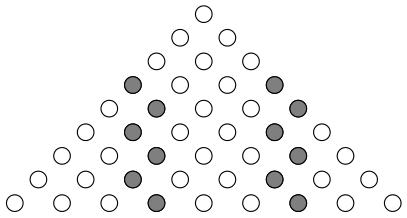
Figure 3

Figure 4

Figure 5

Source: MathNet, licensed CC-BY-4.0. Statement and solution reproduced as published; topic, difficulty and ordering added by this site.