First, we present two following lemmas. Let ABC be a triangle inscribed in (O) and N be the nine-point center of △ABC.
Lemma 1. Let K be the center of (BOC), then AN, AK are isogonal with respect to ∠BAC.
Proof. Let X be the reflection of O through BC. Let H be the orthocenter of △ABC. We have AH=OX, and AH is parallel to OX. Hence, AX cuts OH at the midpoint of OH, which is N, and thus N is the midpoint of AX. We have ∠OXB=∠KOB=∠KBO, so △OKB∼△OBX, implying that OBOK=OXOB, or
OX⋅OK=OB2=OA2.
Hence, we have OAOK=OXOA, implying that △OKA∼△OAX. Therefore, ∠OKA=∠XAO=∠DAK.
Since AH, AO are isogonal with respect to ∠BAC, we have ∠BAK=∠NAC, implying that AN, AK are isogonal with respect to ∠BAC.
Lemma 2. Let B′, C′ be the reflections of B, C through AC, AB, respectively, then AK is perpendicular to B′C′.
Proof. Let Y, Z be the reflection of O through CA, AB. Similar to the argument above, we have N is the midpoint of BY and CZ. Let Nb, Nc be the reflection of N through CA, AB. Since OC′ is the reflection of ZC through AB, and N is the midpoint of ZC, then Nc is the midpoint of OC′. Similarly, Nb is the midpoint of OB′. Hence, NbNc is parallel to B′C′. We have
∠KANb=∠NbAC+∠KAC=∠NAC+∠NAB=∠BAC,
and similarly, ∠KANc=∠BAC. On the other hand, we have ANb=AN=ANc, and since ∠KANb=∠KANc, we get AK is perpendicular to NbNc. So AK⊥B′C′, as desired. □
Back to the main problem, let Oa, Ob, Oc be the circumcenters of △NBC, △NCA, △NAB and Ka, Kb, Kc be the circumcenters of △OaBC, △ObCA, △OcAB. By Lemma 2, we have
ma≡NKa,mb≡NKb,mc≡NKc
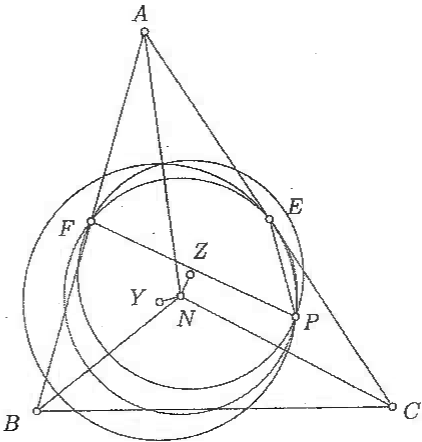
a) If N is the orthocenter H, let ma′, mb′ and mc′ be the reflections of ma, mb and mc through the bisectors of angles BHC, CHA and AHB. Let J be the nine-point center of ABC. Note that (J) is also the nine-point circle of BHC. By Lemma 1, we have HKa, KJ are isogonal with respect to ∠BHC, so ma′ goes through J. Similarly, mb′, mc′ also go through J, and thus ma′=mb′=mc′=HJ.
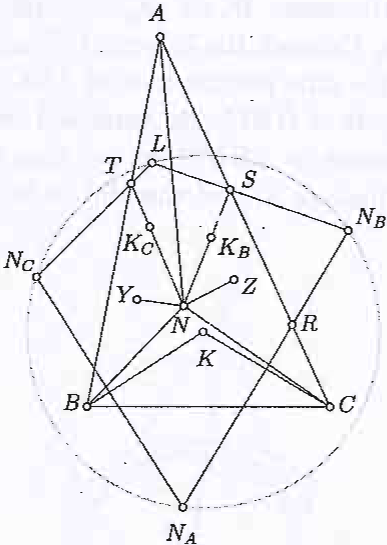
b) Assume that N is the nine-point center of △ABC. Let Na, Nb and Nc be the reflections of N through BC, CA and AB. Let (X), (Y) and (Z) be the nine-point circles of △NBC, △NCA and △NAB. We will show that the reflections of ma, mb and mc through BC, CA and AB concur on NaNbNc.
Denote (N) the nine-point circle of △ABC. Let P be the Poncelet point of the four points A, B, C and N; E, F be the midpoints of AC, AB. We have P, E are the intersections of (N) and (Y), and P, F are the intersections of (N) and (Z). Hence, PE⊥NY, PF⊥NZ, and we have
∠YNZ=180∘−∠FPE=180∘−∠BAC.
Let S, T be the intersections of NKb, NKc with CA, AB, respectively. Let K be the center of NaNbNc. Denote the intersection of the reflection line of mb, mc through AC, AB as L. We have BK⊥NaNc, CK⊥NbNc, and K is the isogonal conjugate of N in △ABC.
We have then
∠LNbNa=180∘−∠RSNb−∠NbRA=180∘−∠NSC−(90∘−∠ACK)=90∘−∠NSC+∠ACK.
And similarly, ∠LNcNa=90∘−∠NTB+∠ABK. It suffices to show that L∈(NaNbNc), and to show that, we need to show ∠ACK+∠ABK=∠NSC+∠NTB. Since NKb, NY are isogonal with respect to ∠ANC, we have
∠NSC=180∘−∠KbNC−∠NCA=∠YNA−∠NCA,
and similarly, ∠NTB=∠ZNA−∠NBA. Thus,
∠NSC+∠NTB=∠YNZ−(∠NBA+∠NCA).
So we need to show that
∠B+∠C=∠NBA+∠NCA+∠ABK+∠ACK,
but this is true since, ∠B=∠ABN+∠CBN=∠ABN+∠ABK and ∠C=∠ACN+∠BCN=∠ACN+∠ACK. The proof is completed. □