Let be a polygon that is convex and symmetric to some point . Prove that for some parallelogram satisfying we have
where and denote the area of the sets and , respectively.
Problem 1862
Official solutions — 2
Solution 1
We will construct two parallelograms and , each of them containing , and prove that at least one of the inequalities and holds (see Figure 1).
First we will construct a parallelogram with the property that the midpoints of the sides of are points of the boundary of .
Choose two points and of such that the triangle has maximal area. Let be the line through parallel to and the line through parallel to . Let , , and be the points or lines, that are symmetric to , , and , respectively, with respect to . Now let be the parallelogram defined by , , and .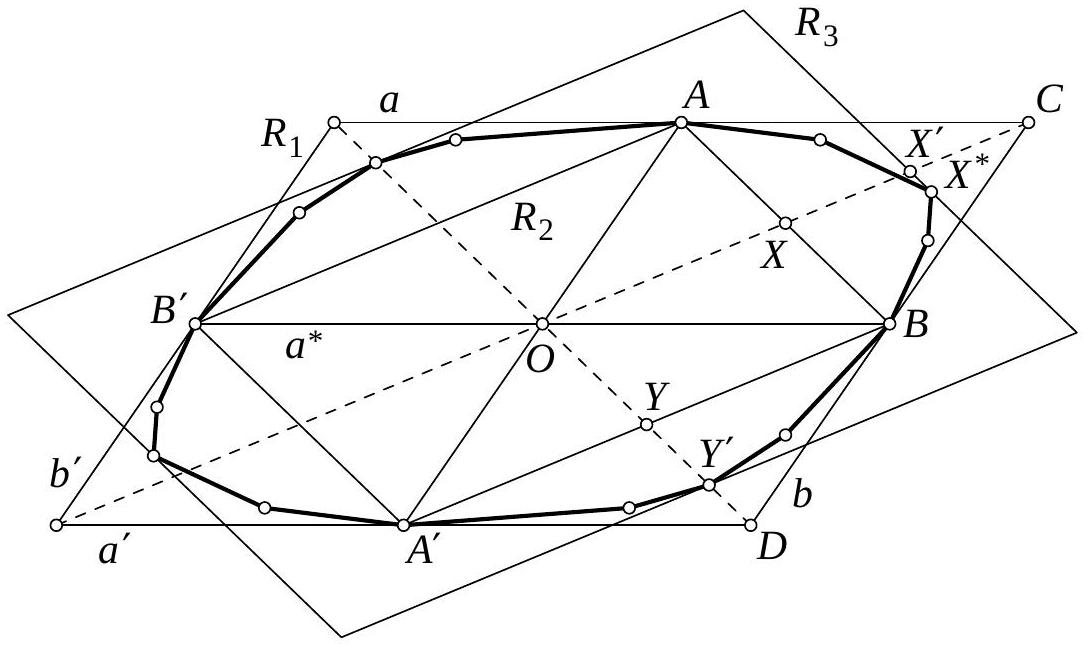
Figure 1
Obviously, and are located on the boundary of the polygon , and , , and are midpoints of the sides of . We note that . Otherwise, there would be a point but , i.e., one of the lines , , or were between and . If it is , we have , which is contradictory to the choice of and . If it is one of the lines , or almost identical arguments lead to a similar contradiction.
Let be the parallelogram . Since and are points of , segment and so . Since , , and are midpoints of the sides of , an easy argument yields
Let be the smallest parallelogram enclosing defined by lines parallel to and . Obviously and every side of contains at least one point of the boundary of . Denote by the intersection point of and , by the intersection point of and , and by the intersection point of and the boundary of . In a similar way denote by the intersection point of and , by the intersection point of and , and by the intersection point of and the boundary of .
Note that and , so there exist real numbers and with and and . Corresponding sides of and are parallel which yields
The side of containing contains at least one point of ; due to the convexity of we have . Since this side of the parallelogram is parallel to we have , so does not exceed the area of confined to the sector defined by the rays and . In a similar way we conclude that does not exceed the area of confined to the sector defined by the rays and . Putting things together we have , . Since , we conclude that ; this is in short
Since all numbers concerned are positive, we can combine (1)-(3). Using the arithmetic-geometric-mean inequality we obtain
This implies immediately the desired result or .
Solution 2
We construct the parallelograms , and in the same way as in Solution 1 and will show that or .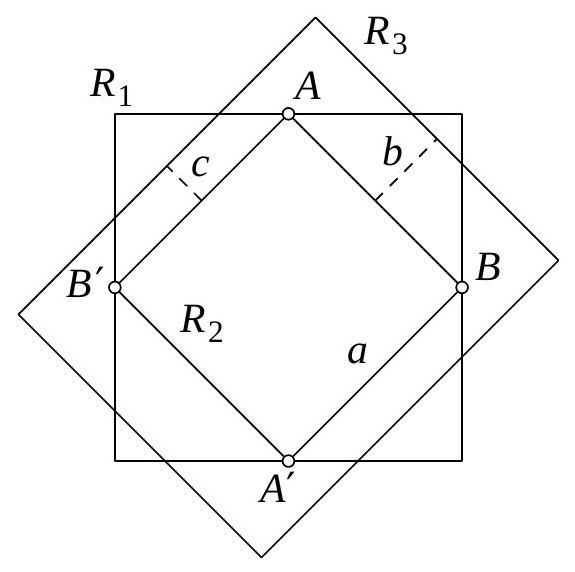
Figure 2
Recall that affine one-to-one maps of the plane preserve the ratio of areas of subsets of the plane. On the other hand, every parallelogram can be transformed with an affine map onto a square. It follows that without loss of generality we may assume that is a square (see Figure 2).
Then , whose vertices are the midpoints of the sides of , is a square too, and , whose sides are parallel to the diagonals of , is a rectangle.
Let , and be the distances introduced in Figure 2. Then and .
Points , , and are in the convex polygon . Hence the square is a subset of . Moreover, each of the sides of the rectangle contains a point of , otherwise would not be minimal. It follows that
Now assume that both and , then
and
All numbers concerned are positive, so after multiplying these inequalities we get
But the arithmetic-geometric-mean inequality implies the contradictory result
Hence or , as desired.