First Solution. (By Gabriel Carroll and Tiankai Liu) Because ∠AOC=2β, we have ∠CAO=90∘−β. Note that in right triangle APC, ∠CAP=90∘−γ, so
∠PAO=∠CAO−∠CAP=γ−β.
By (1), sin∠PAO≥21.
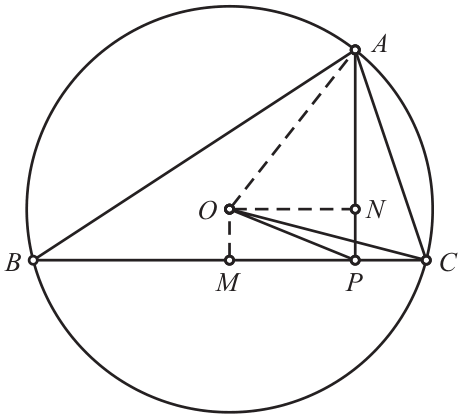
Let N be the foot of perpendicular from O to segment AP. Then MPNO is a rectangle, so
OAMP=OAON=sin∠PAO≥21,
or 2MP≥OA=OC. In right triangles OCM and OPM, OC>CM and OP>MP. Therefore,
PC−MP=MC−2MP≤MC−OC<MC−MC=0.
We obtain OP>MP>PC, as desired.
Second Solution.
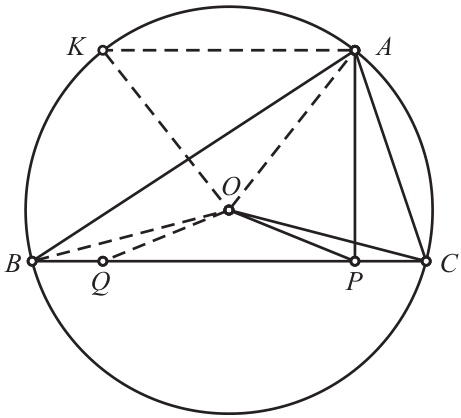
Let K and Q be the reflections of A and P, respectively, across line OM. Then KQPA is a rectangle and QP=KA. Note that
∠KOA=∠BOA−∠BOK=∠BOA−∠COA=2γ−2β≥60∘.
Because K and A are reflections of each other across line OM, we have OK=OA and thus K lies on ω. Hence, QP=KA=2Rsin(21∠KOA)≥R. By the Triangle Inequality, we have
OP+R=Q+OC>QC=QP+PC≥R+PC,
which implies (*).
Third Solution. By (1) and the Product-to-Sum formulas,
4sinβcosγ=2[sin(γ+β)−sin(γ−β)]=2sinα−2sin(γ−β)<2−1=1.
Applying the Extended Law of Sines gives
CP⋅CB=(ACcosγ)(CB)=(2Rsinβcosγ)(2Rsinα)<R2.(2)
We present two proofs of (*) based on (2).
---
* We choose a point J on ray CB so that CJ⋅CP=R2. It follows from this equation and from (2) that CJ>CB, so that ∠OBC>∠OJC. Since OC/CJ=PC/CO and ∠JCO=∠PCO, triangles JCO and OCP are similar and ∠OJC=∠COP. It follows that
∠COP=∠OJC<∠OBC=90∘−∠BAC,
or ∠CAB+∠COP<90∘.
* The power of P with respect to circle ω is BP⋅PC=R2−OP2. By (2), we obtain
OP2=R2−BP⋅PC>PC⋅CB−BP⋅PC=PC2.
Thus, OP>PC, as desired.
Fourth Solution. By the Extended Law of Sines, AB=2Rsinγ and AC=2Rsinβ. Therefore, by (1) and the Addition and Subtraction formulas, we obtain
BP−PC=ABcosβ−ACcosγ=2R(sinγcosβ−sinβcosγ)=2Rsin(γ−β)≥R.
By the Triangle inequality,
R+OP=BO+OP>BP≥R+PC,
which implies that OP>CP, as desired.
Fifth Solution. (By Zhiqiang Zhang, China) By the Extended Law of Sines and the Product-to-Sum formulas, we have
CP=ACcosγ=2Rsinβcosγ=R(sin(β+γ)−sin(γ−β))<R(1−sin30∘)=2OC,
or 2CP<OC. On the other hand, applying the Law of Cosines in triangle COP yields
CP2+OC2−2(CP)(OC)cos∠OCB=OP2.
Now (*) follows from the inequality
OP2>CP2+OC2−OC⋅OC⋅1=CP2.