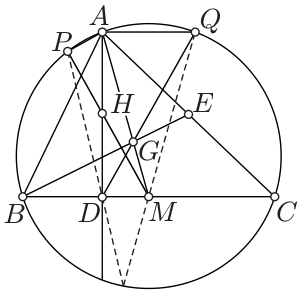
Let be a triangle such that , let be its centroid, and let be its orthocenter. Let be the orthogonal projection of on the line , and let be the midpoint of the side . The circle crosses the ray emanating from at , and the ray emanating from at , outside the segment . Show that the lines and meet on the circle .
BMO 2017 Shortlist
Problem 1791
Official solutions — 2
Solution 1
*First solution.* We show that the angles and are either equal or one is the supplement of the other.
To begin, recall that the reflection of across is the antipode of in the circle , to infer that the angle is right, so , , , are concyclic. Hence the angles and are either equal or one is the supplement of the other.
The circle is the image of the nine-point circle under a homothety of scale factor centred at . This homothety sends to and to , so and are parallel.
Hence , on the one hand; and , on the other, so . Consequently, , and the conclusion follows by the preceding paragraph.
Solution 2
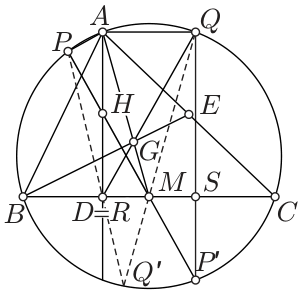
*Second solution.* As in the previous solution, and are reflections of one another in the perpendicular bisectrix of the segment .
Let the line cross the circle again at , and let the lines and cross at . Since is the antipode of in the circle , the angle is right, so the lines and are perpendicular.
Let the line cross the circle again at , let the lines and cross at , and refer to the butterfly theorem to infer that and are reflections of one another across .
The lines and are therefore reflections of one another in the perpendicular bisectrix of the segment .
Finally, since is perpendicular to , so is , and, consequently, the points and coincide. The conclusion follows.