Let be a triangle and let and denote the midpoints of and , respectively. Let be a point such that is tangent to the circumcircle of triangle . Denote by the circle through and tangent to , and by the circle through and tangent to . Show that and intersect on line .
Problem 1874
Official solution
First solution using symmedians (Merlijn Staps) Let be the other tangent from to .
Claim. Line is tangent to ; hence lies on .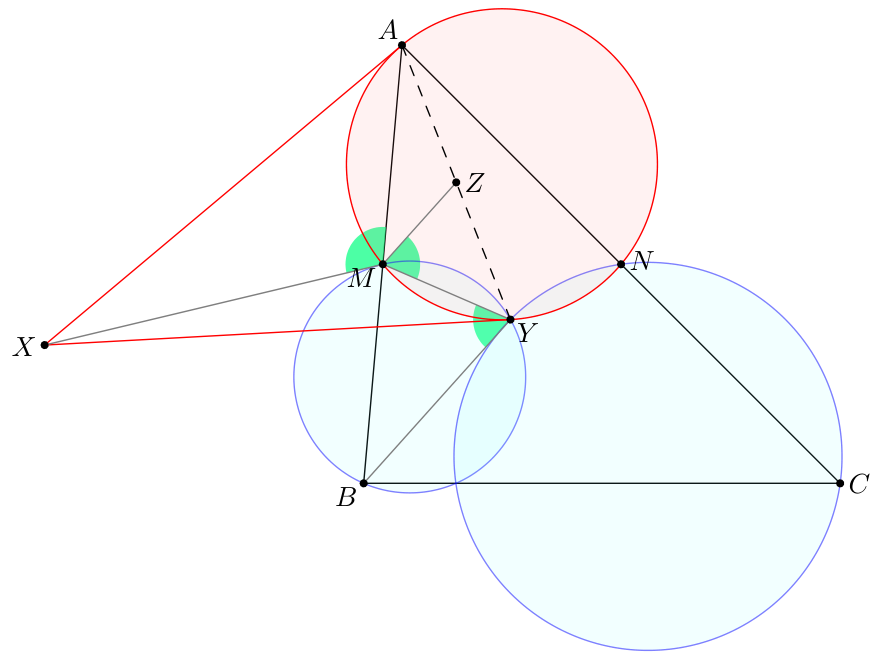
*Proof.* Let be the midpoint of . Then is the -symmedian in triangle . Since , it follows that . We conclude that is tangent to the circumcircle of triangle .
Similarly, is the circumcircle of triangle . As is cyclic too, it follows that and intersect on , by Miquel's theorem.
Second solution (Jetze Zoethout) Let intersect again at and let intersect again at . Angle chasing gives , so is on the circumcircle of triangle . Furthermore, from and it follows that and from and it follows that .
---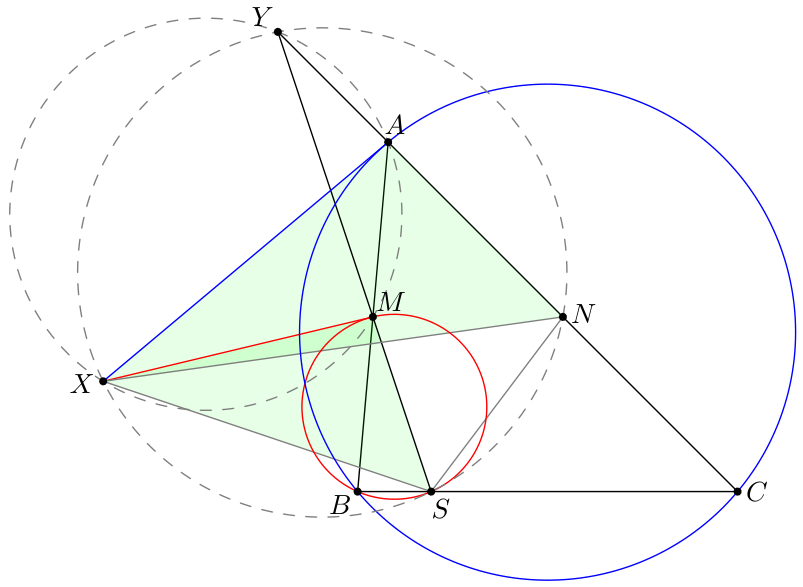
We now find
which together with yields . From we now have that is on the circumcircle of triangle . Finally, we have so is tangent to the circle through , and , as desired.
Third solution by moving points method Fix triangle and animate along the tangent at . We let denote the second intersection point of with line .
Claim. The composed map is a fractional linear transformation (i.e. a projective map) in terms of a real coordinate on line .
*Proof*. Let denote the perpendicular bisector of , also equipped with a real coordinate. We let denote the intersection of with , the circumcenter of . Let denote the midpoint of .
We claim that the composed map
by
is projective, by showing each individual map is projective.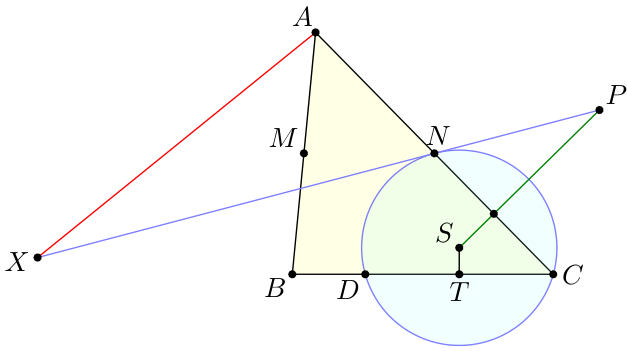
* The map is projective since it is a perspectivity through from to .
* The map is projective since it is equivalent to a negative inversion on at the midpoint of with radius . (Note is fixed.)
* The map is projective since it is a perspectivity through the point at infinity perpendicular to (in fact, it is linear).
* The map is projective (in fact, linear) since it is a homothety through with fixed ratio 2.
Thus the composed map is projective as well.
Similarly, if we define so that is tangent to , the map is projective as well. We aim to show , and since the maps correspond to fractional linear transformations in projective coordinates, it suffices to verify it for three distinct choices of . We do so:
* If , then and satisfy , . This means they are the feet of the -altitude on .
* As approaches the points and approach the infinity point along .
* If is a point at infinity along , then and coincide with the midpoint of .
This completes the solution.
Fourth solution by isogonal conjugates (Anant Mudgal) Let be the isogonal conjugate of in and be the reflection of in . As is tangent to the circumcircle of , it follows that . Thus lies on since bisects the strip made by and .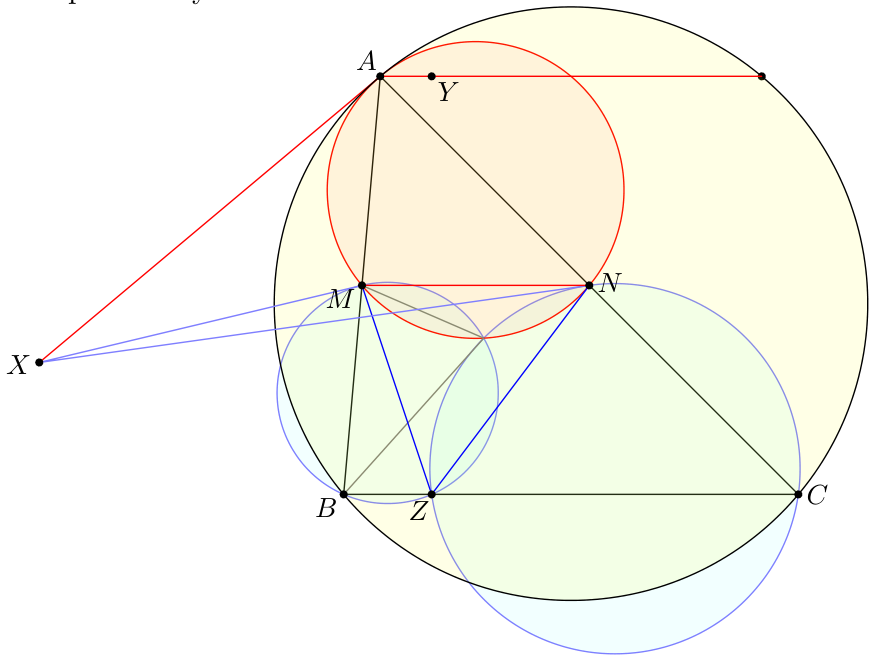
Finally,
so is tangent to the circumcircle of , hence lies on . Similarly, lies on and we're done.