Let be a triangle and be the midpoints of arcs on the circumcircle. Line passes through the feet of the perpendiculars from to and . Line passes through the feet of the perpendiculars from to and . Let denote the intersection of lines and . Define points and similarly. Prove that triangles and are similar to each other.
Problem 1878
Official solution
We prove the following stronger statement: are midpoints of segments , respectively, where is the orthocenter of triangle . Therefore, there is a dilation centered at with magnitude 2 sending triangle to . (For readers familiar with the nine-point circle of a triangle, this stronger statement shows that lie on the nine-point circle of triangle . Furthermore, the statement remains true if are arbitrarily chosen points on arcs . We leave it to the reader to show this more general result.)
We give two solutions; in each, let and denote the feet of the perpendiculars from to lines and respectively. Let and denote the feet of the perpendiculars from to lines and respectively. Then is the intersection of line (or ) and line (or ). Let be the foot of the perpendicular from to line . Let be the midpoint of side . Extend segment to meet the circumcircle of triangle at . We also set , and .
Solution 1.
We consider the left-hand side configuration shown below. (Our proof can be easily modified for other configurations.) Let denote the intersection of lines and . By symmetry, it suffices to show that is the midpoint of segment and is the orthocenter of triangle .
Note that points are collinear – they lie on the Simson line from with respect to triangle . Indeed, because , is cyclic, implying that
Because , is cyclic, implying that
where the third equality holds because is cyclic. By (16) and (17), we know that ; that is, are collinear. In exactly the same way, we know that are collinear (on the Simson line from with respect to triangle ) by establishing
Furthermore, by (17) and (18), we conclude that is an isosceles triangle with . Let denote the intersection of lines and . Then in right triangle , we must have . Thus triangles and are congruent to each other (by SAS, since and ). In particular, is the midpoint of .
That is, . Because is the midpoint of side of triangle and , must be the midpoint of segment . Consequently, line is the reflection of line across line , from which it follows that
Therefore, or ; that is, is the orthocenter of triangle (as ).
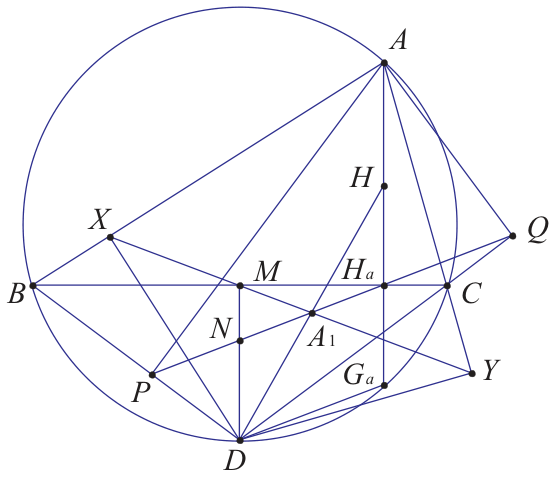
Solution 2
(based on work by Thomas Swayze). Our goal will be to prove that is the midpoint of , where is the orthocenter of triangle , from which the result follows immediately. Let be the midpoint of . Set up a system of complex numbers (equivalently, vectors) having the circumcircle of triangle as the unit circle. Then, if have coordinates , then has coordinate and thus has coordinate . The symmetry of this expression in , and implies that is also the midpoint of , and , where , and are the respective orthocenters of triangles , and . We now disregard the condition that is the midpoint of arc and complete the problem using two symmetric applications of the following lemma.
Lemma 1.
Let be a cyclic quadrilateral and the common midpoint of , and , where , and are the respective orthocenters of triangles , and . Then the Simson line of with respect to triangle passes through .
*Proof.* By definition, the Simson line passes through the feet of the perpendiculars from to , and . But is also a cyclic quadrilateral since , and the Simson line of with respect to triangle also passes through and as well as the foot of the perpendicular from to . We conclude by noting that and are the feet of corresponding altitudes of triangles and , which are congruent through a half-turn about ; hence is the midpoint of and thus lies on line .
By the lemma, lies on both of the Simson lines of the problem and thus coincides with . Applying this result to the three sides of yields that triangles and are homothetic with ratio 2 about .