Olympiad Maths Prep

Track / Stage 10 / 5 of 40 #1965 of 2000

Problem 1965

Hardest shortlist tier
Geometry Difficulty 9.2 Prove it IMO 2019 Shortlisted Problems · IMO · 2019

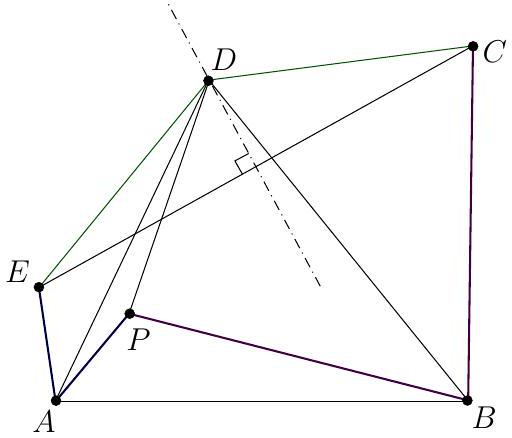
Let ABCDEA B C D E be a convex pentagon with CD=DEC D = D E and EDC2ADB\angle E D C \neq 2 \cdot \angle A D B. Suppose that a point PP is located in the interior of the pentagon such that AP=AEA P = A E and BP=BCB P = B C. Prove that PP lies on the diagonal CEC E if and only if area(BCD)+area(ADE)=area(ABD)+area(ABP)\operatorname{area}(B C D) + \operatorname{area}(A D E) = \operatorname{area}(A B D) + \operatorname{area}(A B P).

This one wants a proof. Work it on paper, read the official solution, then mark yourself honestly — the ladder only means something if the record is true.

Official solutions — 2

Solution 1

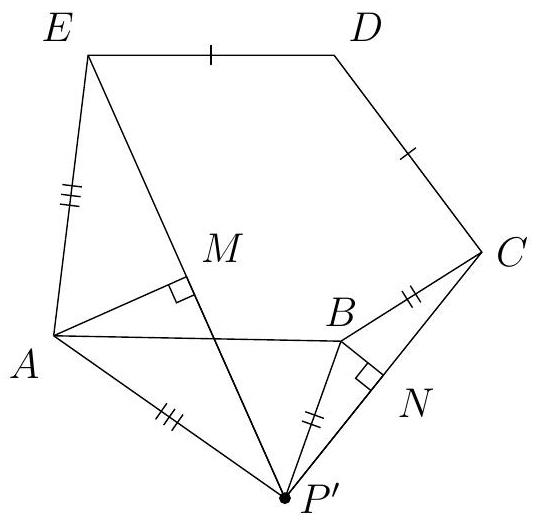
Figure 1
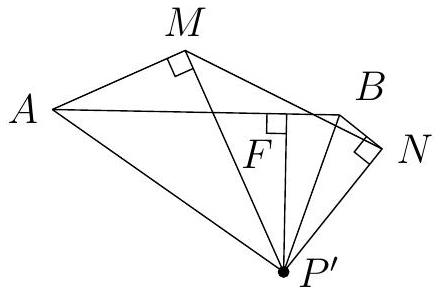
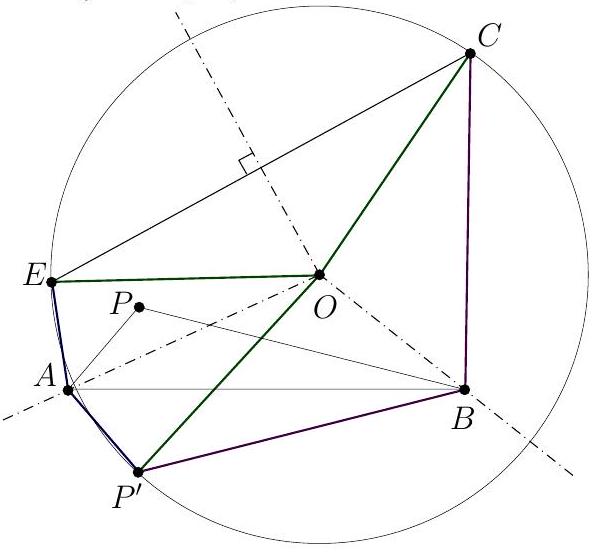
For the equivalence with the collinearity condition, let FF denote the foot of the perpendicular from PP^{\prime} to ABA B, so that FF is the midpoint of PPP P^{\prime}. We have that PP lies on CEC E if and only if FF lies on MNM N, which occurs if and only if we have the equality AFM=BFN\angle A F M = \angle B F N of signed angles modulo π\pi. By concyclicity of APFMA P^{\prime} F M and BFPNB F P^{\prime} N, this is equivalent to APM=BPN\angle A P^{\prime} M = \angle B P^{\prime} N, which occurs if and only if APMA P^{\prime} M and BPNB P^{\prime} N are directly similar.
Figure 2
For the other equivalence with the area condition, we have the equality of signed areas area(ABD)+area(ABP)=area(APBD)=area(APD)+area(BDP)\operatorname{area}(A B D) + \operatorname{area}(A B P) = \operatorname{area}\left(A P^{\prime} B D\right) = \operatorname{area}\left(A P^{\prime} D\right) + \operatorname{area}\left(B D P^{\prime}\right). Using the identity area(ADE)area(APD)=area(ADE)+area(ADP)=2area(ADM)\operatorname{area}(A D E) - \operatorname{area}\left(A P^{\prime} D\right) = \operatorname{area}(A D E) + \operatorname{area}\left(A D P^{\prime}\right) = 2 \operatorname{area}(A D M), and similarly for BB, we find that the area condition is equivalent to the equality
area(DAM)=area(DBN) \operatorname{area}(D A M) = \operatorname{area}(D B N)
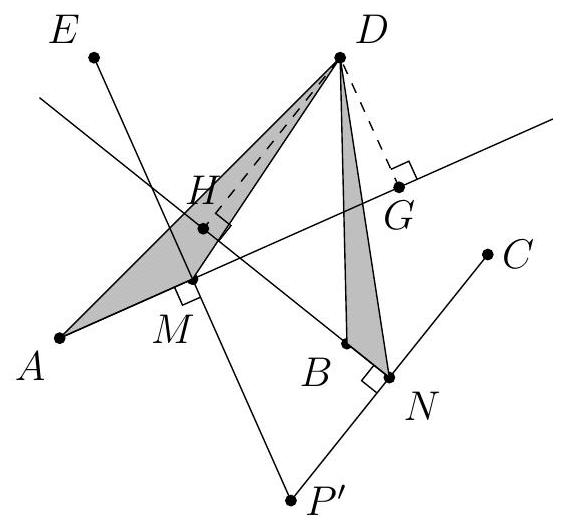
Now note that AA and BB lie on the perpendicular bisectors of PEP^{\prime} E and PCP^{\prime} C, respectively. If we write GG and HH for the feet of the perpendiculars from DD to these perpendicular bisectors respectively, then this area condition can be rewritten as
MAGD=NBHD M A \cdot G D = N B \cdot H D
(In this condition, we interpret all lengths as signed lengths according to suitable conventions: for instance, we orient PEP^{\prime} E from PP^{\prime} to EE, orient the parallel line DHD H in the same direction, and orient the perpendicular bisector of PEP^{\prime} E at an angle π/2\pi / 2 clockwise from the oriented segment PEP^{\prime} E - we adopt the analogous conventions at BB.)
Figure 3
To relate the signed lengths GDG D and HDH D to the triangles APMA P^{\prime} M and BPNB P^{\prime} N, we use the following calculation.
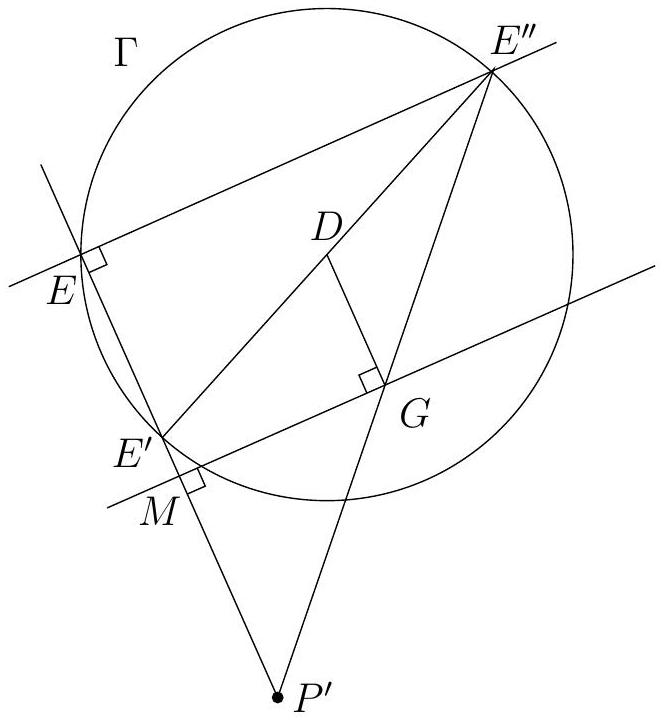
Claim. Let Γ\Gamma denote the circle centred on DD with both EE and CC on the circumference, and hh the power of PP^{\prime} with respect to Γ\Gamma. Then we have the equality
GDPM=HDPN=14h0. G D \cdot P^{\prime} M = H D \cdot P^{\prime} N = \frac{1}{4} h \neq 0 .
Proof. Firstly, we have h0h \neq 0, since otherwise PP^{\prime} would lie on Γ\Gamma, and hence the internal angle bisectors of EDP\angle E D P^{\prime} and PDC\angle P^{\prime} D C would pass through AA and BB respectively. This would violate the angle inequality EDC2ADB\angle E D C \neq 2 \cdot \angle A D B given in the question.
Next, let EE^{\prime} denote the second point of intersection of PEP^{\prime} E with Γ\Gamma, and let EE^{\prime \prime} denote the point on Γ\Gamma diametrically opposite EE^{\prime}, so that EEE^{\prime \prime} E is perpendicular to PEP^{\prime} E. The point GG lies on the perpendicular bisectors of the sides PEP^{\prime} E and EEE E^{\prime \prime} of the right-angled triangle PEEP^{\prime} E E^{\prime \prime}; it follows that GG is the midpoint of PEP^{\prime} E^{\prime \prime}. Since DD is the midpoint of EEE^{\prime} E^{\prime \prime}, we have that GD=12PEG D = \frac{1}{2} P^{\prime} E^{\prime}. Since PM=12PEP^{\prime} M = \frac{1}{2} P^{\prime} E, we have GDPM=14PEPE=14hG D \cdot P^{\prime} M = \frac{1}{4} P^{\prime} E^{\prime} \cdot P^{\prime} E = \frac{1}{4} h. The other equality HDPNH D \cdot P^{\prime} N follows by exactly the same argument.
Figure 4 \square
From this claim, we see that the area condition is equivalent to the equality
(MA:PM)=(NB:PN) \left(M A : P^{\prime} M\right) = \left(N B : P^{\prime} N\right)
of ratios of signed lengths, which is equivalent to direct similarity of APMA P^{\prime} M and BPNB P^{\prime} N, as desired.

Solution 2

Along the perpendicular bisector of CEC E, define the linear function
f(X)=area(BCX)+area(AXE)area(ABX)area(ABP), f(X) = \operatorname{area}(B C X) + \operatorname{area}(A X E) - \operatorname{area}(A B X) - \operatorname{area}(A B P),
where, from now on, we always use signed areas. Thus, we want to show that C,P,EC, P, E are collinear if and only if f(D)=0f(D) = 0.
Figure 5
Let PP^{\prime} be the reflection of PP across line ABA B. The point PP^{\prime} does not lie on the line CEC E. To see this, we let AA^{\prime \prime} and BB^{\prime \prime} be the points obtained from AA and BB by dilating with scale factor 2 about PP^{\prime}, so that PP is the orthogonal projection of PP^{\prime} onto ABA^{\prime \prime} B^{\prime \prime}. Since AA lies on the perpendicular bisector of PEP^{\prime} E, the triangle AEPA^{\prime \prime} E P^{\prime} is right-angled at EE (and BCPB^{\prime \prime} C P^{\prime} similarly). If PP^{\prime} were to lie on CEC E, then the lines AEA^{\prime \prime} E and BCB^{\prime \prime} C would be perpendicular to CEC E and AA^{\prime \prime} and BB^{\prime \prime} would lie on the opposite side of CEC E to DD. It follows that the line ABA^{\prime \prime} B^{\prime \prime} does not meet triangle CDEC D E, and hence point PP does not lie inside CDEC D E. But then PP must lie inside ABCEA B C E, and it is clear that such a point cannot reflect to a point PP^{\prime} on CEC E.
We thus let OO be the centre of the circle CEPC E P^{\prime}. The lines AOA O and BOB O are the perpendicular bisectors of EPE P^{\prime} and CPC P^{\prime}, respectively, so
area(BCO)+area(AOE)=area(OPB)+area(POA)=area(PBOA)=area(ABO)+area(BAP)=area(ABO)+area(ABP) \begin{aligned} \operatorname{area}(B C O) + \operatorname{area}(A O E) & = \operatorname{area}\left(O P^{\prime} B\right) + \operatorname{area}\left(P^{\prime} O A\right) = \operatorname{area}\left(P^{\prime} B O A\right) \\ & = \operatorname{area}(A B O) + \operatorname{area}\left(B A P^{\prime}\right) = \operatorname{area}(A B O) + \operatorname{area}(A B P) \end{aligned}
and hence f(O)=0f(O) = 0.
Notice that if point OO coincides with DD then points A,BA, B lie in angle domain CDEC D E and EOC=2AOB\angle E O C = 2 \cdot \angle A O B, which is not allowed. So, OO and DD must be distinct. Since ff is linear and vanishes at OO, it follows that f(D)=0f(D) = 0 if and only if ff is constant zero - we want to show this occurs if and only if C,P,EC, P, E are collinear.
Figure 6
Figure 7
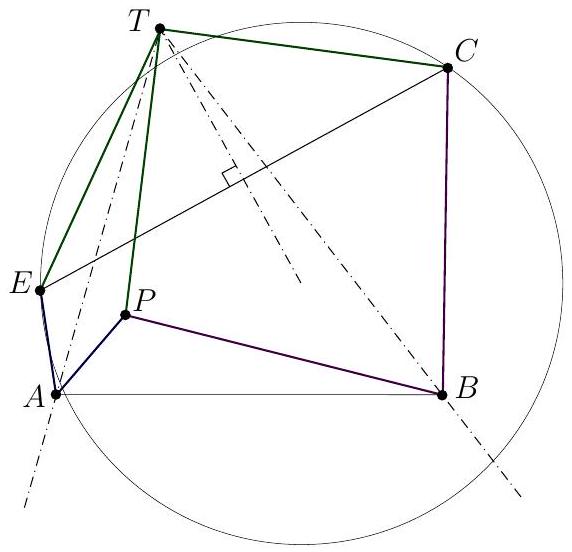
In the one direction, suppose firstly that C,P,EC, P, E are not collinear, and let TT be the centre of the circle CEPC E P. The same calculation as above provides
area(BCT)+area(ATE)=area(PBTA)=area(ABT)area(ABP) \operatorname{area}(B C T) + \operatorname{area}(A T E) = \operatorname{area}(P B T A) = \operatorname{area}(A B T) - \operatorname{area}(A B P)
so
f(T)=2area(ABP)0. f(T) = -2 \operatorname{area}(A B P) \neq 0 .
Hence, the linear function ff is nonconstant with its zero is at OO, so that f(D)0f(D) \neq 0.
In the other direction, suppose that the points C,P,EC, P, E are collinear. We will show that ff is constant zero by finding a second point (other than OO ) at which it vanishes.
Figure 8
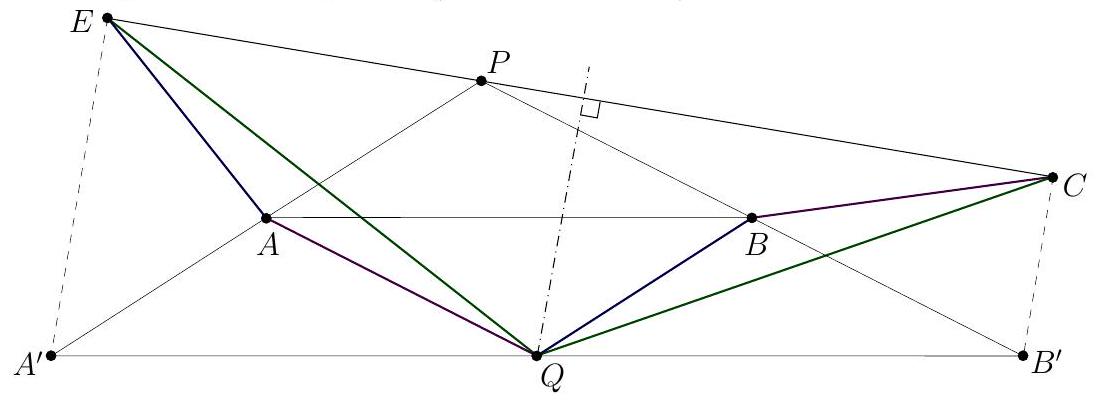
Let QQ be the reflection of PP across the midpoint of ABA B, so PAQBP A Q B is a parallelogram. It is easy to see that QQ is on the perpendicular bisector of CEC E; for instance if AA^{\prime} and BB^{\prime} are the points produced from AA and BB by dilating about PP with scale factor 2, then the projection of QQ to CEC E is the midpoint of the projections of AA^{\prime} and BB^{\prime}, which are EE and CC respectively. The triangles BCQB C Q and AQEA Q E are indirectly congruent, so
f(Q)=(area(BCQ)+area(AQE))(area(ABQ)area(BAP))=00=0. f(Q) = (\operatorname{area}(B C Q) + \operatorname{area}(A Q E)) - (\operatorname{area}(A B Q) - \operatorname{area}(B A P)) = 0 - 0 = 0 .
The points OO and QQ are distinct. To see this, consider the circle ω\omega centred on QQ with PP^{\prime} on the circumference; since triangle PPQP P^{\prime} Q is right-angled at PP^{\prime}, it follows that PP lies outside ω\omega. On the other hand, PP lies between CC and EE on the line CPEC P E. It follows that CC and EE cannot both lie on ω\omega, so that ω\omega is not the circle CEPC E P^{\prime} and QOQ \neq O.
Since OO and QQ are distinct zeroes of the linear function ff, we have f(D)=0f(D) = 0 as desired.

Source: MathNet, licensed CC-BY-4.0. Statement and solution reproduced as published; topic, difficulty and ordering added by this site.