Let be a positive integer. Prove that there exist three permutations ; ; and of such that
for every .
Problem 1828
Official solutions — 3
Solution 1
The idea is to approximate the numbers by the nearest integer with errors . This gives the following sequence
More precisely, for each , we round to , so that there are copies of .
Step 1. We first consider the easier case when has the form
In this case, the numbers are approximated by the elements of the multiset . Let denote "half of" the multiset, i.e.
We will prove by induction that there exists three permutations , and of the elements in the multiset such that is constant for .
When , take . When , take . Suppose that we have constructed three permutations , and of satisfying for every . For , we note that
and also
Here means to add 1 to all elements in . We construct the permutations , ( ), and ( ) of as follows:
- For , we set .
- For with , we set .
It is clear from (1) that , and give three permutations of , and that they satisfy for every .
The inductive construction can be visualised by the matrix
in which the three rows represent the permutations , and the sum of the three entries of each column is .
Thus, when , we can construct permutations , and of such that
This gives
where we used that for positive .
Step 2. We now proceed to the general case. Let be such that
Write for some and let
We will make use of the following inequalities below:
As above, we construct three permutations , and of satisfying (2). Now we construct the three required permutations , and of as follows:
For , if , take , and if , take . For with , set . Define the permutations ( ) and ( ) similarly. Now for , we show . The lower bound is obvious. If , then and hence . If , then
We have similar inequalities for ( ) and ( ). Thus
For , we have
To sum up, we have defined three permutations , and of , such that
holds for every .
Solution 2
This is a variation of Solution 1 that uses induction for Step 2.
Let be an integer satisfying and define the multiset by
In other words, and , where is the set defined in Solution 1.
Claim. There exist three permutations of such that
Proof. We proceed by induction on . If or , the assertion can be proved as in Solution 1. If , we note that
From the hypothesis of induction, it follows that we have three permutations of satisfying for every . We construct the permutations , and of as follows:
- For , we set , and .
- For with , we set if while if , and .
It is clear from the construction that , and give three permutations of , and they satisfy for every .
Again, we can visualise the construction using the matrix
In general, we have for some . Set for some . Then the approximation of by the nearest integer with errors is a multiset
with and .
Since , by using the Claim we can construct permutations ( ), ( ), and to satisfy the following inequality:
Since , it follows that
and so
Solution 3
This solution is based on the geometrical insight of equilateral triangles.
Step 1. We first consider the easier case of triangle numbers
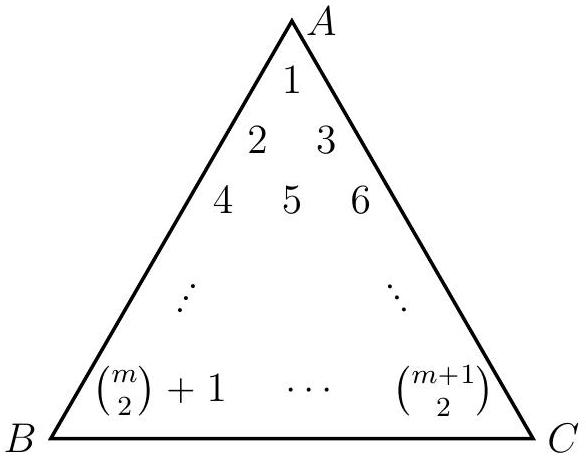
As shown in the following picture, consider the triangular shaped lattice points inside an equilateral triangle with a total of points. The lattice is built in a way that the row has exactly points for each . Rows are numbered in three different ways, one for each vertex.
Each point in the triangular lattice is labelled with a triple of integers as follows. The first coordinate is called the -coordinate, and so on for . To define the -coordinate, denoted , first label the lattice points by starting with the point closest to and then going down the rows with the rule that within a row, the labelling is from left to right (see right picture). The -coordinate, denoted , is defined by rotating the -coordinate counterclockwise by . The -coordinate, denoted , similarly, by rotating the -coordinate counterclockwise by .
Assume that a point lies in the row from the vertex , in the row from the vertex , and in the row from the vertex . Note that is proportional to the height of in the triangle, minus the height of . Since inside an equilateral triangle, the sum of the lengths of the heights from a point to the three sides is independent of the point, we must have
Since there are exactly points in the first rows, the -labeling of the point satisfies
In paticular,
Taking the cyclic sum gives
and thus
Step 2. Now, for a general positive integer , there exists a positive integer such that
Write with . We modify the above construction for points into a construction for points as follows. We remove arbitrary points from the row (namely the bottom row) of the triangular lattice. The remaining triangular lattice has points, and we assign their -, and -coordinates as before (in the same order, yet skipping over the points that are removed so that the coordinates exactly form permutations of ).
For each point in the triangular lattice (that was not removed earlier), suppose that it is in the , and row when viewed from , and , respectively. Now the -coordinates still satisfies
The -coordinate satisfies
because, viewing from point , we have removed either 0 or 1 point from each row, and the first rows have at least points left. For the same reason, the -labeling satisfies
From this, we deduce that
Combining all above with the inequalities and , we deduce that
Therefore, for each point , we have
We may finally order of the points in an arbitrary way. Then the -labelings give the permutation , the -labelings give , and the -labelings give .
For each , we have