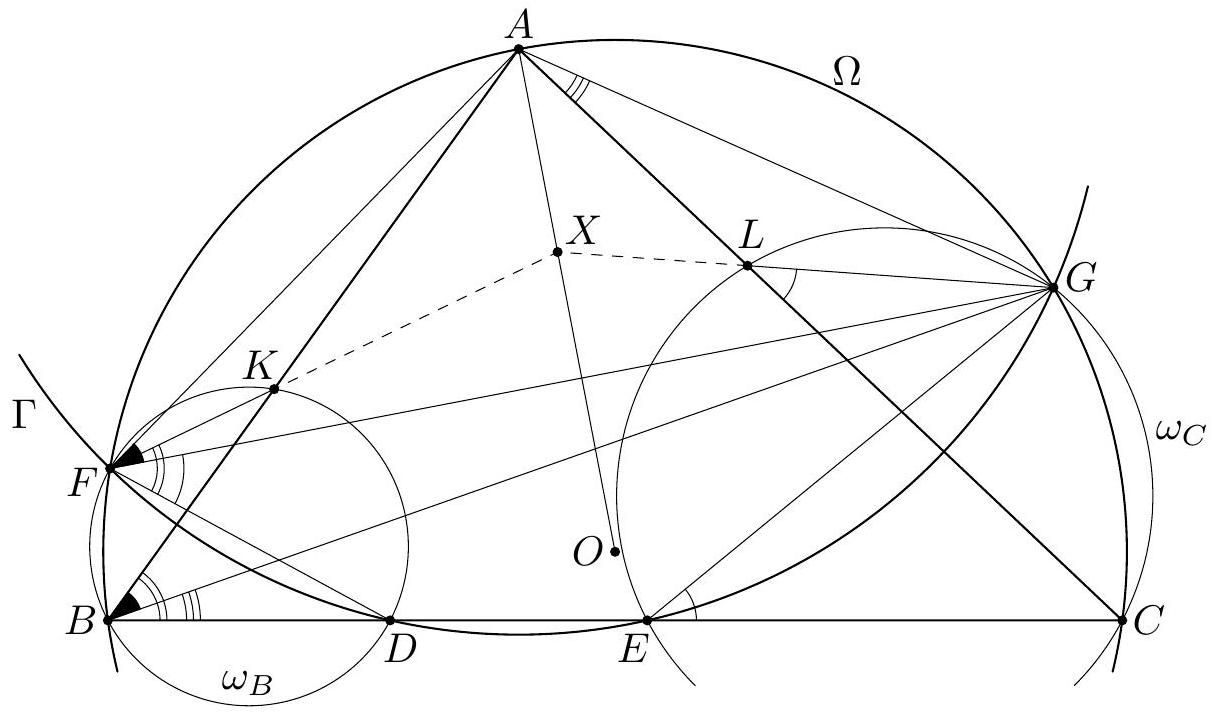
Again, we denote the circumcircle of BDKF by ωB. In addition, we set α=∠BAC, φ=∠ABF, and ψ=∠EDA=∠AED (see Figure 2). Notice that AF=AG entails φ=∠GCA, so all three of α,φ, and ψ respect the "symmetry" between B and C of our configuration. Again, we reduce our task to proving (1).
This time, we start from
2∠KFA=2(∠DFA−∠DFK).
Since the triangle AFD is isosceles, we have
∠DFA=∠ADF=∠EDF−ψ=∠BFD+∠EBF−ψ.
Moreover, because of the circle ωB we have ∠DFK=∠CBA. Altogether, this yields
2∠KFA=∠DFA+(∠BFD+∠EBF−ψ)−2∠CBA,
which simplifies to
2∠KFA=∠BFA+φ−ψ−∠CBA.
Now the quadrilateral AFBC is cyclic, so this entails 2∠KFA=α+φ−ψ.
Due to the "symmetry" between B and C alluded to above, this argument also shows that 2∠AGL=α+φ−ψ. This concludes the proof of (1).
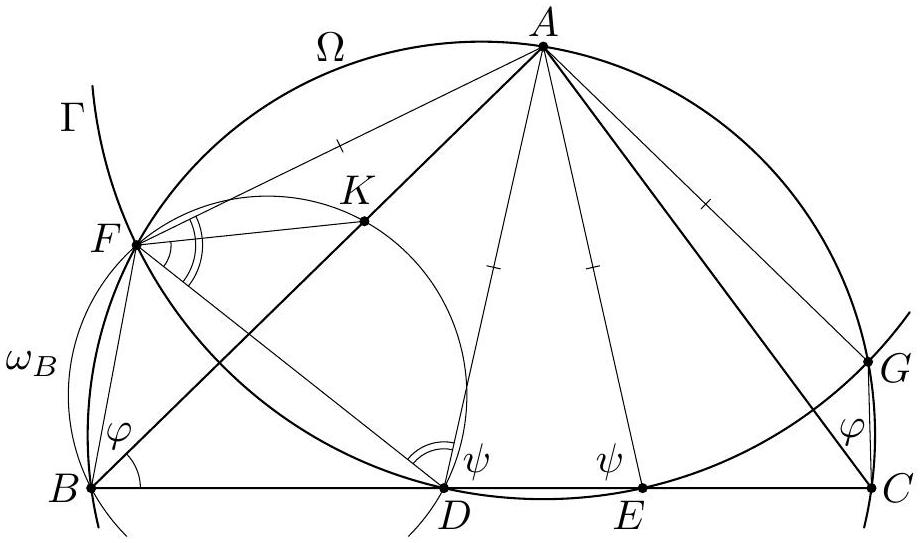
Figure 2