Let be the circumcircle of a triangle , and let be its excircle which is tangent to the segment . Let and be the intersection points of and . Let and be the projections of onto the tangent lines to at and , respectively. The tangent line at to the circumcircle of the triangle intersects the tangent line at to the circumcircle of the triangle at a point . Prove that .
Problem 2522
Official solutions — 2
Solution 1
Let be the point of tangency of and . Let be the point such that is a diameter of . Let be (the unique) point such that and . We shall prove that coincides with .
Let intersect and at and , respectively. Let be the ideal common point of the parallel lines and . Note that the (degenerate) hexagon is circumscribed around , hence by the Brianchon theorem , , and concur at a point which we denote by . Then . It follows that , hence is cyclic. Therefore, . Since , the quadrilateral is cyclic. Hence,
It follows that is tangent to the circle .
Analogous argument shows that is tangent to the circle . Therefore, and .
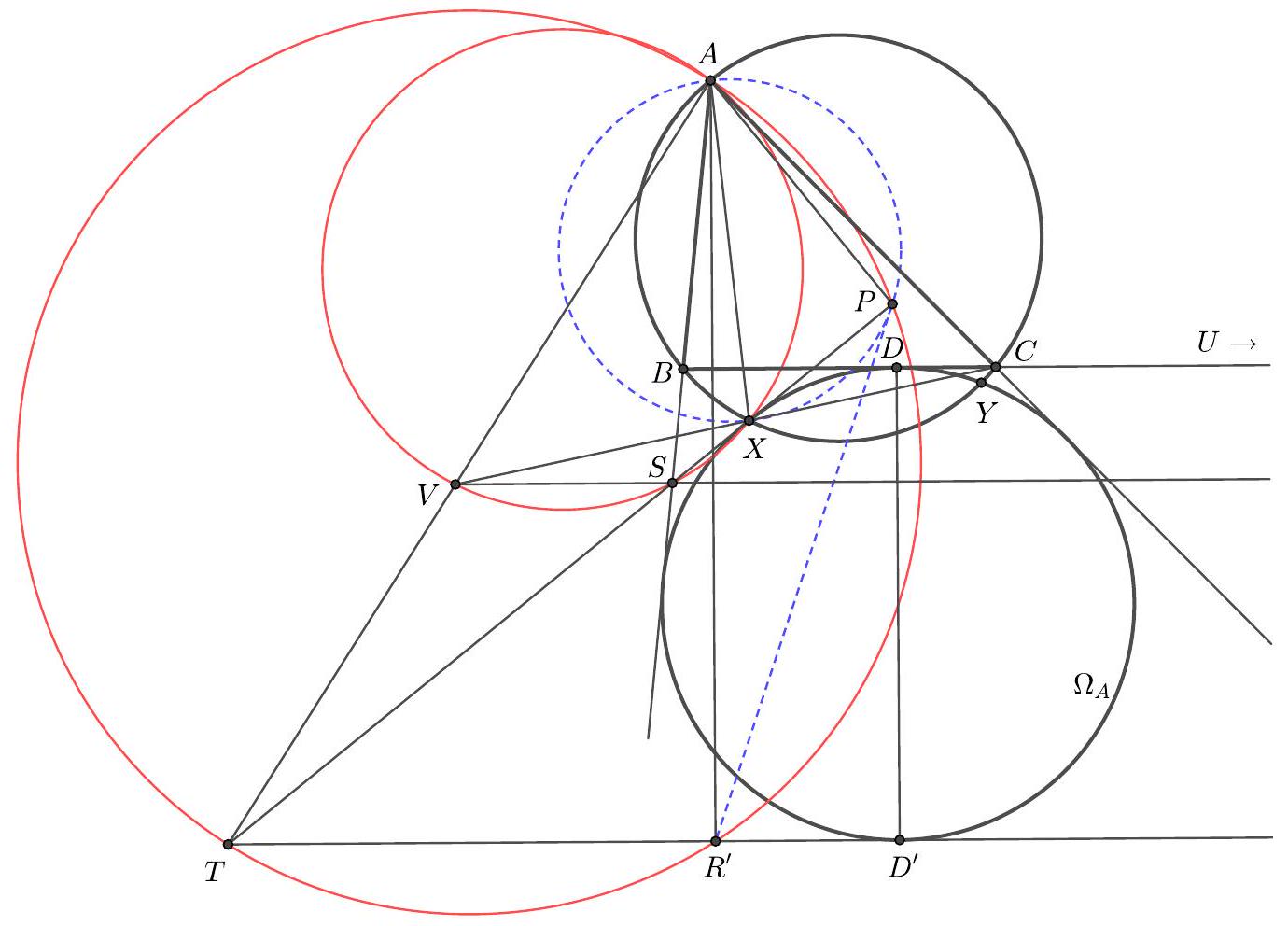
Let intersect again at . Then . Let be a diameter of and let be the midpoint of . Since , we have , so lies on . Let be the point such that is tangent to the circle and . Note that the line is symmetric to the line with respect to .
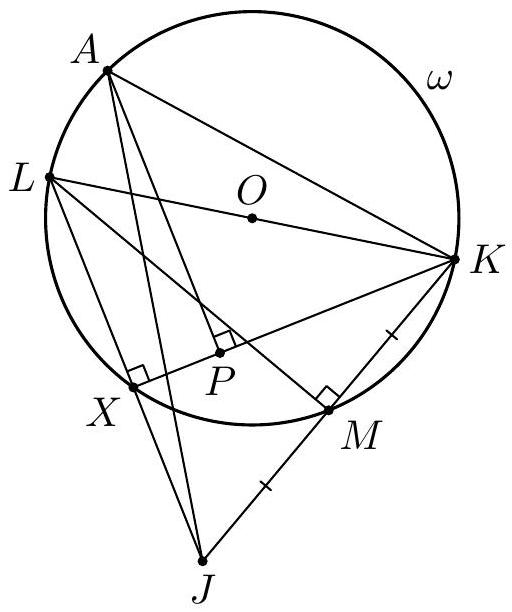
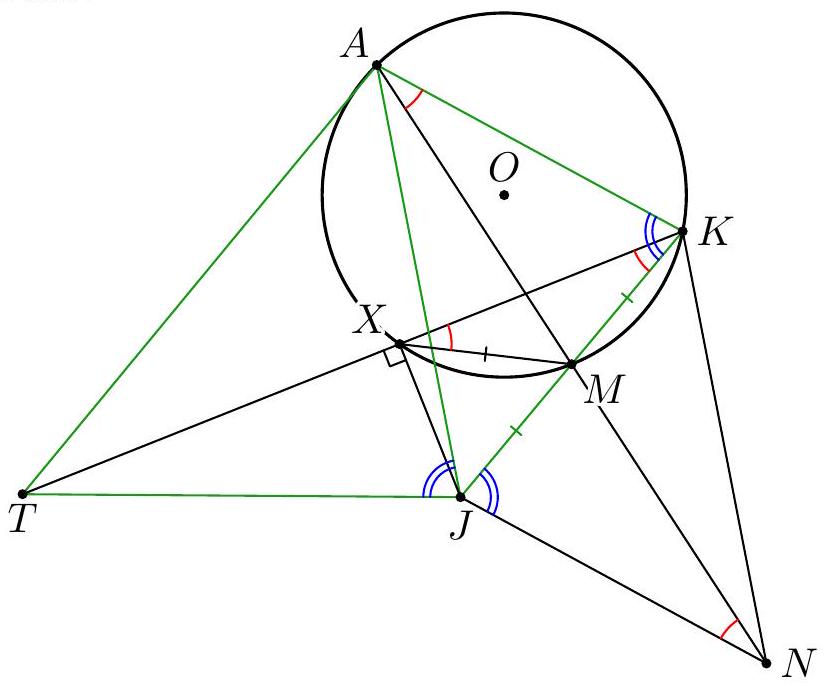
Lemma. Let be the midpoint of the side in a triangle . Let be a point on the circle such that . Then there exists a point on the line such that the triangles and are similar and equioriented.
Proof. Note that . We construct a parallelogram . Let be a point on such that . Then
So there exists a spiral similarity with center mapping the triangle to the triangle . Therefore, the triangles and are similar and equioriented. It follows that the triangles and are similar and equioriented.
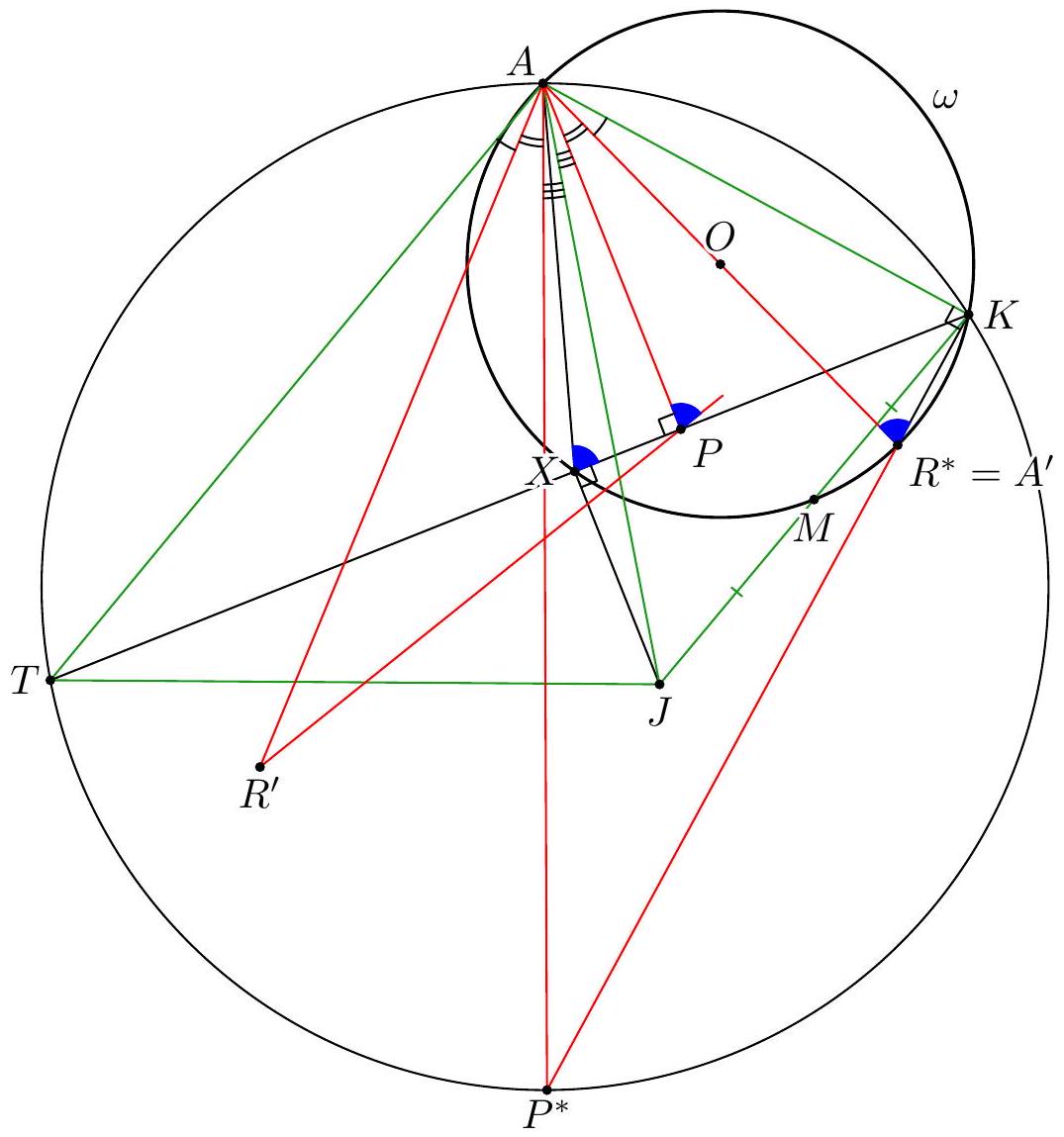
Back to the problem, we construct a point as in the lemma. We perform the composition of inversion with centre and radius and reflection in . It is known that every triangle is similar and equioriented to .
So and . Let and . Observe that is a circle with diameter . Let be a diameter of . Then , so lies on . The triangles and are similar and equioriented, hence
so , and are concyclic. Since and lie on , we obtain . So , and is tangent to the circle .
An identical argument shows that is tangent to the circle . Therefore, and .
Solution 2
Let and be the center and the radius of . Denote the diameter of by and its center by . By Euler's formula, , so the power of with respect to equals .