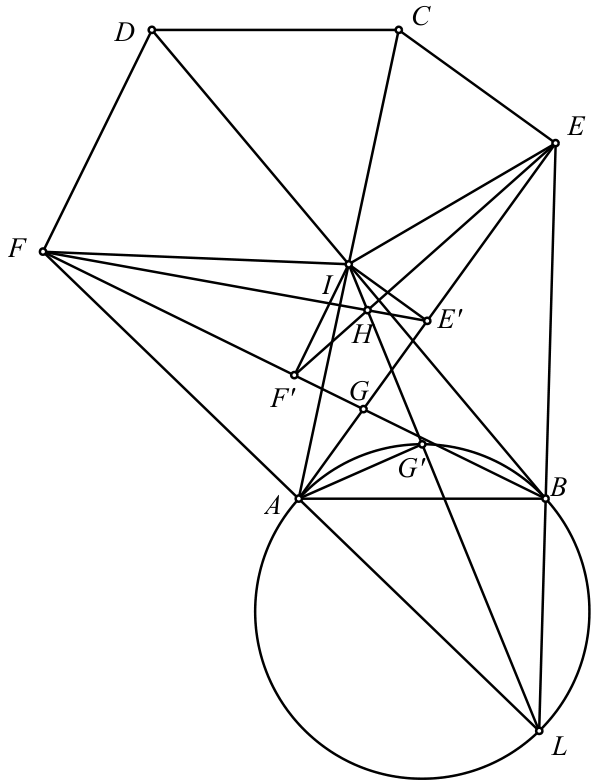
a) Let E′, F′ be the midpoints of AE, BF. Note that triangles DFB and CEA are right at F, E and I is the midpoint of BD and AC then triangles IBF, ICE are isosceles at I. On the other hand, because ∠GAI=∠GBI then △IFB∼△IAE, which implies
∠IE′E=2∠AIE=2∠BIF=∠F′IF
or IE′, IF′ are isogonal with respect to ∠EIF.
Therefore, we get
I(HE′,FE)=E(HE′,FI)=E(F′G,FI)=I(F′G,FE)=I(GF′,EF).
Combining with IE′, IF′ are isogonal with respect to ∠EIF, we obtain that IG, IH are isogonal with respect to ∠EIF, or ∠AIB. Hence, it suffices to show that if AF meets BE at L then IL, IG are isogonal with respect to ∠AIB. It is clear that
△IAF∼⊥△IEB,
then
(LA,LB)≡(IF,IB)≡(IA,IE)(modπ),
which means L lies on (IAE) and (IBF). Let G′ be the intersection of IL and the circumcircle of triangle LAB, we obtain that
∠G′AB=∠G′LB=∠ILB=∠IAE,
which implies that AG, AG′ are isogonal with respect to ∠IAB.
Similarly, we can point out that BG′, BG are isogonal with respect to ∠IBA then G′ is the isogonal conjugate of G in triangle IAB. Hence, IG, IL are isogonal with respect to ∠AIB.
b) Firstly, we will prove the following lemmas
Lemma 1. Denote O to be the circumcenter of triangle GAB then IO,IL are isogonal with respect to ∠AIB.
Proof. The circumcircle of triangle G′AB meets IB,IA at A1,B1 respectively. By angle chasing, we have
∠G′A1I=∠G′LB=∠G′AB=∠GAI.
Note that A1B1 and AB are isogonal with respect to ∠AIB, then
△IG′A1∼△IGA,△IAB∼△IA1B1.
Because O,J are the circumcenters of triangle GAB,G′A1B1 then
△IAB∼△IA1B1,
in which G,O are corresponding to G′,J, implies that IO,IJ are isogonal with respect to ∠AIB. □
Lemma 2. IJ⊥EF and the lines IX,IJ are isogonal with respect to ∠AIB.
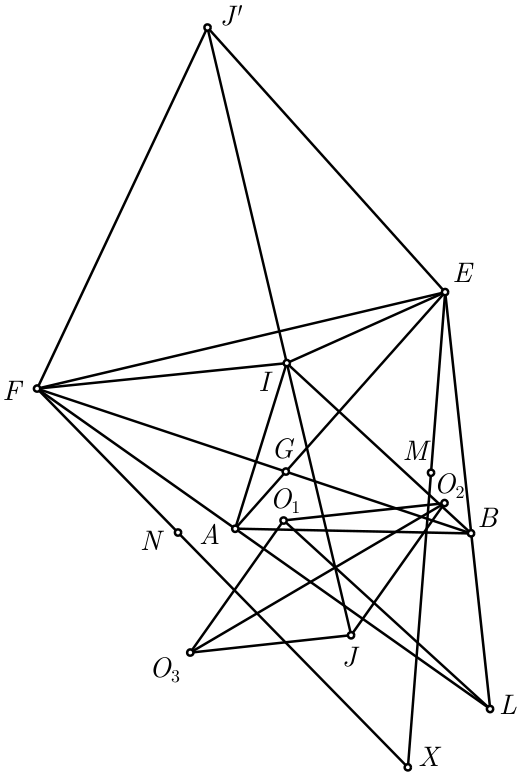
Proof. Let O1,O2 and O3 be the circumcenters of triangles LEF,LAE and LAF. It is clear that
∠O1O2O3=∠ILE=∠IAE=∠IBF=∠ILE=∠JO2O3
or O2O3 is the bisector of ∠O1O2J and LI is the bisector of ∠ELF. Similarly, O3O2 is the bisector ∠O1O3J, hence O1 is the reflection of J with respect to O2O3. On the other hand, because LI is the common chord of (O2) and (O3) then L is the reflection of I with respect to O2O3. Therefore, LIO1J is an isosceles trapezoid, which means the reflection of JI with respect to the bisector LI of ∠LEF passes through the circumcenter of triangle ELF, or IJ⊥EF.
Let J′ be the reflection of J with respect to EF, it is clear that
∠J′FE=∠JFE=90∘−∠IJF=∠NFE=∠XFE
or FJ′, FX are isogonal with respect to ∠IFE. Similarly, EJ′, EX are isogonal with respect to ∠IEF, which means IX, IJ′ are isogonal with respect to ∠EIF or ∠AIB. □
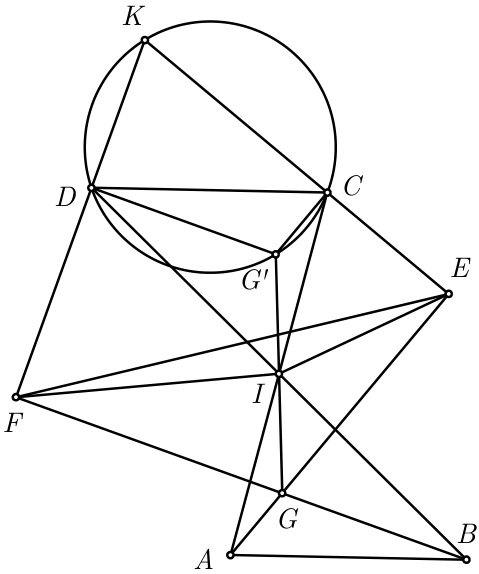
Combining these two lemmas, we obtain that IO passes through X or IO, EM and FN are concurrent. To finish this problem, we need to point out that IO passes through the circumcenter of triangle KCD.
Let G′ be the reflection of G over I, then G′C∥GA or G′C⊥KC. Similarly, G′D⊥KD or G′K is the diameter of (KCD). Therefore, the reflection of G over I lies on (KCD), or (KCD) and (GAB) are symmetric with respect to I, which means IO passes through the circumcenter of triangle KCD. □