An integer is given. We call an -tuple of real numbers Shiny if for each permutation of these numbers we have
Find the largest constant such that
holds for every Shiny -tuple .
Problem 2579
Official solutions — 2
Solution 1
Answer: .
Solution 1. First of all, we show that we may not take a larger constant . Let be a positive number, and take and . Then, every product () is equal to either or . Hence, for every permutation of the , we have
This justifies that the -tuple is Shiny. Now, we have
Thus, as approaches from above, gets arbitrarily close to . This shows that we may not take any larger than . It remains to show that for any Shiny choice of the .
From now onward, assume that is a Shiny -tuple. Let the () be some permutation of the to be chosen later. The indices for will always be taken modulo . We will first split up the sum into expressions, each of the form for some permutation of the , and some leftover terms. More specifically, write
where if is odd, and if is even. We note that for each , there is some permutation of the such that
because we may choose for and for .
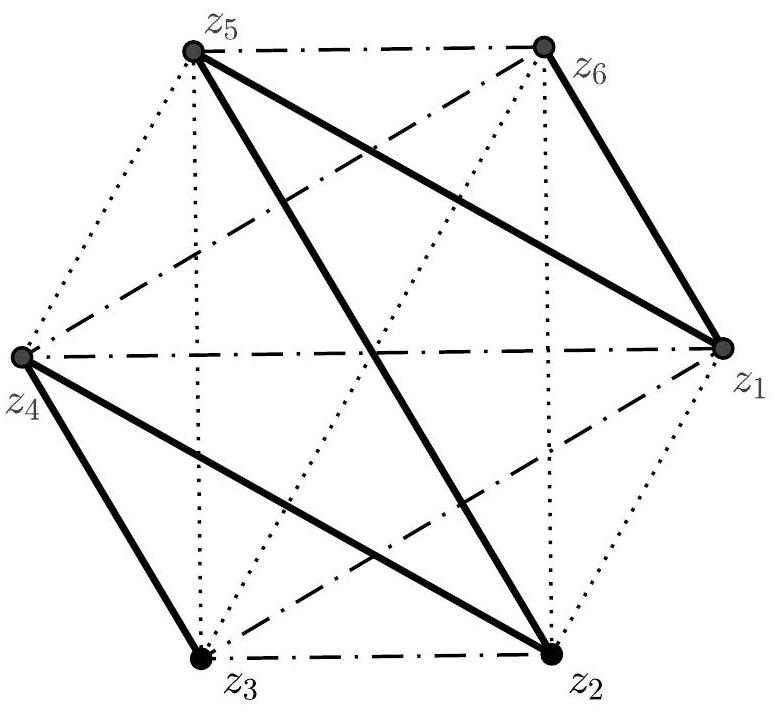
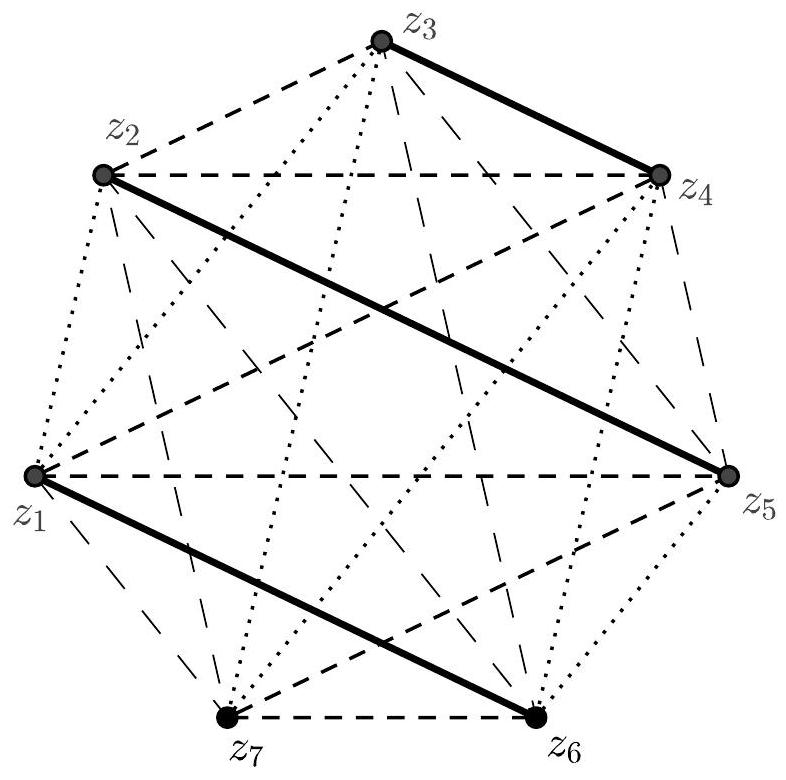
We show (1) graphically for in the diagrams below. The edges of the graphs each represent a product , and the dashed and dotted series of lines represents the sum of the edges, which is of the form for some permutation of the precisely when the series of lines is a Hamiltonian path. The filled edges represent the summands of .
Now, because the are Shiny, we have that (1) yields the following bound:
It remains to show that, for each , there exists some permutation of the such that when is odd, and when is even. We now split into cases based on the parity of and provide constructions of the permutations .
Since we have not made any assumptions yet about the , we may now assume without loss of generality that
## Case 1: is odd.
Without loss of generality, assume that (from (2)) is even, because we may negate all the if is odd. We then have because the factors are of the same sign. Let . We choose our so that this definition of agrees with the sum of the leftover terms in (1). Relabel the as such that
are some permutation of
and . Then, we have , as desired.
Case 2: is even.
Let . Assume without loss of generality . Now, we have
where the first inequality holds because the only negative term in is , the second inequality holds because , and the third inequality holds because the are assumed to be Shiny. We thus have that . We now choose a suitable such that the definition of matches the leftover terms in (1).
Relabel the with in the following manner: , (again taking indices modulo ). We have that
as desired.
Solution 2
We present another proof that for any Shiny -tuple . Assume an ordering of the as in (2), and let . Assume without loss of generality that . Also assume , (as otherwise, all of the are nonpositive, and so the inequality is trivial). Define the sets of indices and . Define the following sums:
By definition, and . We aim to show that .
We split into cases based on whether or .
## Case 1: .
Consider all permutations such that . Note that there are such permutations . Define
We know that for every permutation with the above property. Averaging over all gives
where the equality holds because there are products in , of which are selected for each , and there are products in , of which are selected for each . We now have
Since and , we get the desired inequality.
Case 2: .
We do a similar approach, considering all such that , and defining the same way. Analogously to Case 1, we have
because there are products in , of which are selected for each . Now, we have that
where the last inequality holds because .