Olympiad Maths Prep

Track / Stage 8 / 146 of 180 #1846 of 2000

Problem 1846

IMO Shortlist mid-range; USAMO P2/P5
Geometry Difficulty 8.7 Prove it IMO 3J, Independent Study 1 · Taiwan

Let ABCABC be an acute, scalene triangle with orthocenter HH. Let lal_a be the line through the reflection of BB with respect to CHCH and the reflection of CC with respect to BHBH. Lines lbl_b and lcl_c are defined similarly. Suppose lines la,lbl_a, l_b, and lcl_c determine a triangle. Prove that the orthocenter and circumcenter of this triangle are colinear with HH.

This one wants a proof. Work it on paper, read the official solution, then mark yourself honestly — the ladder only means something if the record is true.

Official solution

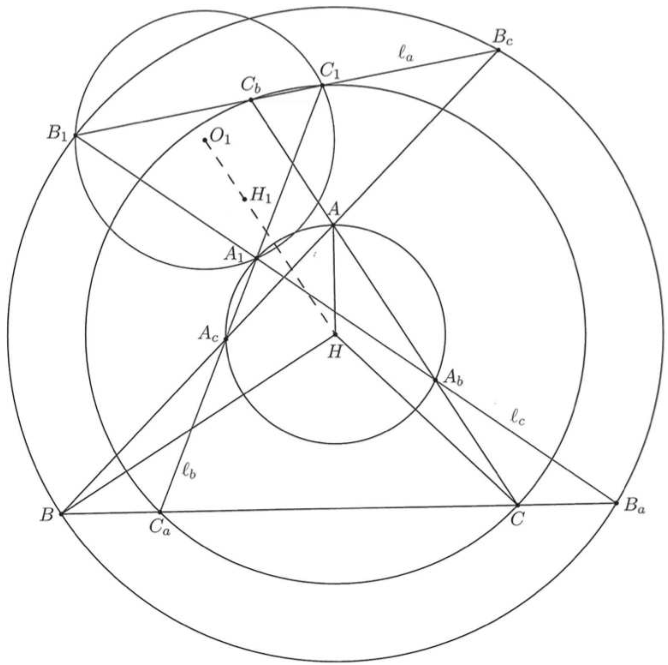
Figure 1
Denote by Ab,AcA_b, A_c the reflections of AA in BHBH and CHCH respectively. Bc,BaB_c, B_a and Ca,CbC_a, C_b are defined similarly. By definition, la=BcCb,lb=CaAc,lc=AbBal_a = B_cC_b, l_b = C_aA_c, l_c = A_bB_a. Let A1=lblc,B1=lcla,C1=lalbA_1 = l_b \cap l_c, B_1 = l_c \cap l_a, C_1 = l_a \cap l_b and let H1,O1H_1, O_1 be the orthocentre and circumcentre of A1B1C1\triangle A_1B_1C_1 respectively.

*Claim 1.* AAbAcABC\triangle AA_bA_c \cong \triangle ABC.
*Proof.* Let P=BHAC,Q=CHABP = BH \cap AC, Q = CH \cap AB, then it is well known that APQABC\triangle APQ \cong \triangle ABC. By the dilation with factor 2 centred at AA, APQ\triangle APQ is sent to AAbAc\triangle AA_bA_c, so we have AAbAcABC\triangle AA_bA_c \cong \triangle ABC.

*Claim 2.* AAbAcABaCa\triangle AA_bA_c \cong \triangle AB_aC_a and A1A_1 lies on the circumcircle of AAbAc\triangle AA_bA_c, which is centred at HH.
*Proof.* Since Ba,CaB_a, C_a are reflections of B,CB, C in AHAH, we have ABaCaABC\triangle AB_aC_a \cong \triangle ABC. Combining this with *Claim 1*, we have AAbAcABaCa\triangle AA_bA_c \cong \triangle AB_aC_a where AA is the centre of this similarity. Therefore, AcA1Ab=AcAAb\angle A_c A_1 A_b = \angle A_c AA_b, meaning A1A_1 lies on AAbAc\odot AA_b A_c. By symmetry, HAb=HA=HAcHA_b = HA = HA_c, so HH is centre of this circle.

*Claim 3.* A1B1C1ABC\triangle A_1 B_1 C_1 \cong \triangle ABC.
*Proof.* From *Claim 2* we have
C1A1B1=AcA1Ab=AcAAb=CAB \angle C_1 A_1 B_1 = \angle A_c A_1 A_b = \angle A_c AA_b = -\angle CAB
and similarly A1B1C1=ABC,B1C1A1=BCA\angle A_1 B_1 C_1 = -\angle ABC, \angle B_1 C_1 A_1 = -\angle BCA, which imply A1B1C1ABC\triangle A_1 B_1 C_1 \cong \triangle ABC.
Denote the ratio of similitude of A1B1C1\triangle A_1 B_1 C_1 and ABC\triangle ABC by λ(=B1C1BC)\lambda(= \frac{B_1 C_1}{BC}), then
λ=H1A1HA=H1B1HB=H1C1HC. \lambda = \frac{H_1 A_1}{HA} = \frac{H_1 B_1}{HB} = \frac{H_1 C_1}{HC}.
Since HA=HA1HA = HA_1 and similarly HB=HB1,HC=HC1HB = HB_1, HC = HC_1 from *Claim 2*, we get
λ=H1A1HA1=H1B1HB1=H1C1HC1. \lambda = \frac{H_1 A_1}{HA_1} = \frac{H_1 B_1}{HB_1} = \frac{H_1 C_1}{HC_1}.
Therefore, the circle A1B1C1A_1 B_1 C_1 is the Apollonian circle of the segment HH1HH_1 with ratio λ\lambda so the line HH1HH_1 passes through O1O_1.

Source: MathNet, licensed CC-BY-4.0. Statement and solution reproduced as published; topic, difficulty and ordering added by this site.