Olympiad Maths Prep

Track / Stage 8 / 95 of 180 #1795 of 2000

Problem 1795

IMO Shortlist mid-range; USAMO P2/P5
Geometry Difficulty 8.3 Prove it Selection tests for the Balkan Mathematical Olympiad 2013 · Saudi Arabia · 2013

ABCDABCD is a cyclic quadrilateral and ω\omega its circumcircle. The perpendicular line to ACAC at DD intersects ACAC at EE and ω\omega at FF. Denote by \ell the perpendicular line to BCBC at FF. The perpendicular line to \ell at AA intersects \ell at GG and ω\omega at HH. Line GEGE intersects FHFH at II and CDCD at JJ. Prove that points CC, FF, II, and JJ are concyclic.

This one wants a proof. Work it on paper, read the official solution, then mark yourself honestly — the ladder only means something if the record is true.

Official solution

To prove that CC, FF, II, and JJ are concyclic, it is equivalent to prove that CFI=CJI\angle CFI = \angle CJI or CFI+CJI=180\angle CFI + \angle CJI = 180^{\circ}, depending on the configuration. We will present here the proof for one configuration. The proof for the other configuration is similar.
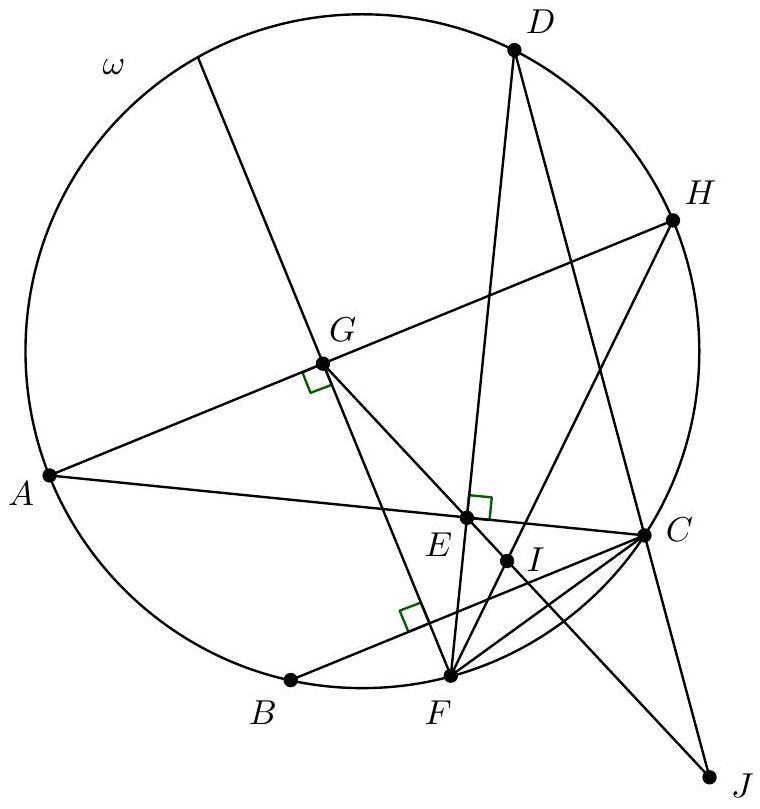
Figure 1

Because AFCHAFCH is cyclic, we have CFI=CAH\angle CFI = \angle CAH.

Because FEA=FGA=90\angle FEA = \angle FGA = 90^{\circ}, the quadrilateral AFEGAFEG is cyclic, and therefore CAH=EFG\angle CAH = \angle EFG.

It remains to prove that EFG=DJG\angle EFG = \angle DJG, which is equivalent to proving that quadrilateral DGFJDGFJ is cyclic.

But EGF=EAF\angle EGF = \angle EAF since AFEGAFEG is cyclic. On the other hand, because AFCDAFCD is cyclic, we deduce that EAF=CDF\angle EAF = \angle CDF. Therefore, EGF=CDF\angle EGF = \angle CDF, which proves that DGFJDGFJ is cyclic.

Source: MathNet, licensed CC-BY-4.0. Statement and solution reproduced as published; topic, difficulty and ordering added by this site.