Suppose there are 101 persons sitting around a round table in an arbitrary order. The th person possesses pieces of cards, . We call it a transition if one transits one of his cards to one of his adjacent persons. Find the minimum positive number , such that whatever the order of the seating, there is a way of no more than transitions so that each person possesses 51 cards.
Problem 2564
Official solution
The answer is .
Let the circumference of the table be 101, and the distance between two adjacent persons be 1. In the following, we consider the least transition times.
Denote the person who initially possesses cards by . So, if , then we can think of person as the source who should send out cards; and if , person is the sink who should receive cards.
Suppose that at the end of transitions, each person has 51 cards. If person possesses a card initially belonging to person , we can think that carries card to by passing through the minor arc , the length of the route is the arc length means the times of transitions.
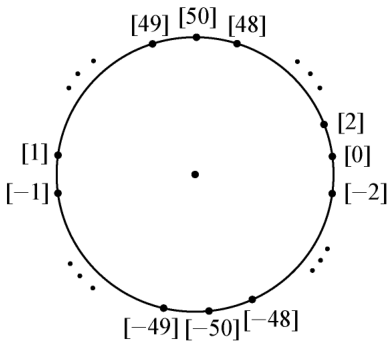
Let seating order be as shown in the figure. Person transits all his cards to person () with route length . So there are all together transitions. In the following, we will show that no less transitions can meet the requirement if persons are seated in this way.
We use the notion of "potential". Let potential at the highest position be 50; the neighbor positions and each has potential 49, . . . , the lowest position and each has potential 0. Then, the total potential at the beginning is
And at the end of transitions, the total potential is
The difference is .
Since after each transition, the total potential changes at most 1, so at least 42,925 transitions are needed.
In the following, we show that whatever be the order of seating, there is always a way of no more than 42,925 transitions such that each person possesses 51 cards. To show this, we give two lemmas.
Lemma 1. Let be integers with their sum zero, and , . If persons denoted by , possess and cards, respectively, where is a positive integer, such that . Let the persons stand on 0, 1, ..., of the number axis, such that stands at . Then there is a way of no more than transitions, such that each person possesses cards.
Proof of Lemma 1. Suppose that , then induction on . If , then passes cards to , such that obtains cards (). Suppose that person stands at (), then is a permutation of 0, 1, ..., . Thus, a card that passes from to needs transitions. So the total transitions needed are
Now suppose that the conclusion is true for integers smaller than . Consider the case of integer . Suppose that
Then there is a person in , ..., and a person in , ..., such that their distance is no more than . We may suppose that the distance between and is no more than , then let person pass a card to by no more than transitions. Next, by induction on and
we see that by taking no more than
transitions, each person possesses cards. Addition of the transitions of card , we know that there are no more than
transitions. The proof of Lemma 1 is completed.
Lemma 2. For any permutation of , , ..., , on a circle, there always exists a person , denote the line passing through and the origin by , such that the sum of each side of (include ) in the brackets has the same sign of .
Proof of Lemma 2. Let the permutation on the circle be , , ..., clockwise. Then there is a directed diameter of the circle such that , , ..., are on one side of and , , ..., are on the other side.
If , then take ; else, if , then the sums of each side of have different sign. If we rotate 180° clockwise, we see that the sum of each side changes sign. So there exists a which meets the requirement of Lemma 2.
Take in Lemma 2. Suppose that (else change each by and change all the directions of the arc). Let , such that the sum of and the numbers on one side of (not include ) is zero. Denote 50 numbers on this side by , and denote 50 numbers on the other side by . Then the sum of and is also zero. Using Lemma 1 to and , respectively, we obtain that the transition times are no more than
Since is a permutation of , by the order inequality
Summing up, the least positive integer .