Maths Olympiad Prep

Track / Stage 7 / 207 of 300 #1607 of 1964

Problem 1607

National olympiad second round; IMO P1/P4
Combinatorics Difficulty 7.4 Prove it China Southeastern Mathematical Olympiad · China

Suppose that 12 acrobats labeled 111212 are divided into two circles AA and BB, with six persons in each. Let each acrobat in BB stand on the shoulders of two adjacent acrobats of AA. We call it a tower if the label of each acrobat of BB is equal to the sum of the labels of the acrobats under his feet. How many different towers can they make?

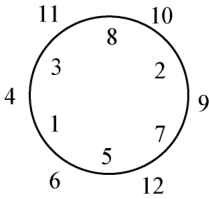
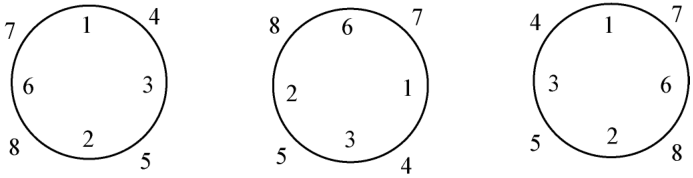
(Remark. We treat two towers as the same if one can be obtained by rotation or reflection of the other. For example, the following towers are the same, where the labels inside the circle refer to the bottom acrobat, the labels outside the circle refer to the upper acrobat.)

Figure 1

This one wants a proof. Work it on paper, then read the official solution and mark yourself. Be honest about it: the record is only any use to you if it is.

Official solution

Denote the sum of labels of AA and BB by xx and yy, respectively. Then y=2xy = 2x. Thus, we have
3x=x+y=1+2++12=78,x=26. 3x = x + y = 1 + 2 + \cdots + 12 = 78, \quad x = 26.
Obviously, 1,2A1, 2 \in A and 11,12B11, 12 \in B. Denote A={1,2,a,b,c,d}A = \{1, 2, a, b, c, d\}, where a<b<c<da < b < c < d. Then a+b+c+d=23a + b + c + d = 23, and a3a \ge 3, 8d108 \le d \le 10 (if d7d \le 7, then a+b+c+d4+5+6+7=22a + b + c + d \le 4 + 5 + 6 + 7 = 22, which is a contradiction.)

(1) If d=8d = 8, then A={1,2,a,b,c,8}A = \{1, 2, a, b, c, 8\}, c7c \le 7, a+b+c=15a + b + c = 15. Thus, (a,b,c)=(3,5,7)(a, b, c) = (3, 5, 7) or (4,5,6)(4, 5, 6), that is, A={1,2,3,5,7,8}A = \{1, 2, 3, 5, 7, 8\} or A={1,2,4,5,6,8}A = \{1, 2, 4, 5, 6, 8\}.

If A={1,2,3,5,7,8}A = \{1, 2, 3, 5, 7, 8\}, then B={4,6,9,10,11,12}B = \{4, 6, 9, 10, 11, 12\}. Since BB contains 11,4,611, 4, 6 and 1212, there is only one tower that, in AA, 88 and 33, 33 and 11, 11 and 55, 55 and 77 are adjacent.

Figure 2

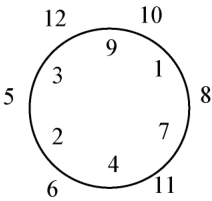
If A={1,2,4,5,6,8}A = \{1, 2, 4, 5, 6, 8\}, then B={3,7,9,10,11,12}B = \{3, 7, 9, 10, 11, 12\}. Similarly, we see that, in AA, 11 and 22, 55 and 66, 44 and 88 are adjacent, respectively. There are two arrangements, that is, there are two towers.
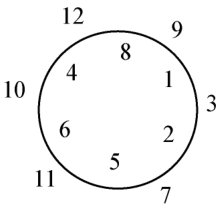
Figure 3
Figure 4

(2) If d=9d = 9, then A={1,2,a,b,c,9}A = \{1, 2, a, b, c, 9\}, c8c \le 8, a+b+c=14a + b + c = 14, where (a,b,c)=(3,5,6)(a, b, c) = (3, 5, 6) or (3,4,7)(3, 4, 7), that is, A={1,2,3,5,6,9}A = \{1, 2, 3, 5, 6, 9\} or A={1,2,3,4,7,9}A = \{1, 2, 3, 4, 7, 9\}.

If A={1,2,3,5,6,9}A = \{1, 2, 3, 5, 6, 9\}, then B={4,7,8,10,11,12}B = \{4, 7, 8, 10, 11, 12\}. To obtain 44, 1010 and 1212 in BB, 11, 33, and 99 in AA must be adjacent pairwise, it is impossible!

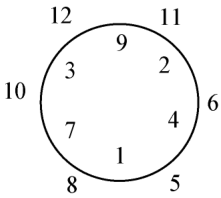
Figure 5
Figure 6

If A={1,2,3,4,7,9}A = \{1, 2, 3, 4, 7, 9\}, then B={5,6,8,10,11,12}B = \{5, 6, 8, 10, 11, 12\}. To obtain 66, 88 and 1212 in BB, 22 and 44, 11 and 77, 99 and 33 must be adjacent in AA, respectively. There are two arrangements, that is, there are two towers.
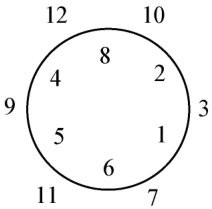
(3) If d=10d = 10, then A={1,2,a,b,c,10}A = \{1, 2, a, b, c, 10\}, where c9c \le 9, a+b+c=13a + b + c = 13. Thus, (a,b,c)=(3,4,6)(a, b, c) = (3, 4, 6), that is, A={1,2,3,4,6,10}A = \{1, 2, 3, 4, 6, 10\} and B={5,7,8,9,11,12}B = \{5, 7, 8, 9, 11, 12\}. To obtain 88, 99, 1111 and 1212 in BB, 66 and 22, 66 and 33, 1010 and 11, 1010 and 22 must be adjacent, respectively. There is only one tower.
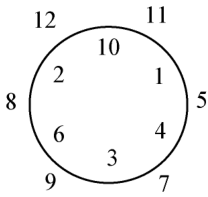
Figure 7

Summing up, there are six different towers all together. ☐
Source: MathNet, licensed CC-BY-4.0. Statement and solution reproduced as published; topic, difficulty and ordering added by this site.