Olympiad Maths Prep

Track / Stage 9 / 50 of 80 #1930 of 2000

Problem 1930

IMO P2/P5; hard shortlist
Geometry Difficulty 9.1 Prove it VN IMO Booklet · Vietnam

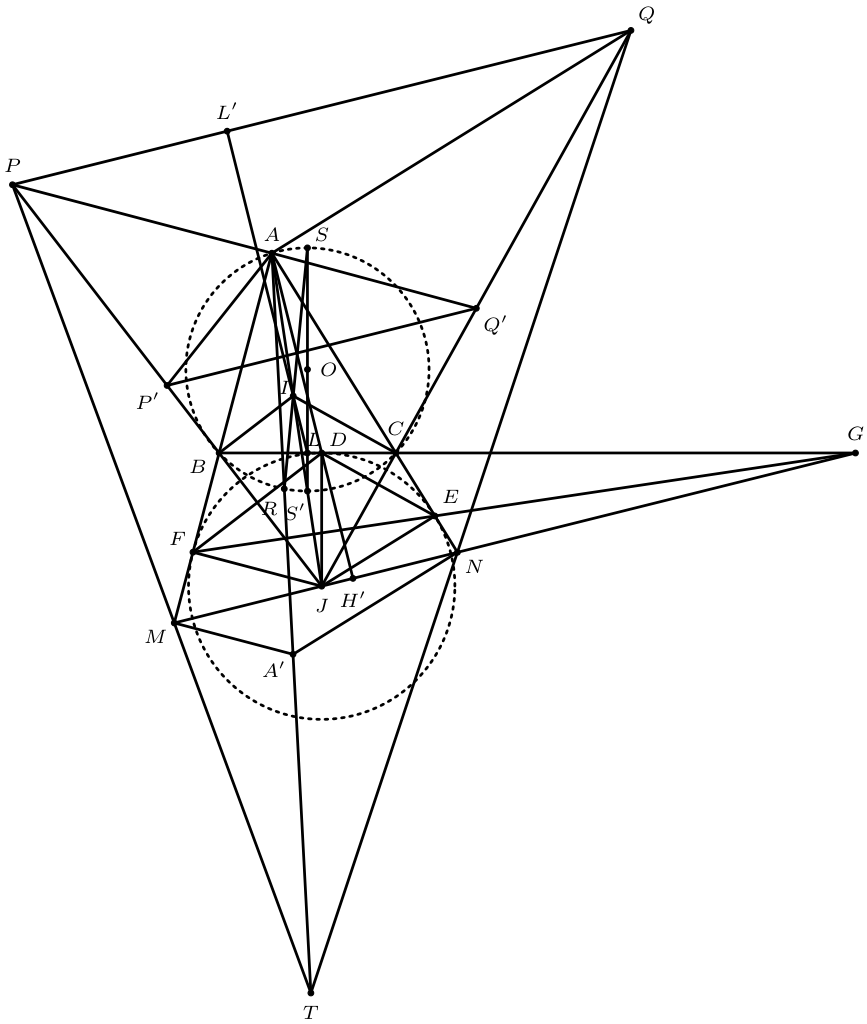
Let ABCABC be a triangle with circumcircle (O)(O), incircle (I)(I), and excircle (J)(J) with respect to vertex AA. Consider D,E,FD, E, F to be the tangent points of (J)(J) with BC,CA,ABBC, CA, AB, respectively.

a. Let LL be the midpoint of BCBC. The circle with diameter LJLJ intersects DE,DFDE, DF again at K,HK, H, respectively. Prove that the circles (BDK)(BDK) and (CDH)(CDH) meet again at a point on circle (J)(J).

b. Assume that EFEF intersects BCBC at GG. Let M,NM, N be the intersections of GJGJ with AB,ACAB, AC, respectively. Consider P,QP, Q on JB,JCJB, JC respectively such that PAB=QAC=90\angle PAB = \angle QAC = 90^\circ. Denote TT as the intersection of PM,QNPM, QN and SS as the midpoint of the major arc BCBC of (O)(O). Prove that SI,ATSI, AT intersect at a point on the circle (O)(O).

This one wants a proof. Work it on paper, read the official solution, then mark yourself honestly — the ladder only means something if the record is true.

Official solution

(a) Denote (I)(I) as the incircle of triangle ABCABC. Let D,FD', F' be the tangent points of (I)(I) with BC,BABC, BA. DWDW is the diameter of (J)(J). We have
AIAJ=IFJF=IDJW \frac{AI}{AJ} = \frac{IF'}{JF} = \frac{ID'}{JW}
hence A,D,WA, D', W are collinear. Denote D1D_1 as the intersection of IDID' and ADAD. We have JD=JWJD = JW, so ID=ID1ID' = ID_1. Moreover, BD=CDBD' = CD then LD=LDLD = LD', therefore ILDD1IL \parallel DD_1.

Let XX be the midpoint of DWD'W. It is easy to see that DLXJDLXJ is a rectangle. Thus XHD=90\angle XHD = 90^\circ, and XHJBXH \parallel JB. Then we have XHBIXH \perp BI.

Construct a rectangle CDJUCDJU. We have JUCDJU \parallel CD and JU=CDJU = CD, hence JUBDJU \parallel BD' and JU=BDJU = BD'. Then BDUJBD'UJ is a parallelogram. We conclude that DUXHD'U \parallel XH.

Let Y,V,ZY, V, Z be the intersection points of XHXH with DJ,UW,UCDJ, UW, UC, respectively. Notice that VV is the midpoint of UWUW, and combined with UZYWUZ \parallel YW, then VV is the midpoint of YZYZ.

The cyclic quadrilateral CEUJCEUJ has CE=CD=UJCE = CD = UJ, so UECJUE \parallel CJ and UEDEUE \perp DE. Moreover, EWEDEW \perp ED then W,UW, U and EE are collinear.

Triangles BICBIC and YVWYVW have
YWV=CED=ICB \angle YWV = \angle CED = \angle ICB
and
WYV=XYJ=BJD=IBC \angle WYV = \angle XYJ = \angle BJD = \angle IBC
then BICYVW\triangle BIC \sim \triangle YVW (a-a). But V,LV, L are midpoints of segments YZ,BCYZ, BC respectively, therefore BILYZW\triangle BIL \sim \triangle YZW (s-a-s). Hence YWZ=BLI=BDA=90WDU\angle YWZ = \angle BLI = \angle BDA = 90^\circ - \angle WDU'. Let UU' be the intersection of WZWZ and ADAD, then DUW=90\angle DU'W = 90^\circ. Moreover, we have DUW=DUZ=90\angle DU'W = \angle DU'Z = 90^\circ. Thus UU' lies on (CDH)(CDH) and (J)(J).

Analogously, (BDK)(BDK) passes through UU'. This completes the proof of this part.

(b) Let S,RS', R be the second intersection points of AI,SIAI, SI with (O)(O). We have SI2=SLSSS'I^2 = S'L \cdot S'S then SIL=SSI=SAR\angle S'IL = \angle S'SI = \angle SAR. But we have ILADIL \parallel AD so SIL=SAD\angle S'IL = \angle S'AD. Then we conclude that SAR=SAD\angle S'AR = \angle S'AD and BAR=CAD\angle BAR = \angle CAD.

Construct DHJGDH' \perp JG (HJGH' \in JG). It is easy to see that GHGJ=GD2=GEGFGH' \cdot GJ = GD^2 = GE \cdot GF then EFJHEFJH' is a cyclic quadrilateral. We also have AEJFAEJF is cyclic, so A,E,F,JA, E, F, J are HH' concyclic. Therefore AHJ=90\angle AH'J = 90^\circ and A,D,HA, D, H' are collinear.

On the other hand, we have PAJ=QAJ=90+12BAC=BIC\angle PAJ = \angle QAJ = 90^\circ + \frac{1}{2}\angle BAC = \angle BIC and IBC=IJC\angle IBC = \angle IJC, ICB=IJB\angle ICB = \angle IJB then IBCAPJAJQ\triangle IBC \sim \triangle APJ \sim \triangle AJQ (a-a).

Denote P,QP', Q' as midpoints of JP,JQJP, JQ then IBLAPPAJQ\triangle IBL \sim \triangle APP' \sim \triangle AJQ' and ICLAQQ\triangle ICL \sim \triangle AQQ'. Therefore A,P,J,QA, P', J, Q' are concyclic. Let LL' be the intersection of LILI and PQPQ. With BLI=JAQ=JPQ=BPQ\angle BLI = \angle JAQ' = \angle JP'Q' = \angle BPQ, we have P,B,I,LP, B, I, L' are concyclic. We also have PBI=90\angle PBI = 90^\circ therefore ILPQIL \perp PQ. Moreover, ILADIL \parallel AD and ADMNAD \perp MN then MNPQMN \parallel PQ.

Consider AATA' \in AT such that MAATMA' \parallel AT. Notice that
TATA=TMTP=TNTQ, \frac{TA'}{TA} = \frac{TM}{TP} = \frac{TN}{TQ},
so NAAQNA' \parallel AQ, then AMA=ANA=90\angle AMA' = \angle ANA' = 90^\circ.

Thus BAR=BAT=90AAM=90ANM=CAD\angle BAR = \angle BAT = 90^\circ - \angle AA'M = 90^\circ - \angle ANM = \angle CAD. Then A,R,TA, R, T are collinear, the proof is complete.
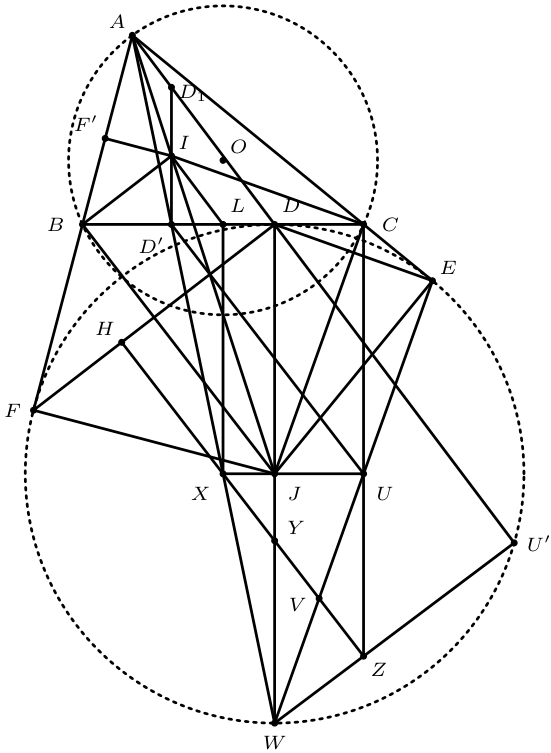
Figure 1

Figure 2

Source: MathNet, licensed CC-BY-4.0. Statement and solution reproduced as published; topic, difficulty and ordering added by this site.