Throughout the solution, triangles AA1D1,BB1A1,CC1B1, and DD1C1 will be referred to as border triangles. We will denote by [R] the area of a region R.
First, we show that k≥1. Consider a triangle ABC with unit area; let A1,B1,K be the midpoints of its sides AB,BC,AC, respectively. Choose a point D on the extension of BK, close to K. Take points C1 and D1 on sides CD and DA close to D (see Figure 1). We have [BB1A1]=41. Moreover, as C1,D1,D→K, we get [A1B1C1D1]→[A1B1K]=41, [AA1D1]→[AA1K]=41, [CC1B1]→[CKB1]=41 and [DD1C1]→0. Hence, the sum of the two smallest areas of border triangles tends to 41, as well as [A1B1C1D1]; therefore, their ratio tends to 1, and k≥1.
We are left to prove that k=1 satisfies the desired property.
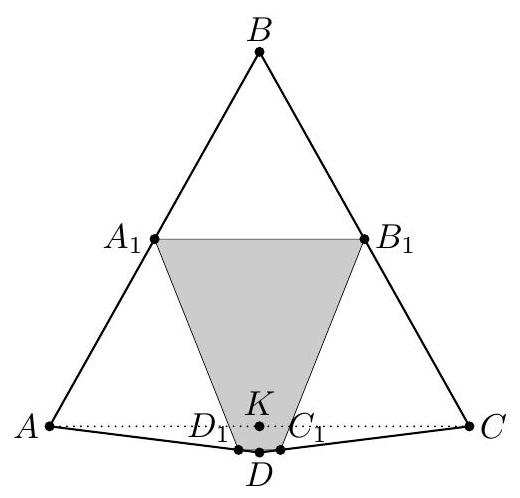
Figure 1
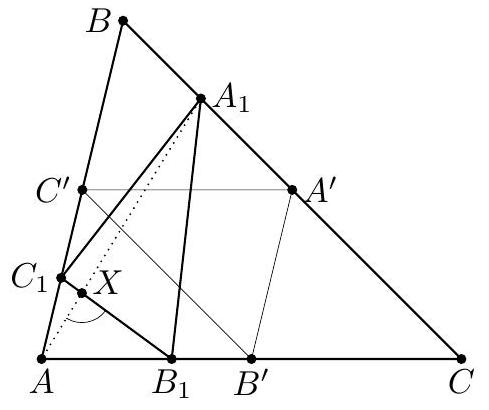
Figure 2
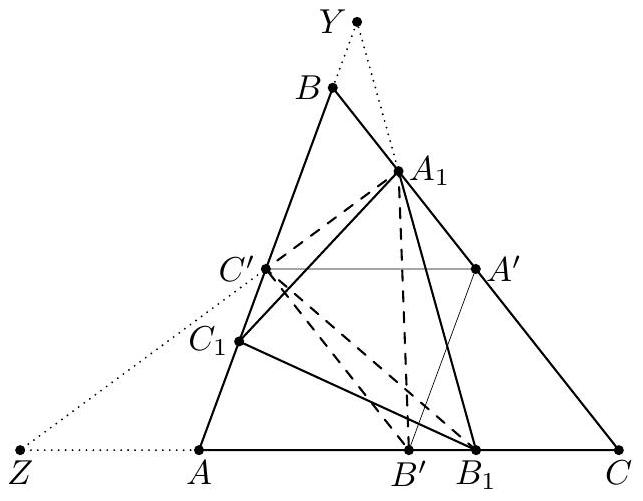
Figure 3
Lemma. Let points A1,B1,C1 lie respectively on sides BC,CA,AB of a triangle ABC. Then [A1B1C1]≥min{[AC1B1],[BA1C1],[CB1A1]}.
Proof. Let A′,B′,C′ be the midpoints of sides BC,CA and AB, respectively.
Suppose that two of points A1,B1,C1 lie in one of triangles AC′B′, BA′C′, and CB′A′. (For convenience, let points B1 and C1 lie in triangle AC′B′; see Figure 2.) Let segments B1C1 and AA1 intersect at point X. Then X also lies in triangle AC′B′. Hence A1X≥AX, and we have
[AC1B1][A1B1C1]=21AX⋅B1C1⋅sin∠AXB121A1X⋅B1C1⋅sin∠A1XC1=AXA1X≥1,
as required.
Otherwise, each one of triangles AC′B′, BA′C′, CB′A′ contains exactly one of points A1, B1, C1, and we can assume that BA1<BA′, CB1<CB′, AC1<AC′ (see Figure 3). Then lines B1A1 and AB intersect at a point Y on the extension of AB beyond point B, hence [A1B1C′][A1B1C1]=C′YC1Y>1; also, lines A1C′ and CA intersect at a point Z on the extension of CA beyond point A, hence [A1B′C′][A1B1C′]=B′ZB1Z>1. Finally, since A1A′∥B′C′, we have [A1B1C1]>[A1B1C′]>[A1B′C′]=[A′B′C′]=41[ABC].
Now, from [A1B1C1]+[AC1B1]+[BA1C1]+[CB1A1]=[ABC] we obtain that one of the remaining triangles AC1B1,BA1C1,CB1A1 has an area less than 41[ABC], so it is less than [A1B1C1]. □
Now we return to the problem. We say that triangle A1B1C1 is small if [A1B1C1] is less than each of [BB1A1] and [CC1B1]; otherwise this triangle is big (the similar notion is introduced for triangles B1C1D1,C1D1A1,D1A1B1). If both triangles A1B1C1 and C1D1A1 are big, then [A1B1C1] is not less than the area of some border triangle, and [C1D1A1] is not less than the area of another one; hence, S1=[A1B1C1]+[C1D1A1]≥S. The same is valid for the pair of B1C1D1 and D1A1B1. So it is sufficient to prove that in one of these pairs both triangles are big.
Suppose the contrary. Then there is a small triangle in each pair. Without loss of generality, assume that triangles A1B1C1 and D1A1B1 are small. We can assume also that [A1B1C1]≤[D1A1B1]. Note that in this case ray D1C1 intersects line BC.
Consider two cases.
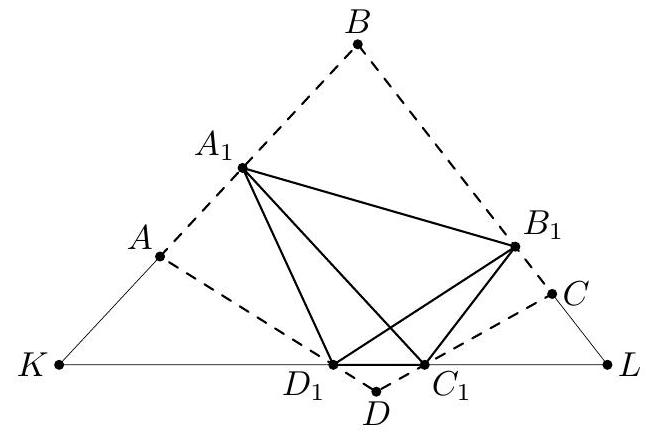
Figure 4
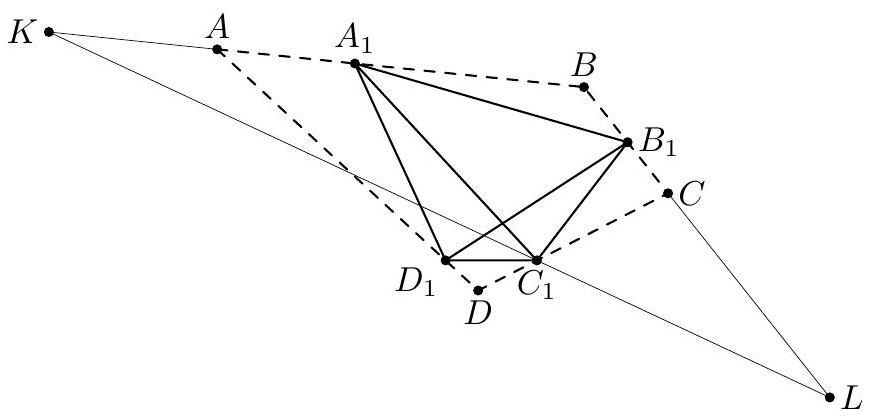
Figure 5
Case 1. Ray C1D1 intersects line AB at some point K. Let ray D1C1 intersect line BC at point L (see Figure 4). Then we have [A1B1C1]<[CC1B1]<[LC1B1], [A1B1C1]<[BB1A1] (both - since [A1B1C1] is small), and [A1B1C1]≤[D1A1B1]<[AA1D1]<[KA1D1]<[KA1C1] (since triangle D1A1B1 is small). This contradicts the Lemma, applied for triangle A1B1C1 inside LKB.
Case 2. Ray C1D1 does not intersect AB. Then choose a "sufficiently far" point K on ray BA such that [KA1C1]>[A1B1C1], and that ray KC1 intersects line BC at some point L (see Figure 5). Since ray C1D1 does not intersect line AB, the points A and D1 are on different sides of KL; then A and D are also on different sides, and C is on the same side as A and B. Then analogously we have [A1B1C1]<[CC1B1]<[LC1B1] and [A1B1C1]<[BB1A1] since triangle A1B1C1 is small. This (together with [A1B1C1]<[KA1C1]) contradicts the Lemma again.