Find out if there is a convex pentagon , such that for the lines , are not parallel and intersect in a point and also the points are collinear. (We assume .)
Problem 1297
Official solution
We will find such a pentagon. The obstruction is, symmetric pentagons (for which it could be easier to show) have always at least one pair of lines , parallel. First we will solve more elementary problem - we will find pentagon with only four points collinear. Here we afford to look for it among symmetric pentagons. To simplify the situation, say be vertices of the square with and be on sides and with (fig. 3). By symmetry . It can be observed when , i.e. when be near , the
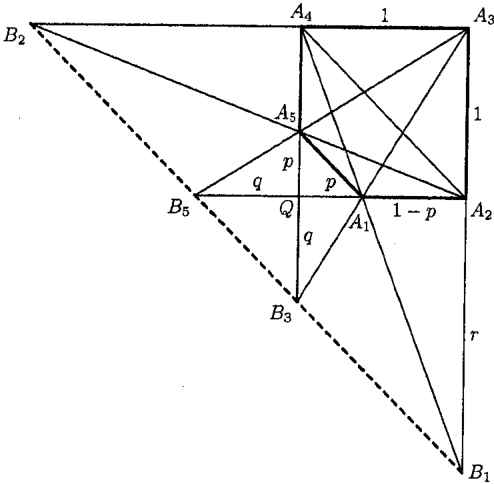
line is more closely to than . On the other side, when , points be near , and is more closely to (or even on the other side of ) than . Thus we can expect for some both lines be identical and collinear. We will find such .
Let and . By similarity of triangles we get
By similarity of triangles we get
Finally, to reach lying on the line , it suffices triangles be similar. This holds when
Substituting by previous we obtain the equation
which can be transformed into . The only solution in is . For this value points lies on one line. Moreover lines are parallel to it. In some sense these three lines intersect "in infinity" in "point" and all points be collinear. To satisfy given conditions it suffices to find proper map, which maps "point from infinity" to particular point (and preserves all the other necessary properties, e.g. maps lines to lines etc.). Such a map is projection (fig. 4). Consider ordinary cartesian coordinate system in space. Pentagon can be imbedded
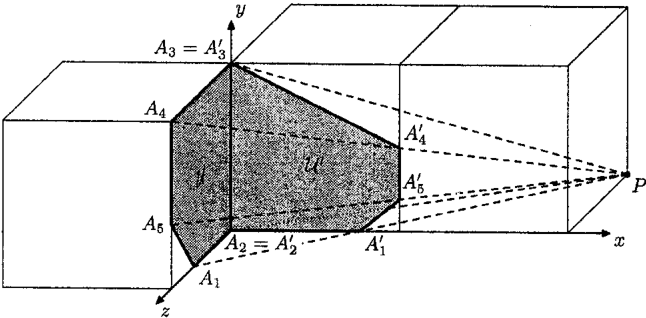
into the plane with be in origin and with , be on positive axis , . Let be the projection-point. Every line intersects the plane in point . Thus we get pentagon . It follows from the properties of the map, that satisfies conditions given in the formulation of the problem. To check this, it is also sufficient to do some calculation. Namely one can easily enumerate the coordinates of in the plane and get
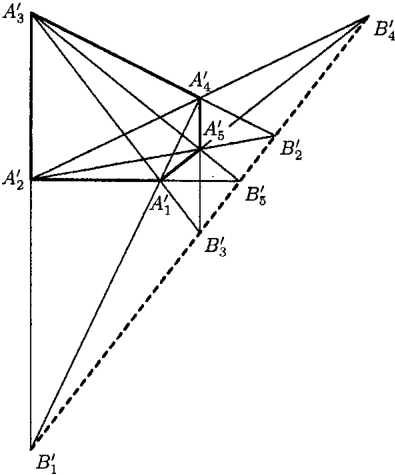
By another manual calculations it is easy to check be collinear (fig. 5).