Let be an integer. Suppose we are given points in a plane such that no three of them are collinear. The points are to be labelled in some order. We then consider the angles . We measure each angle in the way that gives the smallest positive value (i.e. between and ). Prove that there exists an ordering of the given points such that the resulting angles can be separated into two groups with the sum of one group of angles equal to the sum of the other group.
Problem 2534
Official solutions — 4
Solution 1
Let be a line separating the points into two groups ( and ) with points in each. Label the points so that . We claim that this labelling works.
Take a line .
(a) Rotate around until it passes through ; the rotation is performed in a direction such that is never parallel to .
(b) Then rotate the new around until it passes through in a similar manner.
(c) Perform more such steps, after which returns to its initial position.
The total (directed) rotation angle of is clearly a multiple of . On the other hand, was never parallel to , which is possible only if . Now it remains to partition all the angles into those where is rotated anticlockwise, and the others.
Solution 2
When tracing a cyclic path through the in order, with straight line segments between consecutive points, let be the exterior angle at , with a sign convention that it is positive if the path turns left and negative if the path turns right. Then for some integer . Let (indices ), defined as in the problem; thus .
Let be the set of for which the path turns left at and let be the set for which it turns right. Then , which is a multiple of since the number of points is even. We will show that the points can be labelled such that , in which case and satisfy the required condition of the problem.
Note that the value of is defined for a slightly larger class of configurations: it is OK for two points to coincide, as long as they are not consecutive, and OK for three points to be collinear, as long as and do not appear on a line in that order. In what follows it will be convenient, although not strictly necessary, to consider such configurations.
Consider how changes if a single one of the is moved along some straight-line path (not passing through any and not lying on any line , but possibly crossing such lines). Because is a multiple of , and the angles change continuously, can only change when a point moves between and . Furthermore, if when moves between and , is unchanged; it only changes if when moves between those sets.
For any starting choice of points, we will now construct a new configuration, with labels such that , that can be perturbed into the original one without any passing through , so that for the original configuration with those labels as well.
Take some line such that there are points on each side of that line. The new configuration has copies of a single point on each side of the line, and a path that alternates between sides of the line; all angles are , so this configuration has . Perturbing the points into their original positions, while keeping each point on its side of the line, no angle can pass through , because no straight line can go from one side of the line to the other and back. So the perturbation process leaves .
Solution 3
First, let be a line in the plane such that there are points on one side and the other points on the other side. For convenience, assume is horizontal (otherwise, we can rotate the plane). Then we can use the terms "above", "below", "left" and "right" in the usual way. We denote the points above the line in an arbitrary order as , and the points below the line as .
If we connect and with a line segment, the line segment will intersect with the line . Denote the intersection as . If is connected to and , where , then and are two different points, because and are not collinear.
Now we define a "sign" for each angle . Assume . We specify that the sign is positive for the following two cases:
- if is odd and is to the left of ,
- if is even and is to the right of .
Otherwise the sign of the angle is negative. If , then the sign of is taken to be the same as for .
Similarly, we can define the sign of with (or equivalently ). For example, it is positive when is odd and is to the left of .
Henceforth, whenever we use the notation or for a numerical quantity, it is understood to denote either the (geometric) measure of the angle or the negative of this measure, depending on the sign as specified above.
We now have the following important fact for signed angle measures:
for all points and with . The following figure shows a "natural" arrangement of the points. Equation (1) still holds for any other arrangement, as can be easily verified.
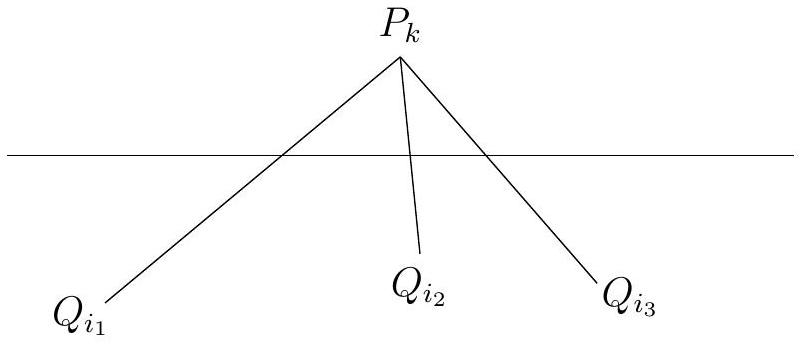
Similarly, we have
for all points and , with .
We are now ready to specify the desired ordering of the points:
- if is odd, put and ;
- if is even, put and .
For example, for this ordering is . This sequence alternates between 's and 's, so the above conventions specify a sign for each of the angles . We claim that the sum of these signed angles equals . If we can show this, it would complete the proof.
We prove the claim by induction. For brevity, we use the notation to denote whichever of the angles has its vertex at , and similarly.
First let . If the four points can be arranged to form a convex quadrilateral, then the four line segments and constitute a self-intersecting quadrilateral. We use several figures to illustrate the possible cases.
The following figure is one possible arrangement of the points.
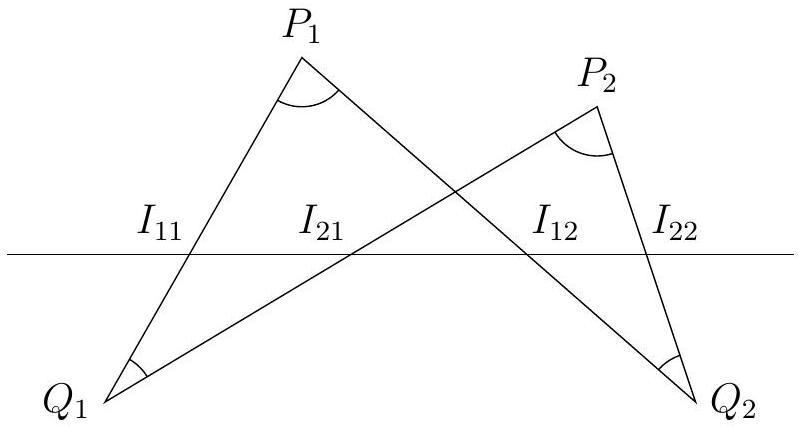
Then and are positive, and are negative, and we have
With signed measures, we have
If we switch the labels of and , we have the following picture:
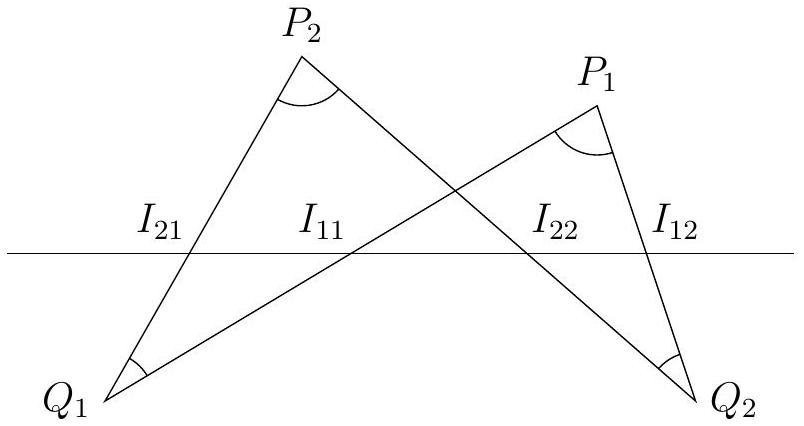
Switching labels and has the effect of flipping the sign of all four angles (as well as swapping the magnitudes on the relabelled points); that is, the new values of () equal the old values of (). Consequently, equation (3) still holds. Similarly, when switching the labels of and , or both the 's and the 's, equation (3) still holds.
The remaining subcase of is that one point lies inside the triangle formed by the other three. We have the following picture.
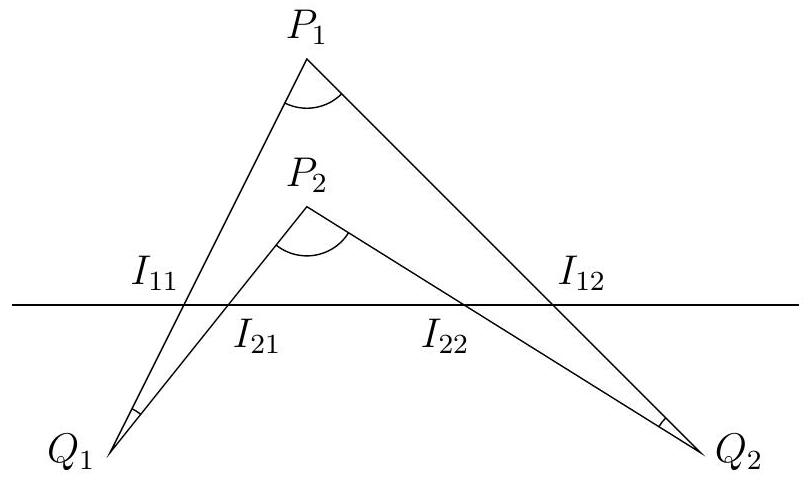
We have
and equation (3) holds.
Again, switching the labels for 's or the 's will not affect the validity of equation (3). Also, if the point lying inside the triangle of the other three is one of the 's rather than the 's, the result still holds, since our sign convention is preserved when we relabel 's as 's and vice-versa and reflect across .
We have completed the proof of the claim for .
Assume the claim holds for , and we wish to prove it for . Suppose we are given our points. First ignore and , and form angles from , as in the case. By the induction hypothesis we have
When we add in the two points and , this changes our angles as follows:
- the angle at changes from to ;
- the angle at changes from to ;
- two new angles and are added.
We need to prove the changes have no impact on the total sum. In other words, we need to prove
In fact, from equations (1) and (2), we have
and
Therefore, the left hand side of equation (4) becomes , which equals , simply by applying the case of the claim. This completes the induction.
Solution 4
We shall think instead of the problem as asking us to assign a weight to each angle, such that the weighted sum of all the angles is zero.
Given an ordering of the points, we shall assign weights according to the following recipe: walk in order from point to point, and assign the left turns and the right turns . This is the same weighting as in Solution 3, and as in that solution, the weighted sum is a multiple of .
We now aim to show the following:
Lemma. Transposing any two consecutive points in the ordering changes the weighted sum by or .
Knowing that, we can conclude quickly: if the ordering has weighted angle sum , then the ordering has weighted angle sum (since the angles are the same, but left turns and right turns are exchanged). We can reverse the ordering of by a sequence of transpositions of consecutive points, and in doing so the weighted angle sum must become zero somewhere along the way.
We now prove that lemma:
Proof. Transposing two points amounts to taking a section as depicted, reversing the central line segment , and replacing its two neighbours with the dotted lines.
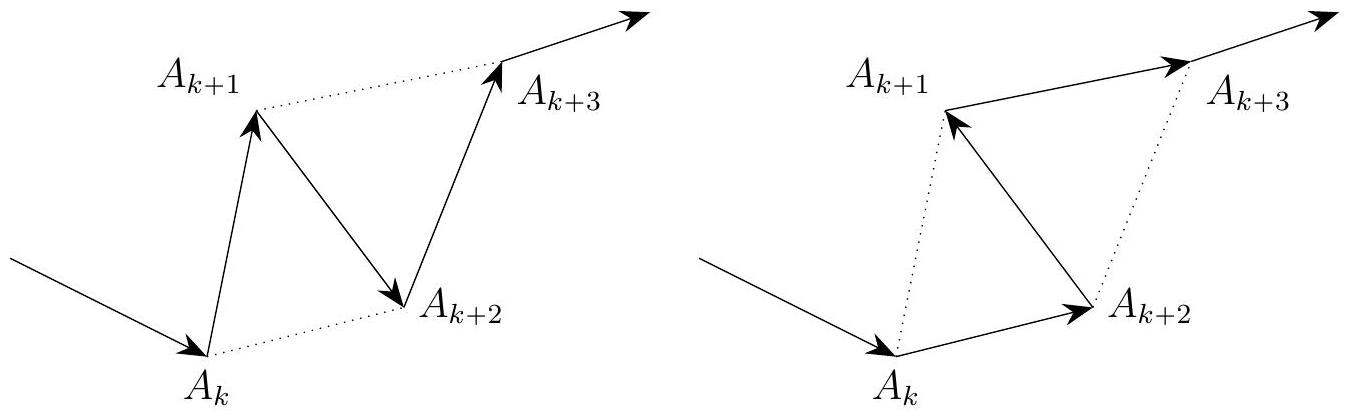
Figure 1: Transposing two consecutive vertices: before (left) and afterwards (right)
In each triangle, we alter the sum by . Indeed, using (anticlockwise) directed angles modulo , we either add or subtract all three angles of each triangle.
Hence both triangles together alter the sum by , which is or .