There are distinct points , , , , , , , , on a plane such that no three points are collinear. The open line segments , , are coloured red, other points on the plane are left uncoloured. An allowed path from point to point is a polygonal chain with first and last vertices at points and , containing no red points. For example, for , and , , , and , and are examples of allowed paths from to ; there are no shorter allowed paths. Find the least positive integer such that it is possible that the first vertex that is not on any shortest possible allowed path from to is closer to than to , and the first vertex that is not on any shortest possible allowed path from to is closer to than to $B.
Problem 2497
Official solution
A path is suitable if it is a shortest allowed path from to and . Similarly, a path is suitable if it is the shortest allowed path from to and . Let us show that for it is possible to choose points , , , , , , such that no shortest path from point to point , nor one from point to point is suitable. Take , , , , , and (Fig. 43).
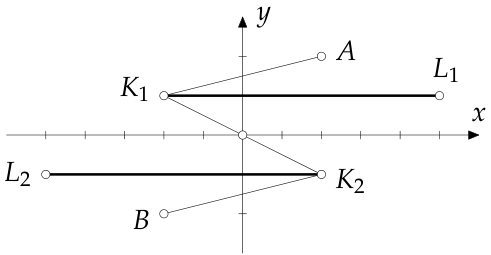
If , then the only shortest paths from point to points and are respectively and , whereas and , and hence they are not suitable. The collinearity of three points can be avoided by shifting slightly while leaving the situation unchanged.
We will show that for there exists at least one suitable path from point to point or point . If the segment or segment does not contain any red points, then it is suitable. Therefore, assume that both segments and contain red points. W.l.o.g., (can change and ). If is a shortest path from point to point , then it is suitable. Otherwise, is the only shortest path from point to point . It is suitable if . Let us further assume that . If is a shortest path from point to point , then it is suitable. Otherwise, is the only shortest path from point to point . Then . This simplifies to . However, adding the inequalities and gives . The contradiction shows that at least one suitable path from point to point or exists.